
User and operator guide · Security
Zero Trust Posture
On this page
PurposeZero Trust Implementation ModelControl AreasProtected Request Decision FlowContinuous Evaluation LoopIdentity, Directory, And Policy ContextApplication And Workload Access PostureDDIL Zero Trust PostureWorkload Identity And Service BoundaryEvidence-Backed StrengthsValidation RunbookEvidence Review StepsFailure ModesEnvironment Evidence Still NeededRelated Pages|
Important
|
This page describes Atlas Zero Trust engineering behavior and validation evidence. It is not a certification, ATO, Common Criteria result, FIPS validation, or deployed-environment approval statement. Production claims require the deployment evidence named in this page. |
Purpose
Atlas implements Zero Trust as a set of runtime enforcement points, not as a banner or network assumption. The strongest current boundary is the API gateway and its service-backed decision path: every protected request must establish identity, session validity, assurance, route authorization, policy context, source freshness, risk posture, and audit evidence before the action is accepted.
The implementation is strong because it ties user, device, application, directory, policy, DDIL, and evidence context together at the moment of access. The frontend guides the operator, but server-side controls decide. Local-live validation, security validation, control validation, and claim-boundary checks provide the evidence chain.
Zero Trust Implementation Model

The model is intentionally layered. Atlas does not rely on a trusted network segment, a hidden frontend control, a cached directory value, or a previous validation summary. Each sensitive request is evaluated against current session context, route capability, directory and policy facts, risk posture, and evidence requirements.
Control Areas
| Zero Trust tenet | Atlas implementation | Review evidence |
|---|---|---|
All access is mediated through explicit enforcement points |
The gateway is the browser-facing API authority. Protected REST, GraphQL, and WebSocket paths are authenticated before route work runs. Public, setup, callback, health, and fixture paths are deliberately narrow. |
Protected-route tests, gateway logs, browser-live validation, static UI validation. |
Identity and session are continuously evaluated |
Atlas validates token signature, expiry, not-before, issuer, audience, session id, JTI, denylist state, roles, AAL, IAL, FAL, provider, and issued-at context on protected paths. |
Auth/session hardening evidence, denial tests, session revoke artifacts. |
Sensitive actions require stronger assurance |
Operator mutations require operator scope and AAL2-or-stronger fresh authentication. The current gateway freshness window is 15 minutes. |
Allowed and denied mutation tests, step-up evidence, audit events. |
Authorization uses dynamic context |
Policy decisions can include Universal Directory facts, source freshness, assignment state, governance state, SoD context, device posture, PAM context, risk signals, trust score, and DDIL posture. |
Policy decision artifacts, Directory Studio evidence, governance validation, risk/device/PAM validation. |
Data sources are not implicitly trusted |
Directory imports and mappings use preview, source priority, stale-source blockers, conflict queues, and evidence hashes before sensitive use. |
Universal Directory evidence, source registry, mapping preview, conflict and source-freshness artifacts. |
Application access is decided server-side |
My Apps visibility, launch, app token exchange, assignment projection, readiness, activation, and rollback are gateway and service decisions, not browser cache decisions. |
Application onboarding validation, assignment projection evidence, launch denial or step-up evidence. |
Degraded operation is explicit |
DDIL exposes cache age, queue state, local model posture, federation cache, replay, reconciliation, and reachback state. Sensitive actions fail closed when required context is stale or unavailable. |
Federated DDIL validation, replay and reconciliation artifacts, DDIL status evidence. |
Telemetry feeds enforcement and review |
Authentication, session, behavior, device, PAM, risk, TrustAI, DDIL, governance, incident, and audit events feed validation and review paths. |
TrustAI validation, audit exports, incident timeline, RMF control results, evidence manifests. |
Claims are evidence-bound |
Guide statements and control results are claimable only when current artifacts, manifests, hashes, and claim-boundary checks exist. |
Guide check, docs-boundary check, security validation, local-live validation, control validation. |
Protected Request Decision Flow
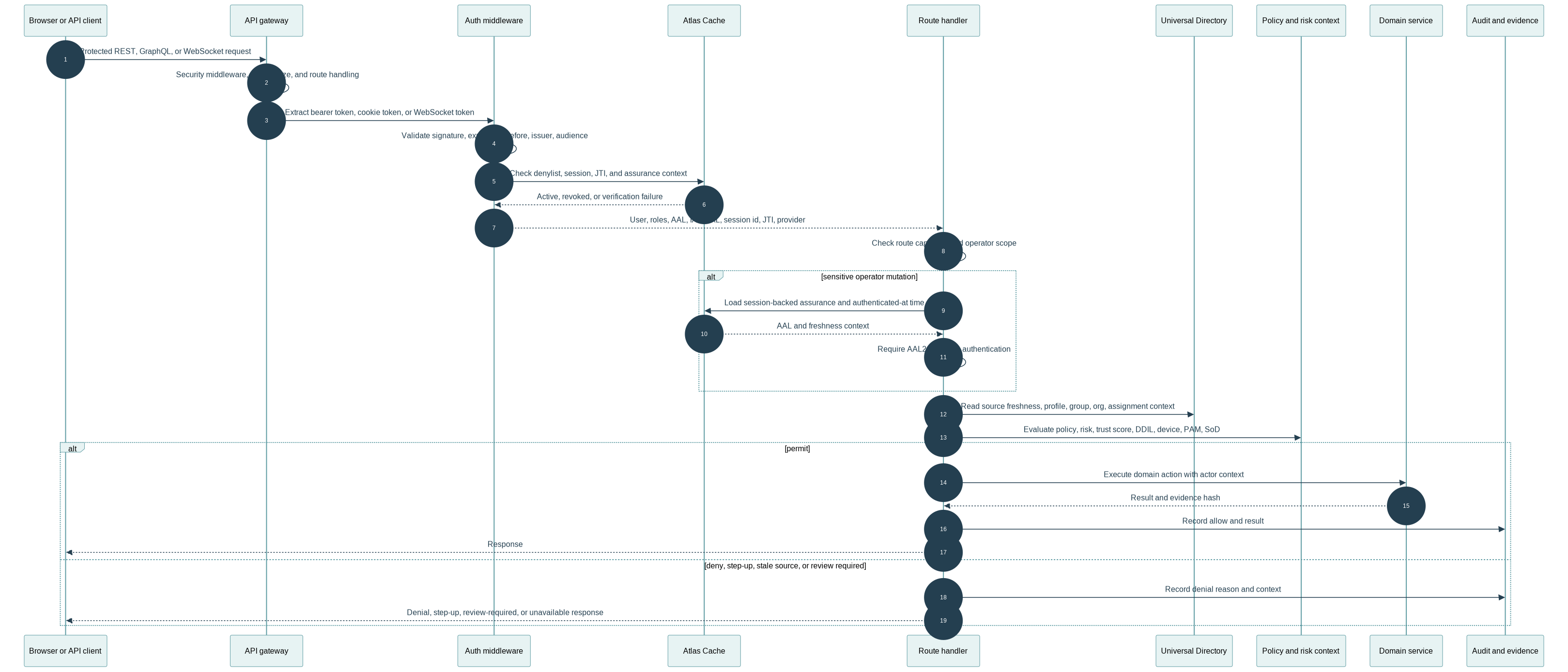
Security excellence comes from the number of independent checks that must agree before sensitive work proceeds. A valid token alone is not enough. A visible button is not enough. A cached directory fact is not enough. A route must pass identity, assurance, route authority, policy context, source freshness, risk posture, and auditability.
Continuous Evaluation Loop

Atlas treats risk as an input to access and session behavior, not as a dashboard-only metric. TrustAI score state, risk signals, DDIL posture, device posture, privileged activity, and directory state can influence policy decisions, session revocation, step-up, review, or denial. When a dependency is unavailable, the decision path records whether the result was live, cached, degraded, or unavailable.
Identity, Directory, And Policy Context

This is where Atlas goes beyond static RBAC. Policy context can be assembled from sourced profile attributes, group membership, org path, mission, clearance, assignment state, governance status, source freshness, and conflict state. Universal Directory supplies facts and provenance; the gateway and policy path decide whether the action is allowed.
Application And Workload Access Posture
| Surface | Zero Trust behavior | What proves it |
|---|---|---|
My Apps and launch |
Server-side assignment projection decides assigned, eligible, requestable, hidden, restored, disabled, and test-access states. Launch and token exchange re-evaluate session and app context. |
My Apps projection evidence, launch broker tests, denied launch evidence. |
Application onboarding |
Draft, import, readiness, activation, rollback, assistant deltas, connector tests, and target-app validation are operator-controlled workflows with evidence. |
Application onboarding validation, readiness artifacts, activation or rollback audit. |
API access |
Service clients, service accounts, scopes, token policies, and high-risk token paths are validated through gateway and service checks. |
API access validation artifacts, token policy evidence, risk-denial evidence. |
Device assurance |
Device posture can gate sensitive API actions and produce stale-posture denial evidence. |
Device posture validation, stale-posture denial, managed-device evidence. |
PAM |
JIT privileged requests, approval, checkout, repeated checkout denial, break-glass evidence, session revocation, and rotation metadata are separate from normal app access. |
PAM validation, checkout audit, revocation and rotation evidence. |
Risk |
Signals and evaluations can trigger step-up, denial, review, or session action. |
Risk signal/evaluation artifacts, policy-facing decision output. |
DDIL Zero Trust Posture

DDIL is deliberately not a broad exception to Zero Trust. It is a controlled degraded posture. Atlas can keep non-sensitive visibility available with stale markers while failing closed for sensitive access, assignment, launch, lifecycle, replay, and reconciliation actions when required context is stale or missing.
Workload Identity And Service Boundary
Atlas supports service identity through SPIFFE and mTLS for internal service paths where configured. That control is separate from browser HTTPS and CAC/PIV trust. A deployment can claim internal workload identity only when it proves live SPIRE registration, mounted Workload API sockets, issued SVIDs, service allowlists, successful mTLS handshakes, unauthorized-peer denial, and rotation behavior.
| Path | Current security posture | Evidence boundary |
|---|---|---|
Browser to gateway |
Gateway HTTPS and route authentication protect browser/API traffic. |
Live endpoint, ingress, TLS, and protected-route evidence. |
Gateway to domain service |
Service endpoint, timeout, actor context, and mTLS/SPIFFE where configured. |
Service contract, endpoint mode, health, and service identity evidence. |
Internal service to internal service |
SPIFFE/mTLS-capable services authorize peers by configured service identity where deployed. |
SPIRE health, SVID issuance, allowlist, handshake, denial, and rotation evidence. |
Gateway to dependency |
Vault, Atlas Cache, LDAP, RabbitMQ, graph, TrustAI edge scoring, and firewall providers each have their own trust boundary. |
Dependency TLS, credential custody, health, receipt, and deployment evidence. |
Evidence-Backed Strengths
| Strength | Why it matters | Evidence path |
|---|---|---|
Gateway-centered enforcement |
Atlas has a clear browser-facing control point for REST, GraphQL, WebSocket, session context, and operator workflows. |
Security validation, protected-route tests, static UI validation, local-live gateway logs. |
Session and assurance continuity |
A session must remain valid across token checks, denylist, session cache, AAL, provider, issued-at, and route context. |
Auth/session validation, revoke evidence, fresh AAL2 denial evidence. |
Source-aware policy context |
Access decisions can account for directory source authority, freshness, assignment, group, org, mission, conflict, and evidence hash. |
Universal Directory validation, governance validation, policy context evidence. |
Server-side app access |
Application visibility, launch, and token exchange are re-evaluated at the server boundary rather than relying on browser state. |
My Apps and application onboarding validation, launch and assignment artifacts. |
Risk-informed control loop |
TrustAI, device posture, PAM, risk evaluations, session lifecycle, and audit form a feedback loop. |
TrustAI validation, API/device/PAM/risk validation, session revocation artifacts. |
DDIL fail-closed semantics |
Disconnected operation is explicit and evidence-bound; stale context does not silently authorize sensitive work. |
Federated DDIL validation, cache-freshness artifacts, replay and reconciliation evidence. |
Claim-boundary discipline |
Atlas distinguishes repo-side engineering evidence from deployment, assessor, FIPS, ATO, and external authority decisions. |
Docs-boundary check, guide claims check, control validation statuses. |
Validation Runbook
Run these gates when reviewing Zero Trust posture after changes to authentication, session handling, protected routes, policy, DDIL, TrustAI, application access, governance, or guide evidence.
./scripts/run-security-validation.sh
./scripts/run-security-validation.sh --live
./scripts/run-local-live-validation.sh
make federated-ddil-validation
make control-validation CONTROL_VALIDATION_ARGS='--family AC --family IA --family AU --family SC'
npm --prefix guide run check
make docs-boundary-check
Expected evidence:
-
Security validation artifacts show baseline tests, vulnerability checks, focused security tests, frontend build/audit, host exposure checks, and TrustAI validation.
-
Live security validation shows live gateway, protected GraphQL/WebSocket, CAC/PIV, federation, and browser checks where the environment provides the required material.
-
Local-live validation shows HTTPS gateway behavior, generated local trust material, federation harnesses, browser CAC local-live behavior, lifecycle, governance, API/device/PAM/risk, TrustAI, DDIL, and evidence manifests.
-
Federated DDIL validation shows enterprise and edge gateway behavior, disconnected state, replay, reconciliation, reachback, and selected control evidence.
-
Control validation reports
validated,failed,evidence-required, orinherited-pendingfor each selected control. -
Guide and docs-boundary checks confirm the documentation remains claim-bounded and buildable.
Evidence Review Steps
After a gate run, inspect the latest evidence before making a Zero Trust claim.
RUN_DIR="$(ls -1dt artifacts/rmf/evidence/* | head -1)"
jq '.summary' "$RUN_DIR/control-results.json"
jq -r '.controls[] | [.id, .status, .boundary, .validation_mode, .reason] | @tsv' \
  "$RUN_DIR/control-results.json"
(cd "$RUN_DIR" && sha256sum -c manifest.sha256)
For DDIL-specific posture:
find "$RUN_DIR/local-live-validation" -maxdepth 2 -type f \
  \( -name '*ddil*cache*freshness*.json' -o -name '*ddil*replay*reconciliation*.json' \) \
  | sort
Use the evidence status exactly:
-
validatedmeans the Atlas-owned evidence boundary passed for that run. -
failedmeans a required validator or behavior did not pass. -
evidence-requiredmeans the expected artifact is missing or not current. -
inherited-pendingmeans a deployment, external service, organization, assessor, or authority artifact is still required.
Failure Modes
| Failure signal | Security meaning | Expected response |
|---|---|---|
Protected route succeeds without valid session context |
The gateway boundary is not enforcing identity/session state. |
Preserve route logs and test output, open a security finding, and block the claim. |
Sensitive operator mutation succeeds at low assurance or stale auth |
Fresh AAL2 behavior is bypassed. |
Collect denial/allow evidence, inspect session context, and keep the mutation unclaimable until fixed. |
Directory source freshness is absent from a sensitive decision |
Policy may use stale or untrusted facts. |
Require Universal Directory source evidence, conflict state, and freshness marker. |
TrustAI or risk state is silently missing |
A decision may appear risk-informed when it is not. |
Mark the decision live, cached, degraded, or unavailable and update evidence. |
DDIL sensitive action succeeds with stale required context |
Disconnected operation is not failing closed for the action. |
Attach DDIL freshness, replay, gateway, and audit artifacts to a finding. |
Firewall termination is claimed without provider receipt |
Session revocation is being overstated as network termination. |
Restrict the claim to gateway/session revocation until provider action evidence exists. |
Guide says validated but artifacts are missing |
The claim flow is stale or unsupported. |
Rerun the evidence gate, regenerate the guide, and keep the claim as evidence-required until artifacts exist. |
Environment Evidence Still Needed
| Claim area | Deployment evidence required |
|---|---|
Enterprise identity authority |
Approved IdP metadata, CAC/PIV trust bundle, certificate policy, federation partner configuration, account lifecycle authority, and assurance mapping. |
Internal workload identity |
SPIRE registration entries, Workload API sockets, issued SVIDs, service allowlists, mTLS handshakes, unauthorized-peer denial, and rotation evidence. |
Network and ingress |
Ingress TLS, WAF/load balancer policy, network policy, firewall segmentation, monitoring, and exposure review. |
External SaaS or SCIM target behavior |
Tenant approval, connector configuration, target write receipt, reconciliation result, rollback evidence, and secret custody. |
SIEM and audit retention |
Forwarding configuration, receipt, retention, immutable storage, review process, and incident reporting procedures. |
FIPS, Common Criteria, ATO, and assessor acceptance |
External approval artifacts from the authorized authority. Repository evidence supports the package but does not issue the decision. |