
User and operator guide · Architecture
API Access, Device Assurance, PAM, And Risk Architecture
Atlas security services provide the service boundaries for API access, device assurance, privileged access management, and TrustAI-backed risk normalization. The browser still reaches Atlas through the API gateway. The gateway remains the BFF and trust boundary; security services own durable domain state and expose gRPC contracts behind that boundary.
Service Topology

Ownership
| Service | Owns | Gateway routes | Completion evidence |
|---|---|---|---|
|
OAuth/API clients, service accounts, scopes, token policy, approval state, grants, revocation records, and audit references. |
|
|
|
Device inventory, posture observations, freshness decisions, certificate/attestation refs, and access decisions. |
|
|
|
JIT privilege requests, approvals, active sessions, credential checkout records, break-glass accounts, revocation, rotation, and action metadata. |
|
|
|
Normalized risk signals, TrustAI scoring references, policy-facing risk decisions, and evidence hashes. |
|
|
Enforcement Rules
| Rule | Implementation behavior |
|---|---|
Operator boundary |
Mutating routes require an authenticated operator role and AAL2-or-better session freshness. |
Secret handling |
Services store secret references. Raw privileged credentials are returned only by approved PAM checkout, once, with |
API access |
High-risk scopes require approved clients, healthy device posture when supplied, low/elevated-risk denial behavior, and auditable token grants. |
Device posture |
Missing or stale posture cannot silently satisfy sensitive access. Sensitive and admin actions deny or require step-up when posture is stale, unmanaged, or degraded. |
PAM |
Approval creates a time-bound privileged session. Self-approval is denied. Checkout is one-time. Revocation triggers credential rotation metadata. |
Risk |
Risk signals influence step-up or deny decisions but do not replace authentication, authorization, resource policy, or audit review. |
Control Flow
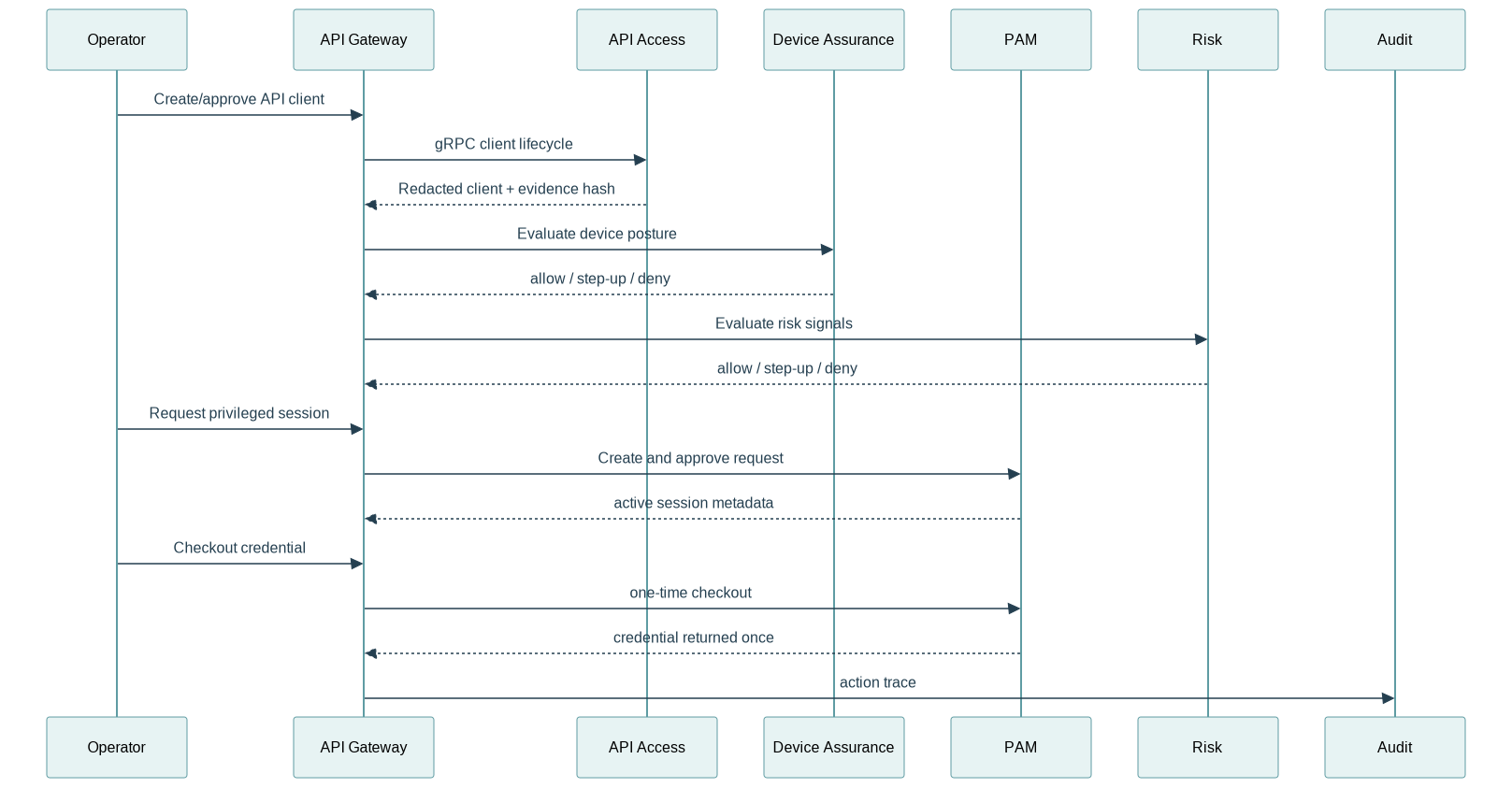
Persistence Boundary
Postgres is authoritative for API, device, PAM, and risk domain state through the shared security-service record store. Current runtime state uses atlas_platform_records; deployments that still contain the legacy record table are migrated forward during schema initialization. Atlas Cache remains transient when used by surrounding platform paths. Vault remains the credential source of record; Atlas stores references and evidence metadata, not raw long-lived privileged secrets.