
User and operator guide · Architecture
DDIL IdP Edge Chain Architecture
On this page
PurposeIdP-To-Edge Chain ModelChain StatesConnected Cache EstablishmentDDIL Edge Decision FlowReconnect And ReconciliationRuntime RecordsTechnical Control PointsThreat ModelOperator And Reviewer WorkflowValidation EvidenceClaim BoundaryRelated PagesPurpose
Use this page to understand how Atlas chains enterprise identity-provider trust to a DDIL edge node. The chain is intentionally conservative: the enterprise IdP remains the identity authority, the enterprise gateway is the connected control point, and the edge gateway can only use cached federation metadata and fresh federated claim context inside explicit freshness, sensitivity, replay, and evidence limits.
The edge is not a new IdP and it is not a shortcut around enterprise authority. It is a constrained decision point for disconnected, degraded, intermittent, or limited conditions. Atlas records the cache state, decision, denial, step-up, replay event, reconciliation run, and evidence hash so a security engineer can review exactly why an edge decision was accepted or blocked.
IdP-To-Edge Chain Model

The important design point is separation of authority. The enterprise IdP proves identity and publishes federation metadata. Atlas carries enough validated metadata and claim freshness state to make limited DDIL decisions at the edge. Enterprise receipt, deployed IdP trust agreements, and mission authorization stay outside the repository claim until environment evidence is attached.
Chain States
| State | What the edge has | What Atlas can do | Evidence to review |
|---|---|---|---|
Connected |
Reachback to enterprise gateway and current IdP metadata. |
Use normal federation and refresh edge cache from the connected authority path. |
Provider inventory, metadata hash, fetched time, expiry, validation status, audit event. |
Disconnected with fresh cache |
Cached provider record within the metadata freshness limit and claim context within the claim freshness limit. |
Accept a degraded non-sensitive session decision and queue replay evidence. |
Decision result, degraded-session flag, metadata age, claim age, replay event hash. |
Disconnected with sensitive action |
Fresh cache and claim context, but the requested action is sensitive. |
Require local step-up or deny according to policy. Atlas treats high-risk API scopes, privileged checkout, administrative mutation, and OAuth client-secret access as sensitive classes. |
Step-up or denial result, reason, replay event, audit evidence. |
Stale or invalid cache |
Missing metadata, stale metadata, disabled provider, thumbprint mismatch, invalid signature, stale claim, or replayed nonce/state. |
Fail closed for the DDIL federation decision and queue denial evidence. |
Denial reason, cache state, claim age, replay event, evidence hash. |
Reconnected |
Enterprise reachback restored through the approved channel. |
Reconcile queued events idempotently, mark duplicates, record conflicts, and preserve the run hash. |
Reconciliation run with accepted, duplicate, conflict, rejected, and failed counts. |
The repository default freshness limits are 900 seconds for provider metadata and 300 seconds for federated claim context. A deployment may set stricter values. Any deployment-specific override should be captured with the DDIL evidence package.
Connected Cache Establishment
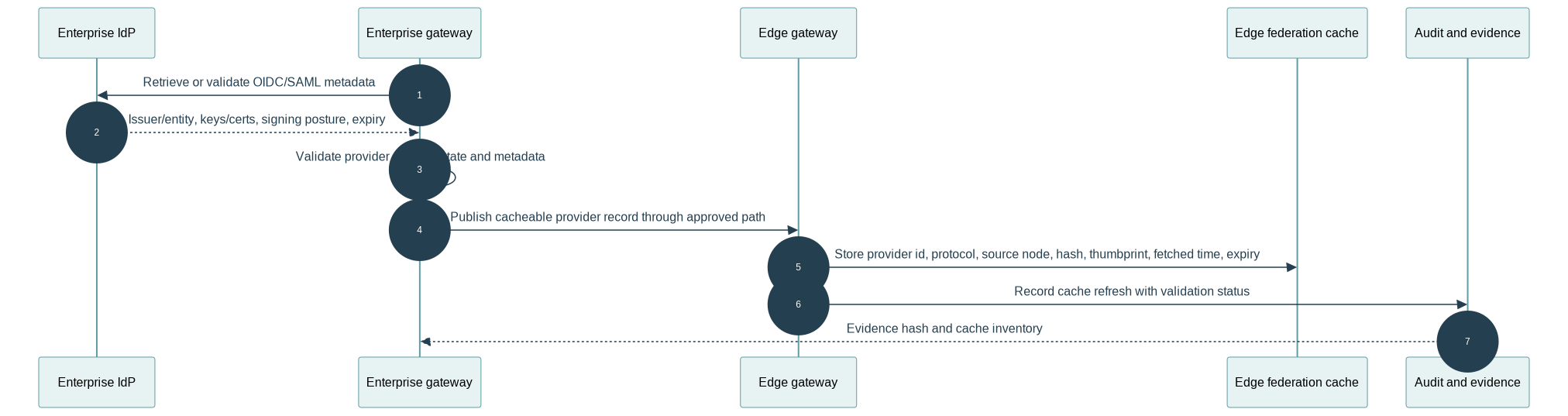
Atlas stores cache records as metadata evidence, not as raw tokens, client secrets, private keys, bearer tokens, or Vault credentials. The cache record is designed to answer security questions: which provider, which protocol, which source node, which metadata hash, which thumbprint, when fetched, when it expires, and whether validation accepted or denied it.
DDIL Edge Decision Flow
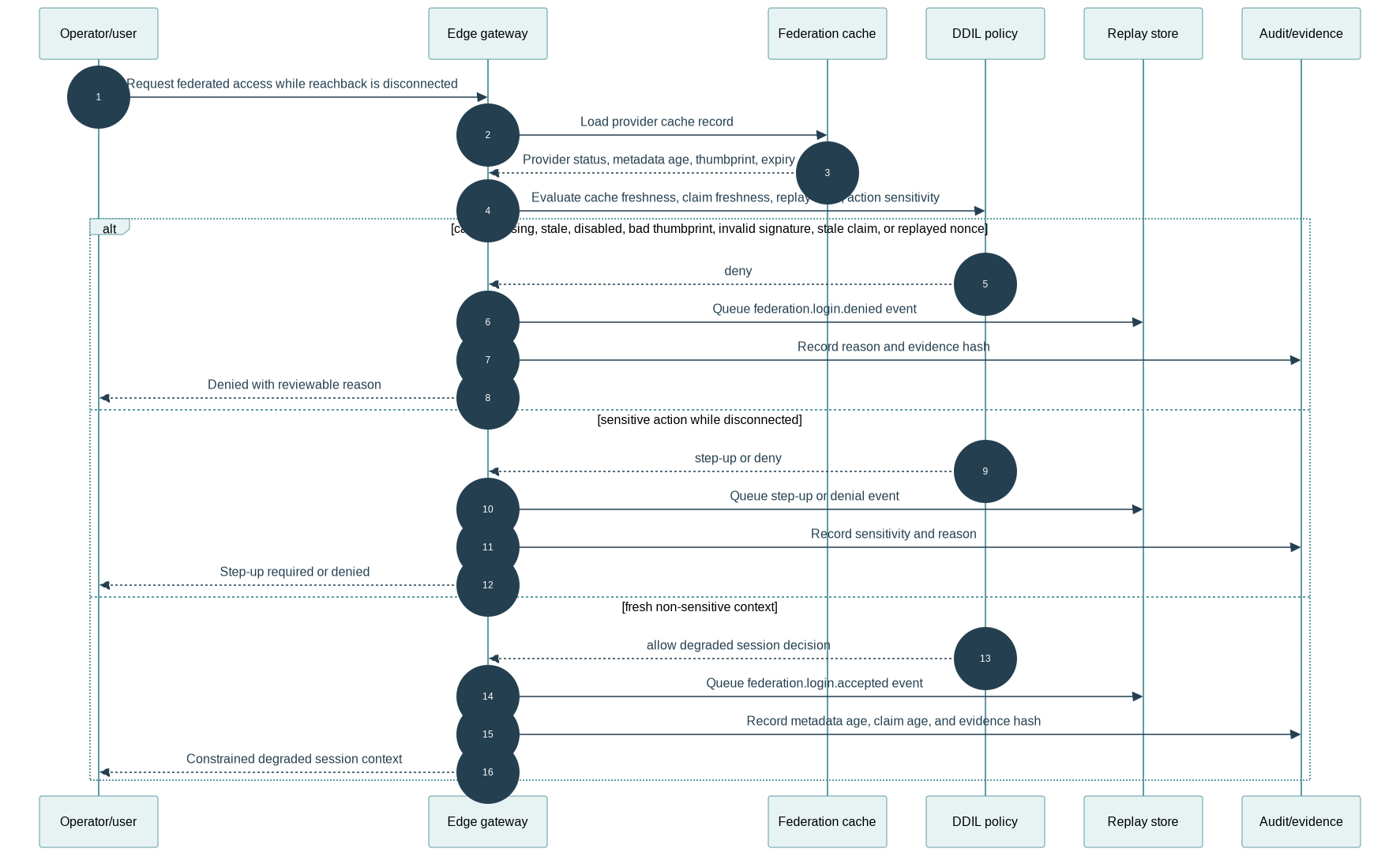
The edge decision uses multiple independent checks. A cached provider record alone is not enough. A federated claim alone is not enough. The decision must satisfy provider status, metadata freshness, claim freshness, signature/thumbprint posture, replay protection, action sensitivity, operator policy, and evidence recording.
Reconnect And Reconciliation
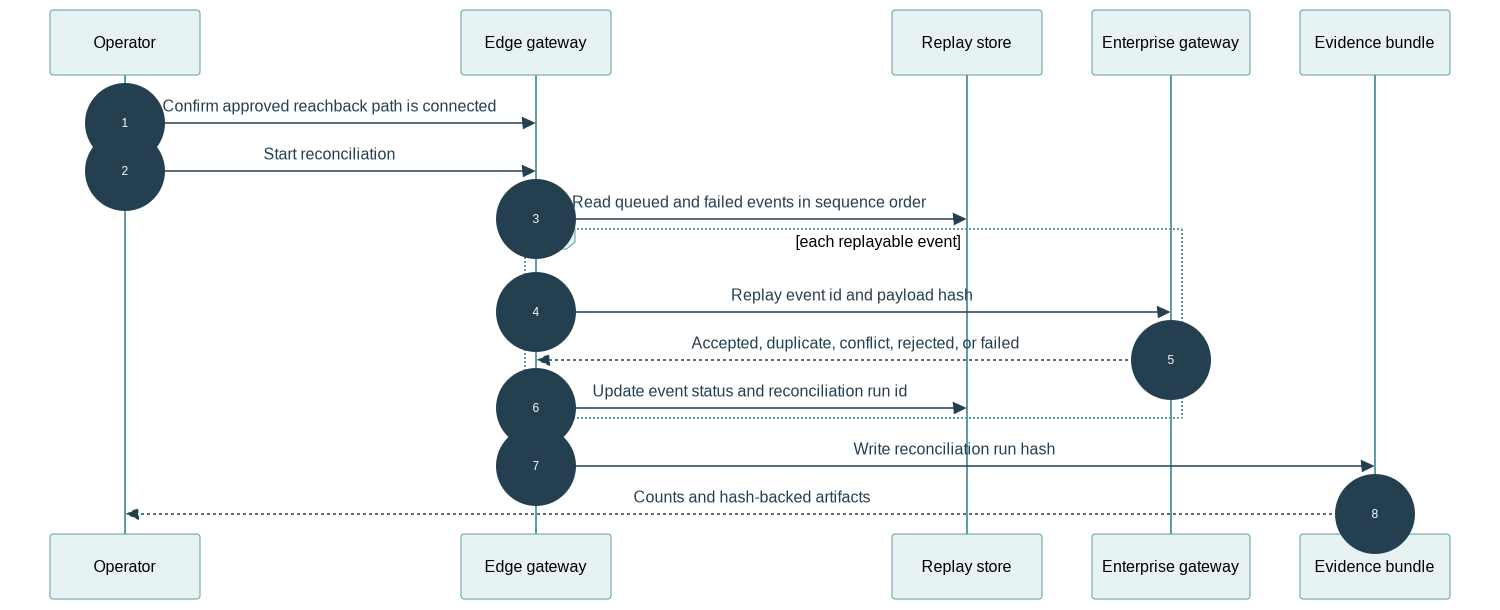
Reconciliation is intentionally unavailable while reachback is disconnected. After reconnect, Atlas uses event id and payload hash for idempotency. Duplicate payloads are recorded as duplicates, conflict-marked events are recorded as conflicts, and failed events retain attempt counts for follow-up. This gives security reviewers a complete path from edge decision to enterprise reconciliation without treating replay as silent success.
Runtime Records
| Record | Key fields | Security meaning |
|---|---|---|
Provider cache record |
Provider id, protocol, node id, node role, source node, issuer or entity id, metadata hash, thumbprint, fetched time, expiry, status, validation status, disabled flag. |
Shows what IdP metadata the edge trusted, where it came from, and whether it was fresh enough for DDIL use. |
Validation result |
Provider id, protocol, node id, node role, reachback state, decision, reason, degraded-session flag, metadata age, claim age, sensitive-action flag, evidence hash. |
Shows why the edge accepted, denied, or required step-up for a specific federated decision. |
Replay event |
Event id, source node, sequence, event type, subject reference, resource reference, occurred time, payload hash, status, attempt count, reconciliation run id, decision details. |
Preserves a reviewable event for accepted, denied, duplicate, conflict, or failed edge behavior. |
Reconciliation run |
Run id, source node, target node, status, started time, completed time, accepted count, duplicate count, rejected count, conflict count, failed count, evidence hash. |
Shows whether queued edge events reached the enterprise reconciliation point and how each class was handled. |
Technical Control Points
| Control point | Atlas behavior | Review focus |
|---|---|---|
Provider cache freshness |
Metadata has a maximum staleness window and explicit expiry. Missing or stale cache denies the DDIL federation decision. |
Confirm the deployed freshness window matches mission policy and the evidence shows current cache age. |
Claim freshness |
Federated claim context has its own shorter freshness window. Stale claim context denies the decision even when metadata is fresh. |
Confirm clock handling, claim issuance time, and replay protection are covered by validation evidence. |
Provider disabled state |
Disabled provider records are denied at the edge. |
Confirm provider disablement propagates to the edge cache before the deployment claims disconnected use. |
Signature and thumbprint posture |
Invalid signature or mismatched thumbprint behavior is fail-closed in the DDIL decision path. |
Review IdP key/certificate rotation procedures and cache refresh evidence. |
Sensitive action handling |
Sensitive actions require reachback or local step-up behavior under DDIL instead of being accepted as degraded sessions. |
Review PAM, administrative mutation, high-risk API, and client-secret access policy. |
Replay idempotency |
Event id and payload hash drive replay handling. |
Confirm duplicates are visible as duplicates and conflicts are not converted to success. |
Local-live reachback simulation |
Reachback state simulation is only available in the local-live validation environment. |
Confirm deployed environments use an approved network/recovery procedure rather than the validation-only simulation route. |
Artifact hygiene |
Federated DDIL evidence is checked for common secret markers before the manifest is written. |
Confirm evidence packages contain hashes and metadata, not raw secrets or bearer material. |
Threat Model
| Threat or failure mode | Atlas control | Expected evidence |
|---|---|---|
Stale IdP metadata is used after key rotation |
Metadata age and expiry checks deny stale cache records. |
Cache freshness results, provider cache inventory, denial reason. |
Replayed federation response is accepted at the edge |
Replayed nonce or state behavior denies the decision and queues denial evidence. |
Negative validation result and replay event. |
Disabled provider remains usable in DDIL |
Disabled provider state produces denial. |
Disabled-provider cache record and denial result. |
Privileged action proceeds without enterprise reachback |
Sensitive action path returns step-up or denial instead of degraded session acceptance. |
Step-up result, action sensitivity flag, audit entry. |
Replay creates duplicate enterprise effects |
Payload hash deduplication marks duplicate events. |
Reconciliation run duplicate count and event status. |
Edge conflict is hidden during reconnect |
Conflict-marked events remain conflicts in reconciliation. |
Reconciliation run conflict count and conflict event hash. |
Validation route appears in deployment |
Reachback simulation route is scoped to local-live validation. |
Deployment route review and environment evidence. |
Operator And Reviewer Workflow
-
Confirm the deployment has an approved enterprise IdP authority, enterprise gateway, edge gateway, cache custody model, and reachback procedure.
-
Review the provider cache inventory for provider id, protocol, issuer/entity id, metadata hash, thumbprint, fetched time, expiry, status, and disabled state.
-
Validate that fresh cached metadata plus fresh claim context can support only non-sensitive degraded session behavior at the edge.
-
Validate that stale metadata, stale claim context, disabled provider state, invalid signature/thumbprint, and replayed nonce/state all fail closed.
-
Validate that sensitive API, PAM, administrative, and OAuth secret actions require reachback or local step-up behavior.
-
Inspect replay events for accepted, denied, duplicate, conflict, and failed state.
-
Restore reachback through the approved channel and run reconciliation.
-
Preserve the reconciliation run, event statuses, evidence hashes, and manifest with the DDIL evidence package.
Expected result: a reviewer can trace every DDIL edge federation decision from IdP metadata source to edge cache, decision reason, replay event, reconciliation status, and evidence hash.
Validation Evidence
Run the Federated DDIL validation gate when the IdP-to-edge chain, DDIL policy, replay behavior, or evidence mapping changes.
make federated-ddil-validationThe validation evidence should show:
-
enterprise and edge gateway health in the same local-live run
-
two OIDC provider records and one SAML provider record in the provider inventory
-
fresh cache acceptance for non-sensitive degraded decisions
-
stale metadata, stale claim, disabled provider, and replayed nonce/state denial
-
sensitive action step-up behavior while disconnected
-
disconnected reconciliation denial
-
connected reconciliation with accepted, duplicate, and conflict counts
-
audit evidence for cache refresh, cache validation, replay queuing, reachback state, and reconciliation
-
a hash manifest for the Federated DDIL artifact set
Claim Boundary
Atlas can use the local-live Federated DDIL evidence to support repository-side engineering claims about cache freshness, decision behavior, replay idempotency, conflict recording, and evidence hygiene. A deployed environment still needs separate evidence for production IdP approval, federation trust agreements, deployed certificate/key custody, edge hardening, mission DDIL approval, enterprise receipt, SIEM retention, backup/recovery authority, and authorization decisions.