
User and operator guide · Architecture
Trust Boundaries
On this page
PurposeCurrent Implementation SummaryBoundary OverviewGateway Enforcement FlowRuntime Service And State BoundariesDDIL And Replay BoundaryBoundary RegisterRoute Boundary RulesDeployment Boundary ModesBoundary Failure ModesValidation MatrixRelated PagesPurpose
This page describes the trust boundaries Atlas actually uses at runtime. The boundaries are centered on the API gateway, the service identities behind it, the state systems they depend on, and the evidence path that turns runtime behavior into reviewable artifacts.
Atlas treats the browser, network, static frontend host, cache, disconnected state, external identity sources, external target applications, and generated summaries as separate trust zones. A user interface can guide an operator, but authorization, assurance, session validity, source freshness, service ownership, and evidence provenance are enforced at explicit runtime boundaries.
Current Implementation Summary
The API gateway is the browser-facing API authority. In Kubernetes, the production ingress routes /api to api-gateway and / to the separate frontend service. The gateway can also serve the SPA directly when static serving is configured. In both deployment shapes, API authority stays with the gateway; the static frontend never becomes the authorization boundary.
The gateway initializes the core security dependencies used by the operator control plane: Vault, Atlas Cache, LDAP, TrustAI rules, kill-switch evaluation, firewall-backed termination when configured, GraphQL, WebSocket trust-score streaming, authentication routes, BFF REST routes, health/readiness endpoints, security middleware, and optional static SPA serving. When gateway TLS is enabled, the HTTP server requires TLS 1.3 or newer. The browser CAC listener is a separate TLS listener that requests a client certificate and routes only the browser CAC login path.
Most operator-facing REST routes are registered through the gateway authentication wrapper. The important exceptions are deliberate: root bootstrap, public SAML IdP metadata and SSO entry handling, application session accounting reports, health/readiness, local validation fixtures, and the browser CAC listener each have their own boundary rules. GraphQL is always wrapped by the gateway authentication middleware. The trust-score WebSocket validates a token from the WebSocket protocol header or the normal authorization path.
Operator mutations add a second gate after route authentication. The gateway checks operator scope, then requires AAL2 or stronger with fresh authentication for the configured mutation window. The current helper uses a 15-minute freshness window and reads session-backed assurance from Atlas Cache when the session record is available.
Several domain services can run as separate deployable services, and selected local-live paths can use in-process service implementations when a service address is not configured. That mode still uses the same gateway boundary and domain contract, but evidence must identify whether the behavior was exercised through a deployed service endpoint or through the local validation path.
Boundary Overview

The diagram shows the browser-facing shape. The static frontend may be separate from the gateway, but the API boundary is always the gateway. Public or setup handlers are intentionally narrow and do not replace route-level enforcement for protected work.
Gateway Enforcement Flow
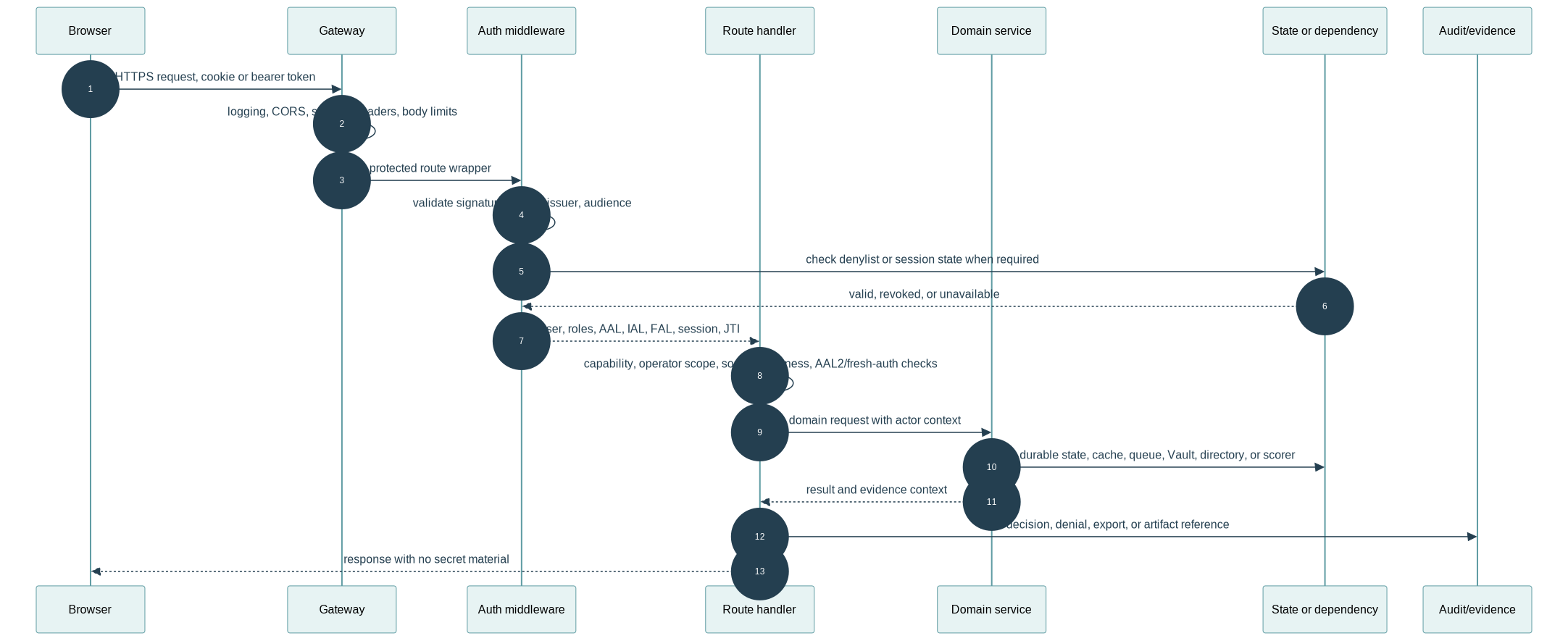
This is the normal protected path. A route can be read-only, self-service, operator-only, or capability-gated, but the browser does not receive domain authority directly. The route handler must enforce the policy that belongs to the action, even when the frontend has already hidden or disabled a control.
Runtime Service And State Boundaries

The service boundary is logical even when a local-live run uses an in-process implementation for selected capabilities. Deployment evidence should identify the mode, the endpoint or local path used, and the same-run artifacts that prove the behavior.
DDIL And Replay Boundary

DDIL is a degraded operating posture, not a shortcut around enterprise authority. Operators may view non-sensitive cached context with freshness markers. Sensitive policy, assignment, launch, lifecycle, replay, and reconciliation actions must carry freshness, deduplication, receipt, and evidence status.
Boundary Register
| Boundary | What crosses it | Current control | Evidence to collect |
|---|---|---|---|
Browser to frontend/static host |
HTML, JavaScript, CSS, images, and route fallback. |
TLS at ingress or gateway, no-store behavior for served HTML, static asset 404 handling for missing files, and no API authority in the static host. |
Ingress config, frontend build, browser route checks, static handler behavior. |
Browser to API gateway |
REST, GraphQL, WebSocket, authentication callbacks, session cookies, bearer tokens, CAC/PIV browser flow, and operator requests. |
TLS where configured, security middleware, CORS allowlist, request size limits, JWT/session middleware, and route-specific public exceptions. |
Gateway logs, protected-route tests, browser-live validation, auth/session evidence. |
Authentication token and session |
Access token, refresh token, session id, JTI, roles, AAL, IAL, FAL, auth method, provider, and issued-at time. |
Signature, expiry, not-before, issuer, audience, denylist/session checks, refresh rotation, and context propagation. |
Auth/session tests, denial evidence, session records, revoke artifacts, token-rotation evidence. |
Operator mutation |
Settings changes, policy updates, identity mutations, governance decisions, application lifecycle changes, DDIL mutations, session revocation, and provider administration. |
Operator scope plus AAL2 or stronger with fresh authentication. The current gateway freshness window is 15 minutes for operator mutations. |
Route tests, denied-mutation audit, AAL2 step-up evidence, workflow evidence. |
Gateway to domain service |
Actor context, domain request, service-owned payload, and service response. |
Service-owned API contracts, configured gRPC or HTTP endpoint, timeout behavior, mTLS/SPIFFE where configured, and in-process local-live mode when an endpoint is not configured. |
Service contract checks, local-live artifacts, service health, mTLS/SPIFFE evidence, mode marker in evidence. |
Domain service to durable state |
Identity, authn, session, governance, lifecycle, application, mission, incident, audit, and RMF records. |
Migrations, transactions, field encryption or hashing where applicable, schema ownership, and restore/backup controls. |
Migration output, restore evidence, integrity checks, data-retention evidence. |
Gateway or service to Vault |
JWT signing material, secret references, transit or key-management operations, and configured secret paths. |
Vault policy, token custody, injected or environment-owned credentials, path separation, renewal behavior. |
Vault configuration, secret initialization evidence, access logs, deployment secret provenance. |
Gateway or service to Atlas Cache |
Session cache, denylist, JTI/session tracking, dashboard state, DDIL cache, and TrustAI cached context. |
Encrypted cache client profile, denylist checks, TTLs, fail-closed auth verification when denylist state cannot be trusted. |
Cache health, revoke tests, denylist evidence, DDIL freshness evidence. |
Gateway or service to external source |
LDAP attributes, IdP metadata, federation assertions, SCIM targets, target app metadata, firewall actions, SIEM exports, and enterprise reachback. |
Configured connector authority, source freshness, secret reference handling, external approval evidence, and fail-closed mutation rules. |
Source inventory, connector validation, external approval artifact, SIEM receipt, firewall action receipt. |
TrustAI and scoring |
Feature vectors, trust score requests, model/rule metadata, graph context, and score explanations. |
Internal service access, TLS/mTLS for edge scoring where configured, model and ruleset provenance, timeout/degraded-state handling. |
TrustAI validation, model hash, ruleset version, scoring evidence, degraded-state marker. |
DDIL local state |
Local queues, federation cache, model weights, replay events, reconciliation runs, and reachback state. |
Operator-only mutation routes, stale-source policy, deduplication, receipt tracking, and fail-closed sensitive actions. |
DDIL local-live artifacts, queue and replay evidence, reconciliation output, reachback state. |
Evidence to claim |
Audit export, RMF result, screenshot, local-live artifact, guide statement, or incident package. |
Artifact provenance, hash manifest, source path, timestamp, claim-boundary review, and external authority separation. |
Control results, evidence manifests, guide checks, docs-boundary checks, assessor/AO artifacts where applicable. |
Route Boundary Rules
| Route family | Implementation reality | Boundary rule |
|---|---|---|
Root setup |
Root bootstrap status and setup routes are intentionally outside the normal operator wrapper. |
Use only for bootstrap. Once root setup is complete, normal protected routes carry the operational boundary. |
Authentication and federation |
Authn routes handle password, MFA, WebAuthn/FIDO2, CAC/PIV, OIDC, SAML, logout, refresh, and session exchange. Federation provider management uses protected gateway routes. |
Public metadata and callback paths perform protocol validation. Provider administration requires authenticated operator authority and fresh assurance where configured. |
SAML IdP surface |
SAML metadata is public by protocol design. The SSO endpoint performs its own browser login path and delegates authenticated work through standard middleware. |
Do not treat public metadata as an authenticated route. SSO issuance must be tied to authenticated session behavior. |
Sessions |
Active session, history, revoke, revoke-all, low-trust-score, and identity session views pass through the gateway wrapper. |
Session revocation and out-of-scope views require operator authority and fresh AAL2 behavior where applicable. |
Identity and Universal Directory |
Users, groups, credentials, proofing, intake, registrations, sessions, directory read models, profile schemas, profile sources, assignments, and Directory Studio are gateway-protected. |
Identity actions require the subject or an authorized operator. Directory source freshness and provenance must be visible for sensitive use. |
Governance and lifecycle |
Catalog, packages, requests, approvals, certifications, SoD, fulfillment, SCIM connections, lifecycle jobs, and reconciliation are gateway-protected. |
Approvals, certification decisions, SoD exceptions, and fulfillment changes require actor context, no-self-approval behavior, fresh assurance where configured, and audit evidence. |
Application onboarding and My Apps |
Application workspace, connector imports, readiness, activation, rollback, assignment rules, app launch, app OIDC token exchange, and application session accounting are gateway surfaces. |
Onboarding mutations are operator controlled. Launch and token exchange must re-evaluate session, assignment, app state, and policy context; accounting reports use their own intake boundary. |
Security services |
Authenticators, enrollment policy, session policy, OAuth clients, service accounts, scopes, token policies, device assurance, PAM, break-glass, risk signals, risk evaluations, and risk evidence are gateway-protected. |
Security-service mutations require capability checks and assurance appropriate to the action. Secrets and credentials must remain references, not raw browser payloads. |
Mission, ICAM, and migration |
Mission config, source imports, personas, scenarios, gaps, mappings, metrics, recommendations, evidence, ICAM summaries, inventories, workflows, adapters, and migration surfaces are gateway-protected. |
External source data remains external evidence until Atlas validates it and an authorized operator accepts the boundary. |
Policy and DDIL |
Policies, thresholds, DDIL status, network status, queues, sync, model weights, events, mode, metrics, federation cache, replay, reconciliation, and reachback state are gateway-protected. |
Read status can show degraded context. Mutable DDIL operations require operator authority, freshness checks, and replay/reconciliation evidence. |
GraphQL and WebSocket |
GraphQL is wrapped by gateway authentication. The trust-score WebSocket validates a JWT through the WebSocket protocol header or standard authorization path. |
GraphQL and WebSocket connections must fail closed when authentication is missing or revoked. |
Deployment Boundary Modes
| Mode | Boundary shape | Evidence note |
|---|---|---|
Kubernetes split frontend and gateway |
Ingress routes static UI to |
Collect ingress, network policy, pod security context, service health, and same-run gateway evidence. |
Gateway-served SPA |
The gateway serves static files and reserves |
Collect gateway static handler behavior and protected-route evidence. Static serving still does not authorize API work. |
Local-live validation |
The validation harness starts a real gateway plus local dependencies and may use configured local service endpoints or in-process domain implementations for selected capabilities. |
Evidence must name the local-live boundary and should not be presented as production IdP, PKI, SaaS, SIEM, firewall, or AO approval. |
Separate service deployment |
Authn, identity, session, directory, governance, application onboarding, API access, device assurance, PAM, risk, mission, incident, TrustAI, and attestation can run as service workloads. |
Collect service health, endpoint configuration, mTLS/SPIFFE posture, contract evidence, and domain-specific validation. |
DDIL edge |
An edge gateway can run with local queues, caches, federation cache, replay events, and disconnected reachback state. |
Collect stale-source posture, replay receipts, deduplication evidence, reconciliation results, and reachback state before claiming enterprise delivery. |
Boundary Failure Modes
| Failure mode | Risk | Expected architectural response |
|---|---|---|
Token validates but the session is revoked |
A stolen or stale token may continue to reach protected routes. |
Check denylist and session state before protected runtime work; fail closed if auth verification cannot be trusted. |
Frontend hides a control but the route accepts a mutation |
The UI becomes mistaken for enforcement. |
Every sensitive mutation route must independently check operator scope, capability, and assurance. |
Service address is missing in local validation |
Evidence may blur deployed-service behavior with local domain behavior. |
Record whether the route used a configured service endpoint or local in-process validation mode. |
TrustAI edge scorer is unavailable |
Trust posture may be stale or absent. |
Record live, cached, or unavailable scoring state and apply the configured deny/degrade behavior. |
DDIL cache is stale beyond policy |
Disconnected operation may use outdated identity or access context. |
Keep non-sensitive visibility marked as stale and fail closed for sensitive access, assignment, launch, lifecycle, and replay decisions. |
Queue replay succeeds locally but enterprise receipt is absent |
Operators may assume synchronization that has not completed. |
Mark replay as staged until reachback delivery, deduplication, and reconciliation evidence exists. |
Audit export lacks hash or custody metadata |
Evidence cannot support a defensible claim. |
Regenerate the artifact with manifest, source path, timestamp, and claim-boundary review. |
Local-live certificate or IdP material is cited as enterprise proof |
The validation boundary is overstated. |
Restrict the claim to local-live behavior and attach deployment-owned IdP, PKI, SaaS, SIEM, or AO evidence for external use. |
Validation Matrix
| Boundary | Repository validation | Deployment evidence still needed |
|---|---|---|
Browser to gateway |
Frontend tests, local-live browser validation, security validation, static UI validation. |
Enterprise TLS, ingress/WAF rules, endpoint hardening, and approved client certificate trust. |
Gateway routes |
Route tests, operator workflow tests, GraphQL and WebSocket auth tests, security validation. |
Production ingress routing, external IdP metadata, log forwarding, and service exposure review. |
Operator mutation |
AAL2/fresh-auth route tests, denied mutation audit, workflow validation. |
Production session policy approval and identity-provider assurance mapping. |
Service-to-service |
Service contract tests, local-live service exercise, mTLS configuration checks. |
SPIRE registrations, trust domain approval, network policy, and deployed certificate issuance. |
State systems |
Migrations, backup/restore docs and checks, cache and session validation. |
Managed database hardening, encryption-key custody, backup storage, restore drill evidence. |
TrustAI |
Edge-scoring validation, ruleset checks, scoring tests, guide and claim-boundary checks. |
Approved model promotion, production model custody, drift monitoring, and operational review. |
DDIL |
Local-live DDIL tests, federated DDIL validation, guide checks. |
Field hardware, mission reachback behavior, replay receipt, media handling, and enclave authorization. |
Evidence and claims |
Control validation, evidence manifests, guide checks, docs-boundary checks. |
Inherited controls, external approvals, assessor results, AO decisions, FIPS or Common Criteria artifacts. |