
User and operator guide · Architecture
Federation Architecture
On this page
PurposeFederation TheoryTechnologies UsedArchitecture OverviewFederation PlanesRuntime ComponentsProvider LifecycleInbound OIDC FlowInbound SAML FlowAtlas As A SAML IdP For ApplicationsApplication Onboarding FederationAssurance MappingSession HandoffPublic And Protected SurfacesFrontend ExperienceDDIL Federation ModelTrust BoundariesReverse Proxy RequirementsSecurity ControlsConfiguration ModelImplementation NotesOperational ProcedureValidation MatrixEvidence Package|
Important
|
Federation is not a shortcut around Atlas authorization. External providers can authenticate a subject and assert attributes. Atlas still validates the protocol exchange, maps the result into an Atlas session, evaluates local policy, records audit evidence, and controls access to Atlas routes and Atlas-managed application launches. |
Purpose
This page explains how federation is implemented and architected in Atlas. It covers the technologies, protocol theory, runtime components, trust boundaries, session handoff model, frontend surfaces, DDIL behavior, and evidence that operators should review.
Use this page when you need to answer:
-
how Atlas consumes external OIDC and SAML providers for workforce sign-in
-
how Atlas acts as a SAML identity provider for downstream applications
-
how application onboarding imports metadata and proves SSO readiness
-
how CAC/PIV, WebAuthn, MFA, AAL, IAL, and FAL relate to federation
-
how Atlas keeps external identity authority separate from local authorization authority
-
which implementation controls defend against token replay, assertion replay, bad issuer, bad audience, stale metadata, stale keys, and unsafe redirects
For route-level IdP behavior, also read architecture:idp-implementation.html. This page is broader: it explains the architecture and the theory behind the implementation.
Federation Theory
Federation is a trust arrangement between security domains. One domain authenticates a subject and sends a signed or otherwise verifiable statement to another domain. The receiving domain validates that statement and decides what local session, identity link, assurance level, and authorization posture should result.
Atlas separates these concepts deliberately:
| Concept | Meaning | Atlas posture |
|---|---|---|
Authentication authority |
The system that proves the user completed an authentication ceremony. |
An external OIDC or SAML provider can be the upstream authority; Atlas can also authenticate locally with password, MFA, CAC/PIV, or WebAuthn. |
Assertion or token authority |
The issuer that signs the ID token, SAML response, or SAML assertion. |
Atlas validates issuer, signature, key material, audience, recipient, expiry, and replay controls before accepting the result. |
Local session authority |
The system that creates the session used by local routes. |
Atlas is the session authority for Atlas routes. External tokens do not become route authorization by themselves. |
Authorization authority |
The policy engine that decides whether a subject may access a resource. |
Atlas applies assignment, role, scope, AAL, device, risk, tenant, application, and route policy after federation completes. |
Evidence authority |
The source of proof that a flow happened and was validated. |
Atlas records Atlas-owned validation and audit evidence; external IdP approval and production trust agreements remain external evidence. |
The security model is therefore "validate then translate." Atlas validates the external ceremony, translates the result into an Atlas session with bounded assurance and provenance, and only then authorizes actions.
Technologies Used
| Technology | Atlas use | Theory behind the use |
|---|---|---|
OpenID Connect |
Inbound workforce sign-in from external providers. |
OIDC adds an identity layer to OAuth 2.0. Atlas acts as a relying party, receives an ID token, validates it, and maps claims into a local session. |
OAuth 2.0 authorization code flow |
The browser is redirected to the provider, Atlas receives a short-lived code, and the gateway exchanges that code server-side. |
The browser never receives the final token exchange secret. Server-side exchange reduces exposure compared with front-channel token delivery. |
PKCE |
Atlas creates a high-entropy verifier and sends a derived S256 challenge with the OIDC request. |
A stolen authorization code is not enough; the token endpoint also needs the original verifier. |
OIDC state |
Atlas stores a one-time state record with a short lifetime. |
State binds the callback to the login request and defends against cross-site request forgery and confused-login responses. |
OIDC nonce |
Atlas stores a nonce and requires the ID token to carry the same nonce. |
Nonce binds the ID token to the browser login ceremony and defends against replayed ID tokens. |
JWT, JWS, JWK, and JWKS |
Atlas validates signed ID tokens against provider key material discovered through JWKS. |
Tokens are accepted only when signature, key identifier, issuer, audience, expiry, issued-at, nonce, and subject checks pass. |
SAML 2.0 service-provider runtime |
Atlas consumes external SAML assertions for workforce sign-in. |
SAML uses XML messages, entity IDs, bindings, metadata, signed assertions or responses, conditions, subject confirmation, and authentication context. |
SAML 2.0 identity-provider runtime |
Atlas publishes per-application IdP metadata and mints signed SAML responses for Atlas-governed application launches. |
Atlas becomes the asserting party for downstream SAML applications after local session and policy checks pass. |
SAML metadata |
Atlas imports provider metadata and publishes Atlas metadata. |
Metadata is the trust bootstrap: entity IDs, endpoints, bindings, certificates, and validity windows are explicit instead of implicit. |
XML Signature |
Atlas validates SAML signature posture and signs Atlas-issued SAML responses with allowed algorithms. |
Signature verification binds assertions and metadata to trusted keys. SHA-1-era algorithms are rejected for Atlas-issued responses. |
CAC/PIV and X.509 |
CAC/PIV can authenticate directly to Atlas or arrive as a federated assurance signal. |
Hardware-backed certificate authentication can raise assurance only when chain, revocation, identity mapping, and key-usage evidence support it. |
WebAuthn/FIDO2 |
WebAuthn can provide local phishing-resistant MFA or step-up. |
Public-key credentials prove possession of an authenticator and user verification without shared passwords. |
Atlas Cache |
Stores short-lived OIDC state, nonce, session-code, relay-state, browser CAC state, and session runtime data. |
Short-lived replay defenses must be shared across gateway replicas and expire quickly. |
Vault or secret provider |
Stores federation client secrets, signing material, and sensitive integration references. |
Federation secrets must be reference-driven and rotated; raw secrets should not appear in UI, logs, or guide evidence. |
PostgreSQL |
Stores durable provider registry, configuration documents, application integration state, DDIL federation cache, replay records, and audit-adjacent state. |
Provider lifecycle and evidence need durability across gateway restarts and HA failover. |
The current OIDC relying-party runtime accepts RS256 and ES256 ID-token signatures. Configuration files may document broader target policy, but runtime acceptance is the enforcement line that should be tested before enabling a provider.
Architecture Overview

Atlas keeps the browser-facing gateway as the federation control point. The frontend displays provider options, starts provider redirects, handles session-code callbacks, and guides app owners through metadata import. The gateway validates protocol messages, issues local sessions, and delegates protected-route decisions to the same policy and session controls used by non-federated authentication.
Federation Planes
Atlas has four related federation planes.
| Plane | What Atlas does | Primary risk controlled |
|---|---|---|
Inbound workforce federation |
Consumes external OIDC or SAML providers and converts valid upstream identity proof into an Atlas session. |
Bad issuer, bad audience, expired token/assertion, replayed state or nonce, stale JWKS, stale metadata, weak assurance, missing required claims. |
Outbound application federation |
Acts as a SAML IdP for applications launched from Atlas. |
Unassigned user launch, stale or wrong ACS, unsigned SP request when signing is required, bad attribute release, stale signing certificate, expired assertion. |
Application onboarding and readiness |
Imports OIDC/SAML metadata, stages protocol settings, tests target behavior, and records readiness evidence before publish. |
Publishing an integration without evidence, importing attacker-controlled endpoints, accepting mismatched metadata, failing to detect certificate drift. |
DDIL federation |
Caches provider metadata and evaluates constrained disconnected decisions with replay and reconciliation evidence. |
Treating stale provider metadata or stale claims as fresh authority while disconnected. |
Runtime Components
| Component | Responsibility | State handled |
|---|---|---|
Authentication frontend |
Shows local sign-in, CAC/PIV, MFA, and enabled federated providers; exchanges a returned session code for an Atlas session. |
Session code in URL or route state; tokens are stored through the normal authentication storage path after exchange. |
Gateway federation routes |
Expose provider discovery, OIDC login/callback, SAML login/metadata/ACS, federated logout, and session-code exchange. |
Short-lived state, nonce, relay state, provider session records, session-code records. |
Provider registry |
Stores external provider definitions, lifecycle state, JIT policy, assurance mapping, metadata locations, secret references, and validation evidence. |
Durable provider registry snapshot with redacted secret posture. |
OIDC relying-party runtime |
Discovers provider metadata, loads JWKS, initiates authorization-code login, validates callbacks, fetches optional user info, and returns claims. |
OIDC state, nonce, code verifier, provider metadata, JWKS. |
SAML service-provider runtime |
Publishes Atlas SP metadata, initiates external SAML sign-in, validates returned assertions, and extracts subject and attributes. |
SP key pair, SAML session cookie, request ID, IdP metadata, SAML assertion. |
Atlas SAML IdP runtime |
Publishes per-application IdP metadata and mints signed SAML responses for application launches. |
Application SP config, signing material, active and next certificates, assertion evidence hashes. |
Session runtime |
Issues Atlas access and refresh tokens after successful authentication or step-up. |
AAL, IAL, FAL, provider type, provider ID, subject, roles, attributes, tenant, nonce, JTI, refresh token. |
Universal Directory |
Resolves or stages local identity records for federated subjects. |
User profile, identifiers, groups, roles, EDIPI, CAC/PIV-related attributes, tenant context. |
Policy runtime |
Decides whether the authenticated Atlas session can access a route or launch an app. |
Assignments, assurance floors, scopes, roles, ABAC inputs, risk posture, tenant boundary. |
Audit and evidence |
Records provider management, login, callback, launch, denial, step-up, logout, and validation events. |
Event records, evidence hashes, validation artifacts, claim-boundary notes. |
DDIL federation runtime |
Caches provider metadata, validates cache freshness, records edge decisions, and reconciles queued events. |
Provider cache records, replay events, reconciliation run summaries. |
Provider Lifecycle
Atlas uses lifecycle state to avoid treating unreviewed provider configuration as production-ready.

| State | Meaning | Runtime effect |
|---|---|---|
Draft |
Provider exists but is not trusted for sign-in. |
Not shown as an enabled login option; validation artifacts can be collected. |
Enabled |
Provider validation passed and operator enabled it. |
Shown to the login page and loaded into the OIDC or SAML runtime. |
Disabled |
Provider remains configured but is not allowed for new sign-ins. |
Removed from runtime login options; existing sessions follow session policy and revocation policy. |
Retired |
Provider is no longer part of active federation operations. |
Kept for audit/history where required; not used for login. |
Create and update operations should return a provider to draft. Enabling should be a separate action that runs readiness checks and records evidence.
Inbound OIDC Flow
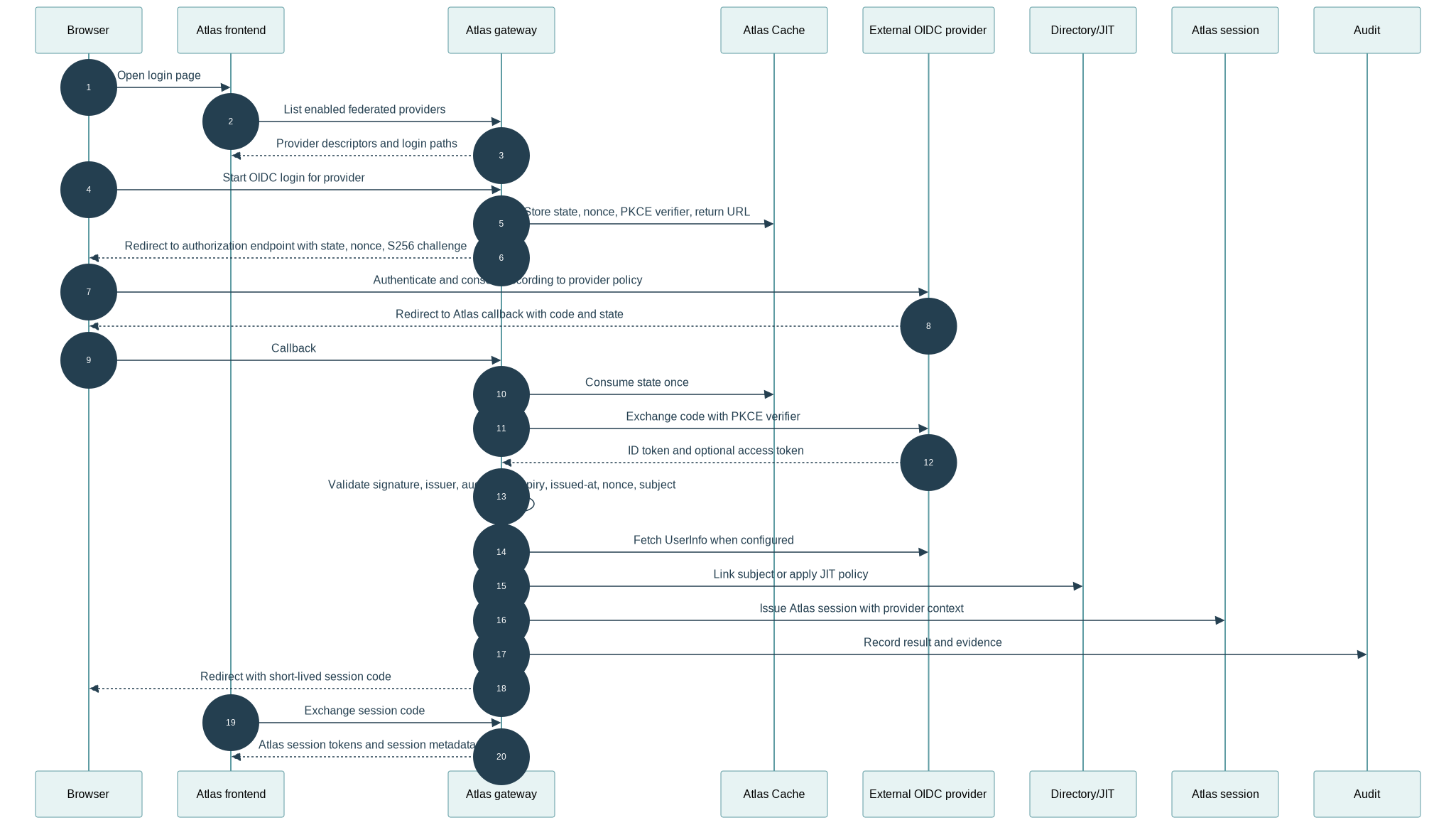
OIDC validation dimensions:
-
provider discovery must resolve the expected issuer and endpoints
-
JWKS must contain the signing key used by the ID token
-
a missing key triggers JWKS refresh for rollover handling
-
signature algorithm must be accepted by the runtime
-
issmust match the configured issuer -
audmust include the Atlas client ID -
expmust not be expired -
iatmust not be too old -
noncemust match the stored nonce -
submust be present and non-empty -
state is consumed once and then deleted
-
PKCE verifier must match the authorization request challenge
The browser receives a short-lived Atlas session code after the protocol callback. The frontend exchanges that code with the gateway. This keeps the protocol callback and local token issuance under the gateway’s control and allows the frontend to use the same post-login routing logic as local authentication.
Inbound SAML Flow
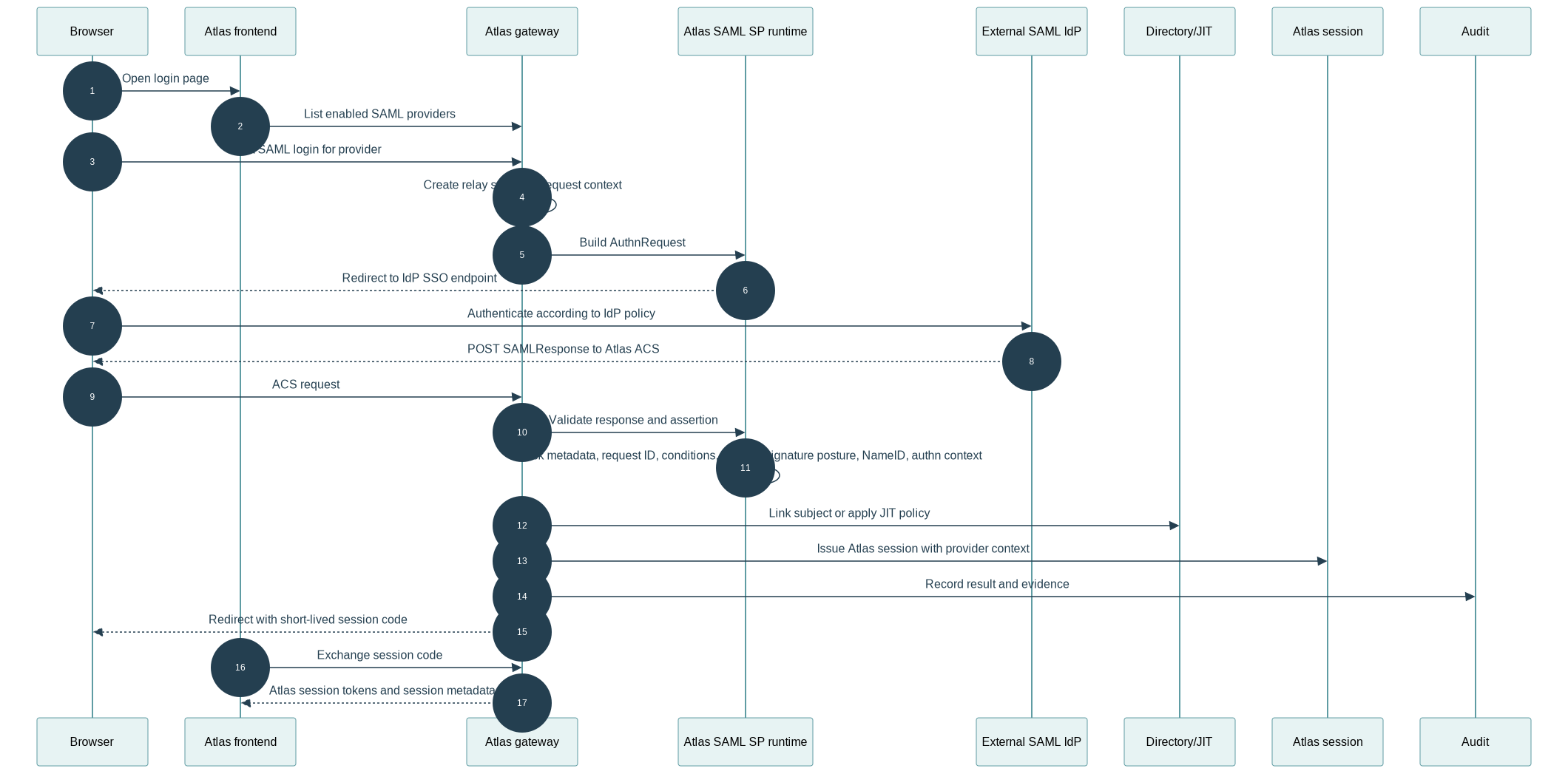
SAML validation dimensions:
-
provider entity ID must be configured and loaded from metadata
-
SSO endpoint binding must be supported
-
Atlas stores request ID and provider context for SP-initiated flows
-
assertion issue time must be fresh
-
NotBeforeandNotOnOrAfterconditions must allow the current time within clock skew -
audience restriction must match the Atlas SP entity ID
-
subject and NameID must be present
-
subject confirmation must be bearer and inside its validity window
-
signed assertion or response must be present when required
-
unacceptable authentication-context values are rejected
-
IdP-initiated sign-in is not the high-assurance default
The design favors explicit provider trust. Dynamic discovery or broad IdP-initiated acceptance should not be used for high-assurance deployments unless the deployment authority documents the trust model and compensating controls.
Atlas As A SAML IdP For Applications
Atlas can also be the asserting party for downstream SAML service providers. This is the app-launch direction, not the workforce-login direction.
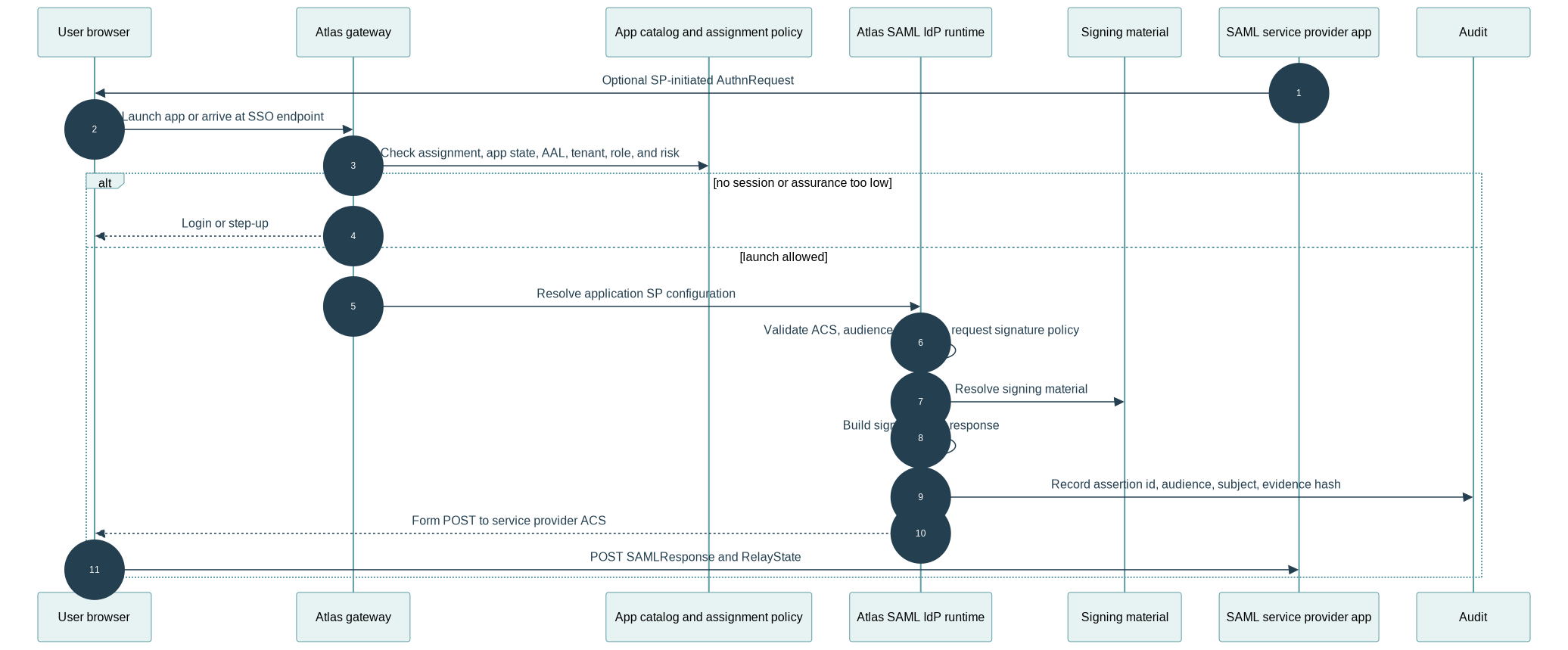
Atlas publishes an IdP metadata URL for each SAML application. The metadata includes entity ID, SSO endpoints, NameID formats, and signing certificates. The metadata URL is also the application-specific entity ID. During key rollover, Atlas can publish current and next signing certificates so the service provider can trust the new certificate before cutover.
Outbound SAML controls:
-
app must be published or represented by an approved onboarding draft
-
subject must have a valid Atlas session
-
assignment and app-launch policy must allow the launch
-
AAL and freshness policy can require step-up
-
ACS URL must match configured ACS or additional allowed ACS values
-
signed AuthnRequest is verified when the app requires signed requests
-
response and assertion are signed with RSA-SHA256 or stronger
-
assertion validity is short-lived
-
NameID and attribute release are derived from configured app mapping
-
assertion evidence hash is recorded without exposing private key material
Application Onboarding Federation
Application onboarding treats SSO as a lifecycle with evidence, not just a form with URLs.
| Stage | Atlas behavior | Evidence produced |
|---|---|---|
Discover |
Operator enters an application URL, metadata URL, pasted metadata, or app-owner package. |
Probe output, parsed metadata summary, field suggestions, target boundary. |
Import |
Atlas parses SAML metadata, OIDC discovery metadata, or application package data into draft fields. |
Evidence hash, suggested changes, rejected/accepted changes. |
Configure |
Operator reviews entity ID, ACS, redirect URI, issuer, JWKS URI, NameID format, attributes, groups, and assignment rules. |
Draft state, operator decisions, metadata provenance. |
Exchange |
Atlas shows OIDC registration handoff or SAML IdP handoff, including metadata URLs and certificate trust status. |
Handoff checklist, signing-certificate fingerprint, trust drift status when a pinned cert is configured. |
Prove |
Atlas runs configured readiness suites such as signed assertion, callback, expired assertion, metadata, and target fixture checks. |
Pass/fail artifacts, evidence references, timestamps. |
Publish |
Atlas allows publication only after required evidence and approvals are present. |
Published app record, launch readiness, rollback reference. |
This design prevents a common federation failure: treating metadata import as equivalent to production readiness. Metadata import tells Atlas what the peer claims; readiness testing shows whether the configured protocol flow behaves as expected.
Assurance Mapping
Federation assertions and tokens carry authentication context, but Atlas must decide how much local assurance to grant.
| Input | Examples | Atlas output |
|---|---|---|
OIDC authentication context |
|
AAL, freshness, provider provenance, possible step-up requirement. |
SAML authentication context |
AuthnContextClassRef, AuthnInstant, session lifetime, NameID format. |
AAL, method label, freshness, possible denial for unacceptable context. |
Subject identifiers |
OIDC |
Directory lookup, account link, JIT review, or denial. |
Groups and roles |
OIDC groups/roles claims; SAML group attributes. |
Local groups/roles only after mapping and policy rules apply. |
CAC/PIV signal |
Smart-card authentication context, PIV subject, certificate serial, EDIPI. |
|
Device signal |
Device ID, posture claim, trusted-device state. |
Device posture context for protected-route or app-launch policy. |
Missing required claim |
No EDIPI, no email where required, missing group, missing tenant claim. |
Deny, require review, or require step-up according to provider JIT and assurance policy. |
JIT policy is intentionally conservative. The baseline provider lifecycle supports disabled, review-required, and auto-create modes, with review-required as the safer default. Production deployments should use auto-create only when external proofing, account linking, deprovisioning, and authoritative source controls are documented.
Session Handoff
The Atlas session is the enforcement object after federation.
| Session field family | Why it matters |
|---|---|
Provider context |
Records provider type, provider ID, issuer or entity ID, and federated subject so operators can trace where authentication came from. |
Assurance context |
Stores AAL, IAL, FAL, authentication method, authentication time, and degraded-assurance flags. |
Identity context |
Carries Atlas user ID, username, EDIPI where available, mapped attributes, roles, groups, and tenant. |
Replay context |
Carries nonce and token identifiers so refresh, step-up, and denylist behavior can revoke or replace prior tokens. |
Authorization context |
Feeds route, application, assignment, risk, tenant, and ABAC policy checks. |
External claims can influence local policy, but they do not directly grant protected-route access. A route still checks the Atlas token, session state, denylist posture, tenant, roles, scopes, assurance, and resource policy.
Public And Protected Surfaces
| Surface | Purpose | Access posture |
|---|---|---|
Provider discovery |
Returns enabled login providers to the frontend. |
Public enough for login rendering; does not expose private secrets. |
OIDC login and callback |
Starts and completes external OIDC sign-in. |
Callback validates state, nonce, PKCE, issuer, audience, key, expiry, and subject before issuing a session. |
SAML SP metadata and ACS |
Publishes Atlas SP metadata and receives external SAML assertions. |
Metadata is public by protocol design; ACS validates assertion and request context before session issuance. |
Federated session-code exchange |
Lets the frontend trade a short-lived code for local Atlas tokens. |
Code is short-lived and single purpose. |
Provider management |
Creates, updates, validates, enables, disables, and retires external providers. |
Protected operator route; secrets are redacted and mutation actions require appropriate authority. |
SAML IdP metadata for an app |
Publishes Atlas IdP metadata for a downstream SAML application. |
Public by SAML design; does not make SSO issuance public. |
SAML IdP SSO endpoint |
Processes SP-initiated or launcher-driven SAML application access. |
Browser entry point can be unauthenticated, but authenticated minting is gated by session, assignment, app, and assurance policy. |
Application onboarding SSO surfaces |
Imports metadata, configures protocol settings, displays handoff, tests readiness, and publishes apps. |
Protected application-owner/operator workflow with evidence gates. |
DDIL federation cache and replay |
Shows cached metadata, validates edge decisions, and reconciles queued events. |
Protected route with freshness and sensitivity controls. |
Frontend Experience
The frontend does not validate federation protocols itself. Its job is to present safe workflows and hand protocol work to the gateway.
| UI surface | What it does | Backend boundary |
|---|---|---|
Login page |
Shows enabled federation providers, local sign-in, CAC/PIV, MFA, and callback errors. |
Provider list and callback exchange come from gateway authentication routes. |
Federated callback handling |
Detects a returned session code and exchanges it for a normal Atlas session. |
The session code is validated server-side; frontend does not parse tokens or assertions. |
Application express wizard |
Imports metadata, stages OIDC/SAML protocol fields, displays handoff panels, and runs readiness tests. |
Gateway and application-onboarding runtime own parsing, testing, evidence, and publish gates. |
SAML trust status |
Shows active signing certificate fingerprint, next certificate where present, and pinned-cert drift status. |
Gateway resolves the signing material and computes the certificate fingerprint. |
Security operations DDIL panels |
Shows provider cache freshness, replay records, and reconciliation state. |
DDIL runtime owns the cache, decision, and replay evidence. |
Frontend safety rules:
-
never paste raw client secrets, private keys, bearer tokens, SAML assertions, or OIDC tokens into app-owner packages or assistant context
-
treat metadata suggestions as reviewable changes, not automatic truth
-
show callback failures without rendering attacker-controlled values
-
route successful login through normal role-aware post-login navigation
-
keep provider secrets and private signing material out of browser responses
DDIL Federation Model
DDIL federation exists for constrained edge operation. It does not turn the edge into an independent identity authority.

DDIL checks:
-
provider cache must exist
-
metadata must be fresh
-
provider must not be disabled
-
validation status must be acceptable
-
thumbprint or signature posture must match policy
-
claim context must be fresh
-
nonce/state must not be replayed
-
sensitive actions must require reachback, local step-up, or denial
-
replay reconciliation must be idempotent
The edge can support a degraded non-sensitive session only within policy-defined freshness windows. Sensitive actions, stale metadata, stale claims, replayed state, disabled providers, and invalid signatures fail closed.
Trust Boundaries
| Boundary | Trusted input | Required validation |
|---|---|---|
Browser to gateway |
Redirects, callbacks, cookies, session code, SAML form posts. |
TLS, cookie flags, allowed origins, state/nonce/relay-state, CSRF posture, request method and content checks. |
Gateway to external OIDC provider |
Discovery document, JWKS, authorization code exchange, ID token, UserInfo. |
TLS, issuer, client ID, redirect URI, JWKS key, signature, audience, expiry, nonce, subject. |
Gateway to external SAML IdP |
Metadata, SSO endpoint, SAML response, assertion, NameID, attributes. |
Entity ID, certificate, signature policy, conditions, audience, subject confirmation, NameID, authn context. |
Gateway to downstream SAML app |
Application SAML configuration and SP AuthnRequest. |
ACS allow-list, audience, recipient, request signature when required, assignment, AAL, session freshness. |
Gateway to directory |
Federated subject and attributes. |
Account-link rules, JIT mode, required claims, tenant boundary, duplicate prevention. |
Gateway to policy |
Mapped session context. |
Route policy, resource policy, app assignment, scopes, roles, AAL, risk, device, tenant, step-up. |
Gateway to cache |
Short-lived state and session artifacts. |
TTL, key namespace separation, deletion after use, encryption/authentication where deployed. |
Gateway to secret provider |
Client secrets, signing keys, certificates. |
Reference-only UI, least privilege, rotation, audit logs, no raw private material in evidence. |
Reverse Proxy Requirements
Federation is sensitive to public URL correctness. Before enabling production federation behind a proxy, apply deployment:reverse-proxy.html.
Required properties:
-
public scheme and host must be stable
-
Host,X-Forwarded-Host, andX-Forwarded-Protomust reflect the trusted external origin -
spoofed incoming forwarded headers must be stripped before trusted values are set
-
OIDC redirect URIs must exactly match provider registration
-
SAML ACS, metadata, SSO, and SLO URLs must use the public origin
-
WebAuthn relying-party ID and origins must match the public browser origin
-
cookies must preserve
Secure,HttpOnly,SameSite, path, and domain semantics -
TLS should remain enabled edge-to-gateway unless an approved deployment exception documents compensating controls
Most federation failures in production are not cryptography failures. They are URL, proxy, cookie, clock, metadata, or certificate-rollover failures.
Security Controls
| Threat | Control | Operator evidence |
|---|---|---|
Callback CSRF |
OIDC state and SAML relay-state/request context. |
State TTL, single-use behavior, invalid callback tests. |
ID token replay |
OIDC nonce, expiry, issued-at freshness, signature, issuer, audience, subject. |
Replay denial tests and callback logs. |
Authorization-code theft |
PKCE S256 challenge and verifier. |
Provider request capture showing PKCE and token exchange success only with verifier. |
Wrong issuer |
Configured issuer/entity ID and metadata validation. |
Bad-issuer negative test. |
Wrong audience or recipient |
OIDC audience check; SAML audience and recipient checks. |
Bad-audience and wrong-ACS negative tests. |
Stale signing keys |
JWKS refresh on missing key; SAML metadata validation; rollover overlap policy. |
Rollover evidence and stale-key denial. |
Unsigned or weak SAML assertion |
Signed assertion/response policy and allowed signature algorithms. |
Unsigned assertion denial and algorithm review. |
Open redirect |
Allowed redirect URI and return URL policy. |
Redirect allow-list and invalid return URL tests. |
Secret leakage |
Secret references and redacted provider responses. |
UI/API inspection and log review. |
Privilege by attribute injection |
Claims map to local policy inputs; local authorization remains required. |
Session claim review and protected-route authorization tests. |
Provider disabled but still usable |
Disabled providers are removed from runtime maps and login discovery. |
Disabled-provider negative test. |
Local-live trust mistaken for production trust |
Claim boundary labels and external evidence requirements. |
Deployment-owned IdP, PKI, app-owner, and SIEM evidence. |
Configuration Model
Core configuration families:
| Configuration | Purpose | Production review |
|---|---|---|
Federation provider lifecycle |
Supported protocols, lifecycle states, stale-key policy, JIT modes, required positive and negative validation cases. |
Confirm provider enablement cannot bypass readiness. |
OIDC provider settings |
Issuer, client ID, secret reference, redirect URI, scopes, trusted CA path, provider enablement, assurance mapping. |
Confirm client secret custody, TLS verification, exact redirect URI, and required claims. |
SAML provider settings |
Atlas SP entity ID, ACS URL, metadata URL, SP certificate, IdP metadata, AuthnContext, assertion policy, JIT attributes. |
Confirm signed assertions/responses, metadata provenance, clock skew, and certificate rotation. |
Connector catalog |
Defines OIDC, SAML, SCIM, LDAPS, proxy header, and API-service connector requirements. |
Confirm required readiness suites exist before app publish. |
Application sign-on settings |
Stores app-level OIDC or SAML protocol settings, redirect or ACS URLs, attribute mappings, and launch policy. |
Confirm app owner accepts metadata, certificates, callback URLs, and readiness evidence. |
Reverse proxy settings |
Public base URL, TLS behavior, headers, cookies, and callback origin behavior. |
Confirm SAML/OIDC/WebAuthn origins through the live ingress path. |
Do not treat sample provider files as production approval. They document target posture and local-live defaults. Production deployments need environment-owned provider metadata, client registration, certificate custody, trust agreements, and validation evidence.
Implementation Notes
These details are useful when reviewing behavior:
-
the gateway initializes federation providers at startup and loads enabled providers into runtime maps
-
provider registry data is persisted as configuration state and merged with seeded provider definitions
-
provider API responses redact client secrets and report configured-secret posture instead
-
OIDC state, nonce, PKCE verifier, and return URL are stored with a short TTL
-
OIDC state is deleted after callback handling to prevent replay
-
OIDC JWKS is refreshed if the token key ID is not found
-
SAML service-provider runtime stores request ID and IdP entity ID in a server-side cookie-backed session
-
SAML SP runtime prefers SP-initiated flow for high-assurance posture
-
SAML assertion validation checks issue time, conditions, subject confirmation, signature requirement, NameID, and authentication context
-
Atlas SAML IdP runtime supports per-application signing material and an optional server-wide signing key mode
-
Atlas SAML IdP metadata publishes current and next signing certificates during rollover windows
-
local file-backed signing material is a fallback for lab, local-live, or constrained environments; production should use the approved secret provider
-
application SAML trust status compares active signing certificate fingerprints with configured pinned certificate material when provided
Operational Procedure
Use this procedure when adding or changing a federation provider.
-
Record the authority boundary.
Provider owner: Protocol: Environment: Purpose: Authoritative subject identifier: Required claims: Expected AAL/IAL/FAL: JIT mode: Deprovisioning source: Metadata source: Certificate/key owner: Rollback owner: -
Create the provider in draft.
Do not enable the provider at creation time. Store client secrets, certificates, and keys through approved secret references.
-
Validate metadata and trust material.
For OIDC, validate issuer discovery, JWKS, client ID, redirect URI, TLS CA, and secret posture.
For SAML, validate entity ID, metadata URL, SSO binding, signing certificate, metadata signature policy, ACS, and assertion signing posture.
-
Validate positive and negative cases.
Required negative cases include bad issuer, bad audience, expired assertion or token, replayed state or nonce, stale JWKS or metadata, disabled provider, and denied JIT.
-
Enable only after readiness passes.
The enabled provider should appear on the login page without exposing private secret material.
-
Complete a user session test.
Confirm the resulting Atlas session has expected provider type, provider ID, subject, mapped user, AAL, IAL, FAL, roles, tenant, and assurance flags.
-
Test protected-route and app-launch policy.
A successful login is not enough. Test a protected Atlas route, a route that should deny, and an action requiring step-up.
-
Capture evidence.
Store validation artifacts, runtime logs, session metadata with secrets redacted, provider registry state, and approval references.
Validation Matrix
| Area | Positive case | Negative case |
|---|---|---|
OIDC discovery |
Expected issuer discovery and JWKS load. |
Issuer mismatch, bad TLS, missing JWKS URI, stale JWKS. |
OIDC callback |
Authorization code with valid PKCE, state, nonce, ID token, issuer, audience, expiry, subject. |
Replayed state, missing nonce, bad audience, expired token, unsupported algorithm, unknown key. |
SAML inbound |
Signed assertion from configured IdP with valid conditions, audience, subject, NameID, and authn context. |
Unsigned assertion, expired assertion, bad audience, missing NameID, unacceptable authn context, unknown IdP. |
Provider lifecycle |
Draft provider validates and then enables. |
Disabled or retired provider is hidden from login and cannot start a new login. |
JIT/account link |
Required claims link to an existing user or create review-required JIT record. |
Missing required claim denies or routes to review according to policy. |
Atlas session |
Session contains provider context and expected assurance. |
Session with insufficient AAL cannot perform sensitive operation. |
Outbound SAML app launch |
Assigned user receives signed SAML response to registered ACS. |
Wrong ACS, unassigned user, stale app, or low AAL blocks launch. |
SAML certificate rollover |
Metadata publishes current and next certificate during overlap. |
Pinned cert drift is visible and unresolved drift blocks acceptance by policy. |
DDIL cache |
Fresh provider cache and fresh claim allow constrained non-sensitive degraded session. |
Stale metadata, stale claim, disabled provider, replay, or sensitive action fails closed. |
Evidence Package
For a production federation change, collect:
artifacts/federation/<run-id>/
  provider-boundary.txt
  provider-registry-redacted.json
  oidc-discovery.json
  oidc-jwks-summary.txt
  saml-metadata-summary.txt
  certificate-fingerprints.txt
  positive-login.log
  negative-cases.log
  session-context-redacted.json
  protected-route-checks.log
  app-launch-checks.log
  ddil-cache-checks.log
  approval-references.txt
  exceptions-and-gaps.md
Never store raw private keys, client secrets, bearer tokens, refresh tokens, SAML assertions, ID tokens, session cookies, or PII in the evidence package unless the repository and retention controls are approved for that data type.
Design Tradeoffs
| Decision | Benefit | Tradeoff |
|---|---|---|
Gateway owns federation callbacks |
Centralizes protocol validation, session issuance, audit, and policy handoff. |
Gateway must be highly available and correctly configured behind reverse proxy. |
External tokens become Atlas sessions |
Keeps protected-route authorization consistent across local and federated login. |
Requires careful claim mapping and session provenance. |
Provider enablement is lifecycle-gated |
Prevents draft metadata from becoming trusted accidentally. |
Operators must run validation before login is available. |
Application SSO is evidence-gated |
Prevents publishing unproven OIDC/SAML integrations. |
App onboarding takes more steps than direct URL entry. |
DDIL allows only constrained degraded sessions |
Supports edge operations without treating stale external metadata as full authority. |
Sensitive workflows require reachback, local step-up, or denial. |
Secrets are reference-driven |
Reduces exposure in UI, logs, artifacts, and assistant context. |
Requires mature secret-provider operations and rotation. |