
User and operator guide · Security
DDIL Security Posture
On this page
PurposeFunctional DDIL ModelOperator Control FlowSecurity Posture In DDILValidated BehaviorsEnvironment Evidence NeededReview Notes|
Important
|
This page describes implemented and validated Atlas engineering behavior for disconnected, denied, intermittent, and limited environments. It does not prove production DDIL readiness by itself; deployed cache custody, network paths, queue backends, certificate material, and operator procedures require environment-specific evidence. |
Purpose
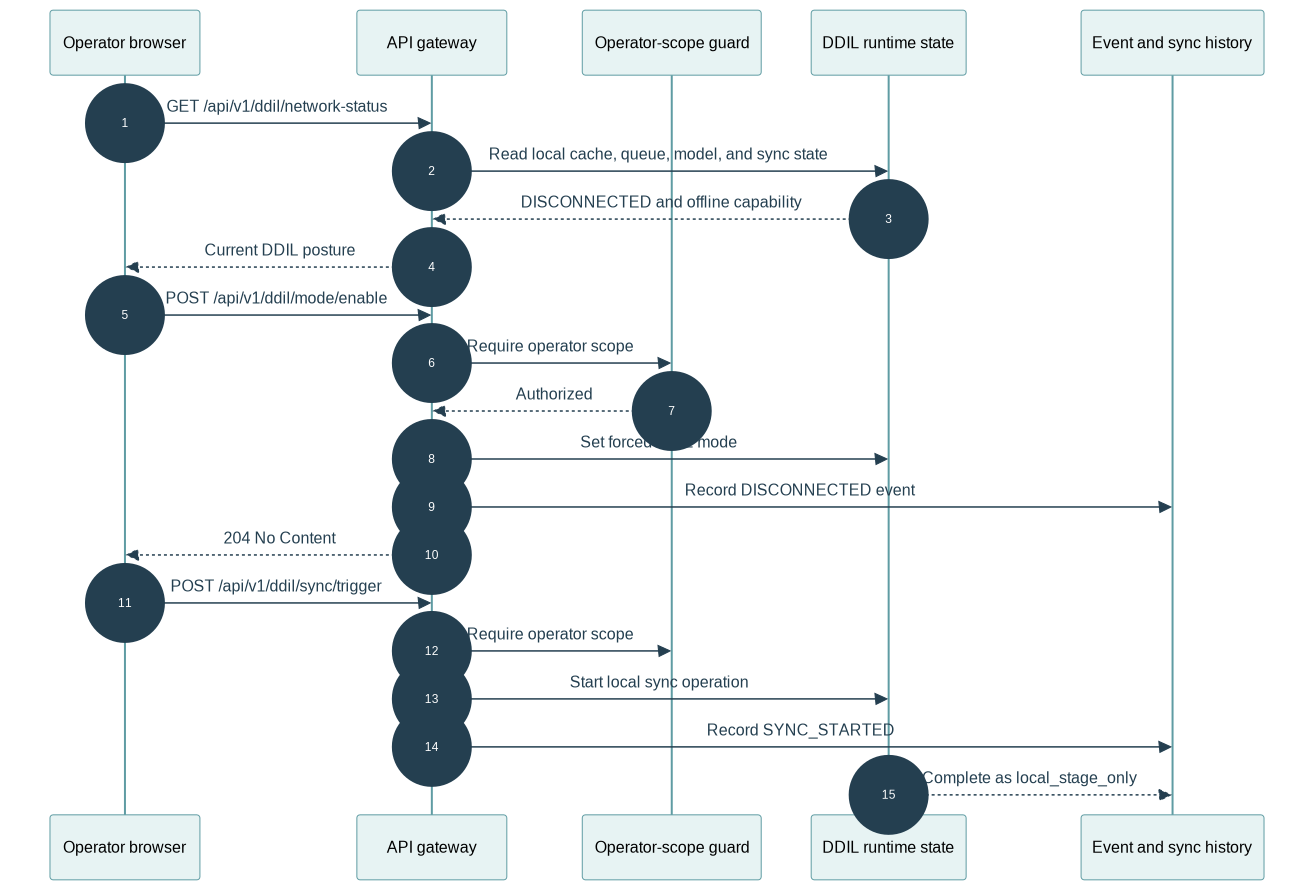
Atlas treats DDIL as a security posture, not only a network status. When enterprise reachback is unavailable, the gateway continues to expose local status, cache, model, queue, and sync controls while keeping mutable actions behind operator authorization. Local-live validation proves the functional behavior of this control surface; it does not prove successful enterprise delivery after reconnection.
Functional DDIL Model

Operator Control Flow
Security Posture In DDIL
| Posture area | Current behavior | Review boundary |
|---|---|---|
Gateway-local status |
Reports disconnected state, operating mode, queue status, packet loss, local latency, model availability, cache availability, and estimated offline time. |
Status is local runtime evidence. It is not proof that an external enterprise link is available. |
Operator-only mutation |
Mutable DDIL operations require authenticated operator scope before changing local state. |
The guide does not claim a deployed RBAC/ABAC authority beyond the gateway evidence unless that environment is validated. |
Local queues |
Exposes queue depth, capacity, utilization, pause/resume, and purge behavior for named local queues. |
Queue durability and persistence depend on the deployed backend and must be evidenced per environment. |
Sync behavior |
Records sync start, completion, history, item counts, and DDIL events. Completion is explicitly local staging until reachback exists. |
Describe local-live sync completion as local staging unless enterprise delivery evidence is attached. |
TrustAI edge model |
Reports local model version and checksum state used by offline capability and DDIL health. |
Production model provenance, signing, distribution, and rollback evidence remain external deployment artifacts. |
PKI offline validation |
Supports cached revocation status and configurable offline grace periods for DDIL operation. |
Offline revocation policy is sensitive. Review whether the deployed configuration allows or rejects certificates without fresh cached revocation data. |
Policy context |
Includes DDIL-related policy attributes and TrustAI rule behavior for tactical/offline cases. |
Policy semantics must be reviewed against mission policy before an environment claim is made. |
Validated Behaviors
| Behavior | Evidence anchor | What the evidence shows |
|---|---|---|
Disconnected default posture |
|
After disabling forced mode, local-live status remains |
Local capability remains available |
|
Local connection test succeeds, WAN test fails as unavailable, cache is enabled, local inference is enabled, and model weights are loaded. |
Forced DDIL mode |
|
Operator-triggered DDIL mode reports |
Queue controls |
|
The |
Sync and event history |
|
Incremental sync starts, completes into history, and records |
Operator surfaces show DDIL state |
|
Dashboard, help, and settings surfaces expose |
Environment Evidence Needed
| Before claiming | Evidence needed |
|---|---|
Operational DDIL readiness |
A deployed-environment run showing real cache services, queue persistence, local model files, certificate trust material, operator accounts, and network isolation behavior. |
Enterprise replay after reconnection |
Evidence that locally staged events and sync payloads are delivered, reconciled, deduplicated, and audited after reachback returns. |
Certificate validation posture |
Configuration review and test evidence for revocation cache freshness, grace period, fail-open or fail-closed policy, and audit records. |
Model custody |
Model provenance, checksum/signature validation, distribution process, rollback plan, and evidence that stale or missing models produce the intended degraded state. |
Queue protection |
Queue encryption, retention, pruning, back pressure, operator access control, and data spill handling evidence. |
Review Notes
-
DDIL diagrams should be kept close to the code and test anchors above.
-
The local-live stack intentionally models WAN reachback as unavailable. This is useful for functional validation, but the guide must continue to say
local stage onlyuntil external reachback is proven. -
DDIL mode should be reviewed with Zero Trust posture because cached identity, policy, revocation, and model inputs are still explicit decision inputs rather than implicit trust.