
User and operator guide · Security
Vault And Secret Management
On this page
PurposeWhat This Helps You DoRuntime ModelVault Engines And PathsService Policy BoundariesAuthentication And TransportSecret Reference ModelTransit Signing And EncryptionSAML IdP Key CustodyPAM And Break-Glass Credential CustodyDDIL And Offline Cache BehaviorInitialization And SetupMonitoring And AlertsConfigure Or ReviewVerify The ResultEvidence To CollectClaim BoundaryRelated TopicsPurpose
Use this page to understand how Atlas uses Vault as the deployment secret and key-control plane. The page is written for security engineers who need a complete mental model: which secrets are referenced, where key operations occur, how services authenticate to Vault, how DDIL operation is bounded, and what evidence to collect before making a deployment claim.
Atlas treats secret material as a controlled runtime dependency. Application state, onboarding drafts, policy records, and operator evidence should store references, hashes, metadata, or readiness results. Raw credentials, private keys, signing keys, and long-lived shared secrets belong in the deployment secret store or another approved key-management boundary.
What This Helps You Do
Use the Vault model to:
-
Review whether an Atlas deployment keeps secrets out of user-facing state and drafts.
-
Confirm service identities have narrow Vault policy access.
-
Validate encryption, signing, PKI, database credential, and backup-key paths.
-
Understand what still works during DDIL conditions and what requires reachback.
-
Collect evidence for operators, ISSOs, system owners, and assessors.
Runtime Model

The important boundary is that Vault is not just a place to store passwords. In Atlas it provides four related capabilities:
-
KV v2 storage for service secrets, signing material, application credential references, backup material, and operational tokens.
-
Transit encryption and signing operations where Atlas sends plaintext input for a controlled operation and receives ciphertext, plaintext, or a signature result without exporting Transit keys.
-
PKI issuance for deployment patterns that use Vault-issued service certificates as a backup or complementary certificate source.
-
Dynamic database credentials for deployments that enable database roles and leases.
Vault Engines And Paths
| Engine or path | Atlas use | Security meaning |
|---|---|---|
|
Default KV v2 base path used by the current Vault client configuration and deployment policy artifacts. |
Stores service-scoped secrets under bounded subpaths. Treat the path name as a deployment identifier, not a product authority. |
|
KV v2 data endpoint used for reads and writes. |
Services read only the paths allowed by their policy. Operators should review both data paths and metadata paths. |
|
Encryption, decryption, signing, and verification for named keys. |
Atlas can perform cryptographic operations without exporting Transit keys to application state. |
|
Internal certificate issuance path in the deployment policy. |
Supports certificate issuance when configured. Production trust roots and issuance policy remain deployment evidence. |
|
Dynamic database credential lease path. |
Enables short-lived database credentials where Vault database roles are configured. |
|
Health, seal, metrics, and audit surfaces used by operators, monitoring, and audit roles. |
Makes Vault availability, sealed state, and audit configuration observable. |
Service Policy Boundaries
Atlas policy artifacts define separate capabilities for application services, operators, CI/CD, monitoring, backup, and security audit review.
| Policy area | Current capability pattern | What to review |
|---|---|---|
Attestation service |
Reads its service secrets and common shared values, uses the trust-score Transit key, can request internal certificates, and can read its configured database credential role. |
Confirm the service account maps to the attestation policy and does not inherit operator or wildcard policies. |
TrustAI inference |
Reads TrustAI-specific secrets, common values, and model-weight references; uses model encryption; can request internal certificates. |
Confirm model material and endpoint credentials are scoped to the inference role. |
Telemetry ingestion |
Reads telemetry and RabbitMQ secrets, common values, and telemetry encryption; can request internal certificates. |
Confirm message-broker credentials are read-only for the ingestion runtime. |
Policy API and gateway policy paths |
Reads policy API secrets and OPA policy references; signs and verifies policy-signature material. |
Confirm signing authority is limited to the policy path and that verification is available where required. |
Kill switch |
Reads kill-switch secrets and common values; signs revocation material. |
Confirm revocation signing is separated from policy signing. |
Cache, graph, and backup jobs |
Read service-specific backup or storage credentials and use backup Transit keys. |
Confirm backup encryption keys and object-store credentials are separated from application read paths. |
Operators |
Broad read, write, list, and metadata capabilities under the Atlas secret tree plus health and mount visibility. |
Treat this as an administrative role. Require named operator access, ticketing, session evidence, and rotation evidence. |
Monitoring |
Reads monitoring secrets and Vault metrics. |
Confirm monitoring can observe health without receiving unrelated secrets. |
Security audit |
Reads metadata, audit configuration, audit hashes, and token lookup evidence. |
Confirm audit review can prove custody and access patterns without retrieving application secret values. |
Authentication And Transport
Atlas services can authenticate to Vault in two modes:
-
Kubernetes auth, where the service presents its mounted service-account token to the configured Vault Kubernetes auth role.
-
Direct token auth, used for local development, local-live validation, or tightly controlled deployment automation.
The production-oriented path is Kubernetes auth with service-account binding, namespace binding, policy binding, Vault token renewal, a configured CA bundle, and TLS verification. A direct token should be treated as an explicit deployment exception or automation credential with its own rotation and storage evidence.
| Setting | Meaning |
|---|---|
|
Vault API endpoint used by Atlas services. The default client value points at the in-cluster Vault service. |
|
Optional Vault Enterprise namespace. |
|
Direct token mode. Use for local-live, controlled automation, or approved exceptions. |
|
Kubernetes auth role for the workload. |
|
Service-account token path used for Kubernetes auth. The default is the standard mounted service-account token. |
|
KV v2 base path. The default is |
|
Transit mount path. The default is |
|
CA bundle used to validate Vault TLS. |
|
Development-only TLS bypass. Do not use as deployment evidence. |
|
Runtime timeout and bounded retry behavior. |
|
Enables automatic lease renewal for renewable tokens. |
Secret Reference Model
Atlas uses secret references as the user-facing and API-facing boundary. References identify where approved secret material lives. They do not disclose the value.
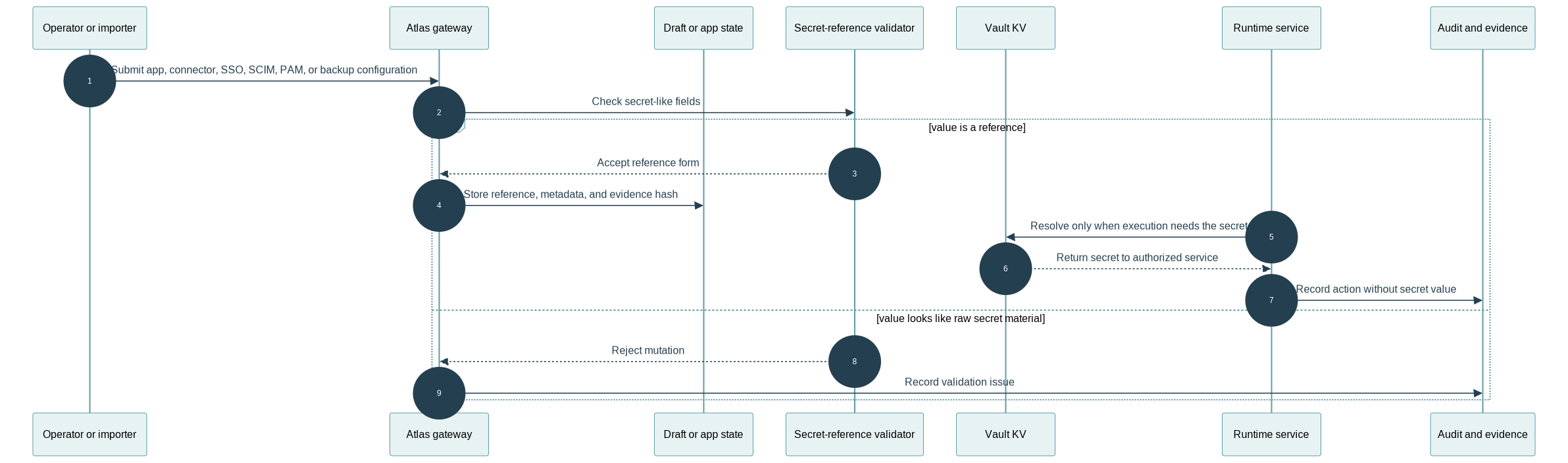
Accepted reference families include Vault references, secret-manager references, cloud key references, file references, PKCS#11 references, issuer references, and evidence references where the specific workflow supports them. SAML signing material, SCIM tokens, OIDC client secrets, session-accounting tokens, SWA replay credentials, connector bind secrets, PAM credentials, and backup keys should be represented as references in Atlas state.
Transit Signing And Encryption

The current policy model includes these named Transit keys:
| Transit key | Intended use |
|---|---|
|
Trust-score and attestation data encryption operations. |
|
Model or inference-related encryption operations. |
|
Telemetry payload encryption operations. |
|
Policy signing and verification. |
|
Kill-switch or revocation signing. |
|
Cache backup encryption. |
|
Graph backup encryption. |
|
Field-level PII encryption configuration for environments that enable that key. |
Transit keys should be non-exportable in production-oriented setup. Rotation evidence should include key version, rotation period, minimum decryption version, and a sample encrypt/decrypt or sign/verify validation result that does not expose sensitive payloads.
SAML IdP Key Custody
Atlas SAML IdP signing material is per application. The preferred mode stores private key material and signing certificates in Vault and records only the application-specific reference in Atlas state.
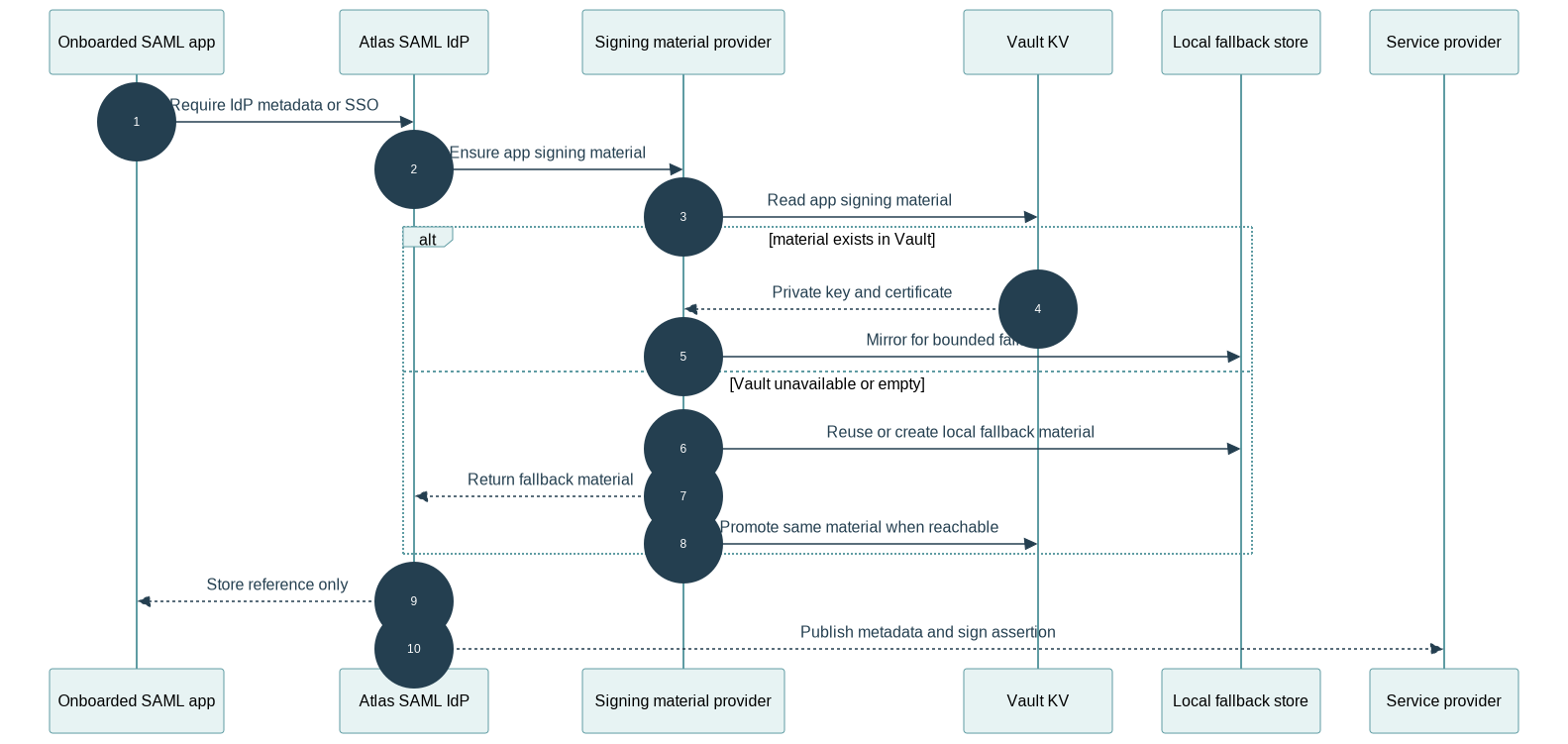
This design preserves service-provider trust during disconnected operation. If an app first receives signing material during a disconnected window, Atlas reuses that same material and promotes it back to Vault when reachback returns. It does not silently replace the app identity as part of reconnect.
Use ATLAS_SAML_IDP_KEY_MODE to select the runtime mode:
| Mode | Behavior | Evidence boundary |
|---|---|---|
|
Resolve signing material from Vault, mirror it locally, and promote fallback material on reconnect. |
Preferred deployment mode when Vault is reachable and approved. |
|
Use a configured local key directory. |
Suitable for local-live, controlled DDIL fallback, and test evidence when documented. |
|
Use temporary local material. |
Suitable for disposable tests only. Do not use for production trust establishment. |
PAM And Break-Glass Credential Custody
Atlas PAM records keep credential references and evidence metadata in platform state. Credential checkout and rotation are performed through the configured credential provider. Break-glass account custody uses Vault paths for generated passwords, records the path in account metadata, sends high-priority security notifications when activated, audits activation and rotation, and schedules password rotation when the emergency window closes.
Security review should confirm:
-
Break-glass account records contain references and metadata, not reusable password values.
-
Activation requires an accountable user, reason, and bounded duration.
-
Activation and rotation are represented in audit evidence.
-
Password rotation writes the new value back to the approved Vault path.
-
Notifications and incident records are configured for the deployment.
DDIL And Offline Cache Behavior
Vault reachability can degrade in DDIL environments. Atlas supports an encrypted local cache for bounded read fallback and a file-backed SAML signing-material fallback for IdP continuity.

The offline cache uses AES-256-GCM with a 32-byte local cache key, stores encrypted cache files on disk, validates entry TTLs, skips expired entries on load, saves atomically, and can clean expired entries. The default cache path is /var/lib/trustscore/vault-cache.enc; the default cache key path is /etc/trustscore/vault-cache.key; the default TTL is 24 hours.
The cache is intentionally bounded:
-
It is a read fallback for cached values, not a general-purpose substitute for Vault.
-
It only returns entries that are present and still within TTL.
-
Transit encryption, Transit decryption, signing, verification, writes, dynamic credential issuance, and certificate issuance require live Vault.
-
The local cache key has its own custody requirement. Protect it with host permissions, deployment secrets management, and rotation evidence.
Initialization And Setup
Atlas includes deployment scripts that initialize the Vault environment and create the local cache key for DDIL use.
| Script | Use |
|---|---|
|
Enables KV v2, Transit, and PKI engines; creates named Transit keys; initializes service secrets; applies Vault policies; configures Kubernetes auth roles when run in Kubernetes mode; and enables audit logging when permissions allow. |
|
Configures the PII encryption Transit key, policy, key rotation settings, and an encrypt/decrypt validation sample for environments that use field-level encryption. |
|
Generates a 32-byte AES-256 key file for the encrypted offline cache and sets owner-read permissions. |
|
Reviews repository configuration, policy coverage, service integration hooks, Transit operations, retry behavior, token renewal support, and guide presence. |
|
Validates field-level encryption behavior and Vault Transit operation for PII encryption environments when the required runtime dependencies are present. |
Before running initialization, confirm the target Vault endpoint is reachable, unsealed, protected by TLS for deployment environments, and authenticated with an approved administrative token or automation identity. Do not promote placeholder root tokens, demo credentials, or generated local-live credentials into production evidence.
Monitoring And Alerts
Atlas monitoring configuration includes a Vault scrape job for the Vault metrics endpoint and a critical sealed-state alert based on vault_core_unsealed. Operators should also collect Vault audit status and audit sink evidence where the deployment uses Vault for production secret custody.
| Signal | Review expectation |
|---|---|
Health and sealed state |
Vault should be reachable and unsealed before Atlas services that require live secrets are considered ready. |
Metrics scrape |
Prometheus should scrape the Vault metrics endpoint with an authorized bearer token or approved monitoring credential. |
|
Alert should fire when Vault reports sealed state. |
Token renewal |
Renewable runtime tokens should renew automatically. Expired or non-renewable tokens should be visible through logs and health checks. |
Audit sink |
Vault audit logging should be enabled for production custody claims, with sink configuration and retention handled by deployment policy. |
Secret access records |
Reviews should show which role accessed which path and when, without disclosing secret values. |
Configure Or Review
Use this review sequence for a deployment:
-
Confirm Vault endpoint, namespace, TLS CA, authentication mode, KV path, Transit path, timeout, retry count, and token renewal settings.
-
Confirm service accounts map to the intended Vault roles and policies.
-
Confirm the KV v2, Transit, and PKI engines are enabled where required by the deployment.
-
Confirm named Transit keys exist, are non-exportable where required, and have rotation evidence.
-
Confirm SAML IdP key mode is appropriate for the environment and that application state stores only references.
-
Confirm application onboarding, SCIM, OIDC, SAML, SWA, connector, PAM, and backup workflows reject raw secret material and accept only approved reference forms.
-
Confirm DDIL cache settings, cache-key custody, cache TTL, and reconnect behavior.
-
Confirm monitoring, alerting, and audit sinks are attached to the evidence bundle.
Verify The Result
Run validation from the deployment or validation workstation that can reach the target services:
./scripts/validate-vault-integration.shFor deployments that enable field-level encryption with Transit:
./scripts/validation/verify-pii-encryption.shFor guide validation after documentation or policy changes:
npm --prefix guide run checkThe validation result should show current policy coverage, Vault client behavior, Transit operations, guide coverage, and any deployment-specific prerequisites that still require live evidence.
Evidence To Collect
| Evidence item | Why it matters |
|---|---|
Vault health and seal status |
Shows the secret-control plane was available and unsealed during validation. |
Enabled secrets engines |
Shows KV v2, Transit, PKI, and database engines match the deployment claim. |
Applied policies and Kubernetes auth roles |
Shows service identities are bound to least-privilege Vault policies. |
Service environment and TLS settings |
Shows Atlas services are using the intended Vault endpoint, CA bundle, auth mode, KV path, Transit path, timeout, retries, and token renewal. |
Transit key inventory and rotation settings |
Shows encryption and signing keys are present and governed. |
Sample encrypt/decrypt and sign/verify results |
Shows live Transit operations work without exposing sensitive payloads. |
Reference-only validation results |
Shows drafts and app state reject raw credentials and store approved references. |
SAML IdP key evidence |
Shows per-application key origin, metadata publication, certificate rollover posture, and any fallback or promotion events. |
PAM and break-glass evidence |
Shows activation, checkout, notification, audit, and rotation records. |
DDIL cache evidence |
Shows encrypted cache path, key custody, TTL, cache hit/miss behavior, and reconnect behavior. |
Vault audit and monitoring evidence |
Shows security operations can detect access, sealed state, and metrics. |
Claim Boundary
Atlas can provide implementation and validation evidence for how services use Vault, how secret references are enforced, how Transit operations are called, how local-live and DDIL fallback is bounded, and how operators can collect evidence.
Production authorization still depends on deployment-specific evidence: Vault cluster configuration, unseal custody, administrative access control, key ceremony, backup and restore, audit sink receipt, external HSM or FIPS validation, enterprise SIEM ingestion, disaster-recovery testing, and assessor acceptance.