
User and operator guide · Operations
Backup And Recovery
On this page
PurposeRecovery PrioritiesBackup Domain ModelData ClassesDeployment MatrixDocker Lab RunbookKubernetes RunbookEnterprise Managed-Service RunbookClassified Environment RunbookDDIL Edge RunbookRecovery SequenceValidation And EvidenceCP-9 And CP-10 Evidence ChecklistRelated PagesPurpose
This page defines how Atlas backup and recovery should be planned, tested, and evidenced across local-live, Docker, Kubernetes, enterprise, classified, and DDIL deployments. The repository provides scripts, package structure, and documentation anchors. The deployed environment owns the actual storage platform, key custody, restore authority, retention period, and recovery approval.
Recovery Priorities
Prioritize these assets in order:
-
Secret and key custody, including Vault or external secret manager state, TLS trust material, signing keys, and recovery credentials.
-
Authoritative identity and access data, including users, credentials, groups, assignments, application onboarding packages, approvals, and policy state.
-
Audit and evidence integrity, including audit logs, Merkle/hash artifacts, validation reports, and exported evidence bundles.
-
Session, queue, and DDIL continuity, including Atlas Cache/session denylist state, RabbitMQ or local queue state, sync staging, model bundles, and replay evidence.
-
Observability and operator context, including monitoring rules, dashboards, incident records, and operational notes.
|
Important
|
Restore order matters. Never restore application data without confirming the matching secret material, schema migration level, audit retention policy, and deployment configuration. A backup that cannot be restored with the correct keys and schema is not usable recovery evidence. |
Backup Domain Model

Data Classes
| Data class | Examples | Backup requirement | Recovery concern |
|---|---|---|---|
Authoritative database state |
Identity records, credentials metadata, policies, approvals, application onboarding data, audit indexes. |
Consistent database backup with schema version, migration state, checksum, and encryption posture recorded. |
Restore must match application binary/config version and credential/key availability. |
Secret and trust material |
Vault state, signing keys, TLS private keys, CA bundles, OIDC/SAML secrets, HSM references. |
Back up with environment-approved key custody and split knowledge where required. |
Secret restore is security-sensitive and may require a separate recovery authority. |
Audit and evidence |
Audit logs, Merkle/hash proofs, validation artifacts, RMF evidence, screenshots, signed bundles. |
Immutable or append-only storage where available; hashes retained outside the mutable runtime. |
Preserve chain of custody and record redaction/export decisions. |
Cache and session state |
Atlas Cache session entries, denylist, token replay protection state, local DDIL cache. |
Decide whether to back up or rebuild. For many environments, cache restore is less important than fail-closed behavior. |
Restored stale sessions can create security risk. Prefer forced reauthentication unless the recovery plan explicitly requires session continuity. |
Queue and DDIL staging state |
RabbitMQ messages, local DDIL sync staging, replay records. |
Back up when messages represent security or mission records that cannot be regenerated. |
Recovery must include deduplication, replay ordering, and reconciliation evidence. |
TrustAI artifacts |
Model bundles, graph data, ontology/config, bundle checksums. |
Retain approved model bundle, checksum, promotion record, and graph snapshot where graph state is authoritative. |
Do not restore unverified or stale model bundles into a validated environment. |
Deployment configuration |
Rendered Kubernetes manifests, Compose files, Helm values, ConfigMaps, environment files. |
Store sanitized rendered config plus hash and approval ticket. |
Restored config must not reintroduce dev secrets, sample hostnames, or obsolete claim boundaries. |
Deployment Matrix
| Deployment | Primary backup owner | Must back up | Recovery approach | Evidence required |
|---|---|---|---|---|
Local-live validation |
Developer or validation operator |
Generated evidence artifacts, generated config, audit validation material, logs needed to reproduce a result. |
Rebuild the environment from |
Run directory under |
Docker lab |
Lab operator or deployment engineer |
Named volumes for PostgreSQL, Atlas Cache if required, RabbitMQ, Oxigraph, Vault dev/test state, Compose files, environment files, and validation artifacts. |
Stop or quiesce services, snapshot volumes, verify checksums, restore to an isolated host, then run health and security validation. |
Compose file hashes, volume manifest, restore transcript, |
Kubernetes |
Platform SRE plus Atlas service owner |
PVC snapshots, managed database backups, secret manager recovery material, rendered manifests, ConfigMaps, NetworkPolicies, and image digests. |
Use namespace-scoped restore or managed-service restore, then roll workloads with readiness gates and live validation. |
Snapshot IDs, restored PVC/database IDs, rendered manifest hash, rollout logs, pod health, and live validation evidence. |
Enterprise managed services |
Enterprise platform owners with Atlas owner review |
Managed database backups, cache/broker recovery plan, secret manager state, SIEM/audit retention, registry/image provenance, deployment config. |
Follow provider runbooks and attach provider evidence. Atlas owners verify application health, access control, audit, and claim boundaries after restore. |
Provider backup job output, restore approval, service health, identity/federation checks, and |
Classified enclave |
Enclave operations authority and evidence custodian |
In-enclave databases, secrets, audit/evidence, registry artifacts, deployment config, local mirrors, and approved transfer records. |
Restore entirely inside the enclave unless export/import is explicitly approved. Redacted summaries are secondary evidence. |
Classified retained evidence, hashes before and after redaction, media-control records, and in-enclave validation logs. |
DDIL edge node |
Edge operator plus enterprise synchronization owner |
Local queues, local audit, model bundle, revocation cache metadata, configuration, and staged sync records. |
Restore local state first, force stale security decisions to fail closed, then replay/reconcile only through approved channels when reachback returns. |
Queue depth before/after, replay log, deduplication result, model checksum, revocation cache age, and reconciliation record. |
Docker Lab Runbook
Docker backups are suitable for developer, lab, and controlled demonstration environments. They are not a substitute for enterprise storage procedures.
| Step | Action | Evidence |
|---|---|---|
Inventory |
Record active Compose files, container image digests, named volumes, mounted host paths, environment files, and exposed ports. |
|
Quiesce |
Stop write-heavy services or enter a maintenance window before volume snapshot. |
Maintenance note and |
Capture |
Back up PostgreSQL using a logical dump or volume snapshot; capture RabbitMQ/Oxigraph/Vault state only if the lab requires state continuity. |
Backup file names, sizes, SHA-256 hashes, and owner. |
Restore |
Restore into an isolated host or clean Compose project name to avoid overwriting the source environment. |
Restore command transcript and container startup logs. |
Validate |
Run service health, login/session checks, audit checks, and the security validation path applicable to the lab. |
|
docker compose -f docker/atlas-infrastructure.yml ps
docker compose -f docker/trustscore-services.yml ps

# Example evidence capture. Adapt volume names and database credentials per deployment.
docker compose -f docker/atlas-infrastructure.yml exec postgres \
  pg_dump -U atlas atlas_iga > artifacts/backup/docker/postgres-$(date +%Y%m%d-%H%M%S).sql

sha256sum artifacts/backup/docker/*.sql > artifacts/backup/docker/hashes.txt
Kubernetes Runbook
Kubernetes recovery should be namespace-scoped where possible and coordinated with the platform’s storage, secret, registry, ingress, and monitoring owners.
| Layer | Backup method | Restore check | Evidence |
|---|---|---|---|
Namespace and rendered config |
Retain rendered manifests, Helm values, Kustomize output, ConfigMaps, NetworkPolicies, and image digests. |
|
Manifest hash, approval ticket, and rendered output. |
Persistent volumes |
Use CSI VolumeSnapshot, storage-array snapshot, or platform-approved backup tool. |
PVCs bind, pods mount expected volumes, filesystem permissions match security context. |
Snapshot ID, restore timestamp, PVC names, storage class, encryption statement. |
Managed database |
Use provider-native point-in-time recovery or scheduled backup. |
Atlas schema version and migration state match service version. |
Provider job ID, restore target, database checksum or row-count sanity checks. |
Secrets |
Use Vault/secret-manager recovery procedure; do not rely only on Kubernetes Secret exports. |
Workloads receive current secrets; old dev or sample secrets are absent. |
Secret path inventory, access approval, rotation note. |
Ingress and certificates |
Back up issuer references, TLS secret names, trust bundles, and ingress annotations. |
TLS chain, client cert policy, and host routing validate after restore. |
Certificate inventory and ingress validation output. |
kubectl get pods -n trustscore -o wide
kubectl get pvc -n trustscore
kubectl get networkpolicy -n trustscore
kubectl rollout status deployment -n trustscore --all

ATLAS_BASE_URL=https://<restored-gateway> ./scripts/run-security-validation.sh --live
Enterprise Managed-Service Runbook
Enterprise deployments usually split responsibility across Atlas application owners and platform service owners. Record the split before the first backup.
| Decision | Required owner | Minimum documentation |
|---|---|---|
Database recovery point |
Database platform owner |
Backup schedule, PITR window, encryption status, restore role, last restore test date. |
Secret recovery |
Secret manager owner |
Recovery authority, unseal or break-glass process, rotation after restore, access log review. |
Cache and broker recovery |
Platform owner plus Atlas owner |
Whether Atlas Cache/RabbitMQ state is restored, drained, or rebuilt; effect on sessions, denylists, DDIL queues, and replay. |
Audit retention |
SIEM/log platform owner |
Authoritative log source, retention period, export process, hash or immutability evidence. |
Application validation |
Atlas owner |
Health, authentication, access enforcement, audit generation, and artifact-gated control validation result. |
After restore, run a go/no-go review that includes:
-
Identity and privileged access checks.
-
Session termination and token denylist checks.
-
Audit event generation and export checks.
-
Backup manifest and restore transcript review.
-
Claim-boundary review before any external statement.
Classified Environment Runbook
Classified backup procedures must be written and approved inside the target environment. This guide provides an unclassified structure only.
| Area | Requirement | Evidence handling |
|---|---|---|
Media control |
Backup media, transfer media, and restored media follow local classified handling rules. |
Retain authoritative records in enclave; export only approved redacted summaries. |
Secret and key custody |
Recovery credentials, CA keys, signing keys, and Vault/HSM material use enclave-approved custody. |
Do not place classified key identifiers, hostnames, or custody details in this repository. |
Evidence integrity |
Hash original evidence before redaction and keep the original hash in the classified evidence package. |
Exported summaries must identify that authoritative evidence remains in enclave. |
Tooling availability |
Validation scripts may need local mirrors for packages, images, vulnerability data, and Antora dependencies. |
Record offline mirrors and tool versions used during validation. |
DDIL Edge Runbook
DDIL recovery is not only a restore problem. It is also a stale-state and replay problem.
| State | Backup question | Recovery rule |
|---|---|---|
Local sessions and denylist |
Does mission continuity require restoring sessions, or should users reauthenticate? |
Default to forced reauthentication unless the deployment has approved session-continuity evidence. |
Local queues and sync staging |
Are queued records authoritative or replayable from another source? |
Restore only when ordering, deduplication, and reconciliation behavior is validated. |
Audit trail |
Can local audit records be tampered with or lost during transport? |
Preserve hashes before transfer and record every replay or export action. |
Revocation cache |
How old can PKI revocation material be before denial? |
Enforce the configured grace period and record cache age after restore. |
TrustAI model bundle |
Which model version is approved for the edge node? |
Verify checksum/provenance before startup and preserve rollback bundle. |
Recovery Sequence
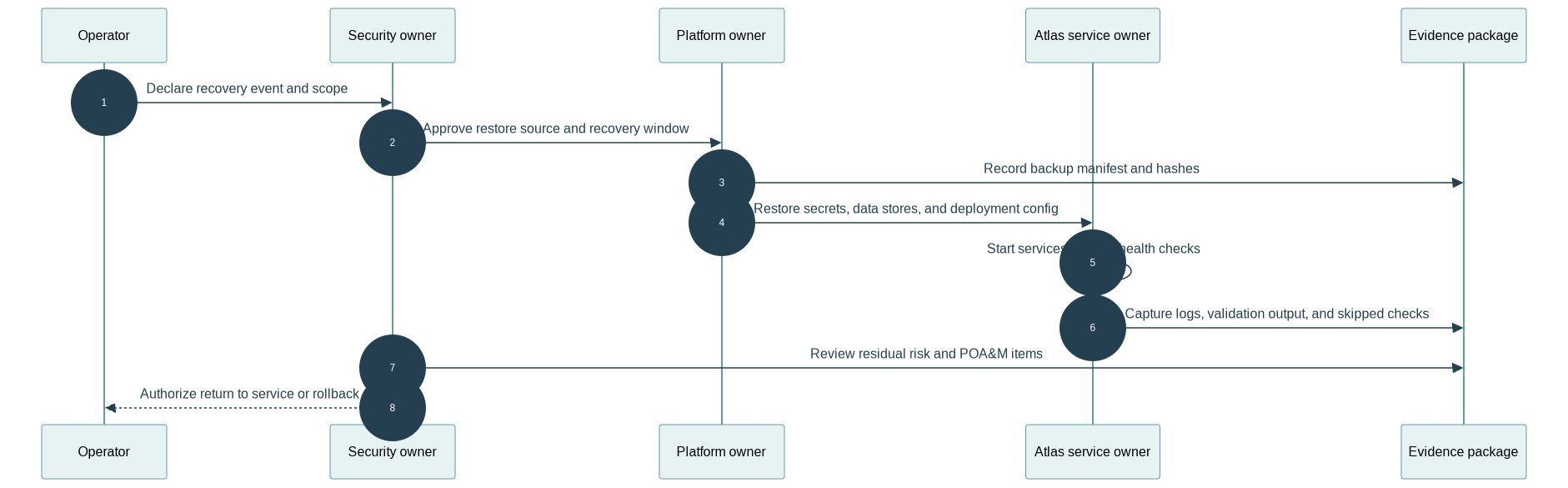
Validation And Evidence
Backup and recovery changes should be paired with targeted tests plus the standard security gate. Treat tabletop output as historical evidence unless it is tied to a current environment run.
| Validation | Command or evidence | Pass criteria |
|---|---|---|
Guide and claim language |
|
Documentation builds and claim-boundary checks pass. |
Backup restore test |
|
Restore completes, checksums match, and validation summary is retained. |
Weekly or scheduled backup test |
|
Scheduled test output is retained with CP-9 evidence and owner review. |
Live security validation |
|
Health, authentication, session, audit, and live checks pass or skipped checks are explicitly excluded from claims. |
Artifact-gated controls |
|
CP-9 and CP-10 remain |
Audit integrity |
Audit export, Merkle/hash proof, SIEM receipt, or equivalent environment evidence. |
Reviewer can verify records were preserved across backup and restore. |
CP-9 And CP-10 Evidence Checklist
| Evidence item | CP-9 | CP-10 | Required content |
|---|---|---|---|
Backup inventory |
Yes |
Yes |
Data stores, volumes, secrets, artifacts, config, owner, schedule, retention, and encryption posture. |
Backup manifest |
Yes |
Yes |
File/object IDs, snapshot IDs, sizes, SHA-256 hashes where applicable, generation time, and operator. |
Restore transcript |
Yes |
Yes |
Commands or platform job IDs, target environment, start/end time, errors, and operator. |
Application validation |
No |
Yes |
Health checks, login/session checks, access enforcement, audit generation, and relevant live validation output. |
Audit/evidence integrity |
Yes |
Yes |
Hash verification, SIEM receipt, immutable store proof, or reviewer attestation. |
Residual risk |
Yes |
Yes |
Open gaps, skipped restore steps, stale data risk, owner, due date, and POA&M reference. |