
User and operator guide · Architecture
ICAM Architecture
On this page
Design GoalsComponent ModelRuntime TopologyGateway BFFIntegrated Operations SnapshotWorkflow ModelAuthority ModesPerformance ModelAtlas ICAM is a modular package facade plus gateway BFF. It is not a new runtime service and it does not replace every overlapping enterprise system. The default posture is Atlas-owned for Atlas-native records and explicit observe, recommend, external, or inherited authority for systems that remain authoritative elsewhere.
Design Goals
| Goal | Implementation | Control value |
|---|---|---|
Unified operator surface |
|
Operators see provenance, denial context, validation state, and workflow status in one place. |
No duplicated ownership |
ICAM composes existing Atlas services instead of reimplementing identity, lifecycle, governance, PAM, or risk logic. |
Service ownership remains clear and validation evidence stays tied to the owning component. |
Configurable authority |
|
Atlas can coexist with overlapping systems without becoming an unbounded system of record. |
Artifact-backed claims |
ICAM validation produces hashed artifacts under |
Guide and RMF status use evidence status, not manual optimism. |
Component Model
| Component | Responsibility | Notes |
|---|---|---|
Compatibility facade |
Preserves the public ICAM domain model used by Atlas services and validation. |
Existing Atlas callers continue to use the supported ICAM contract. |
Domain model |
Shared DTOs, capability IDs, statuses, authority modes, workflow envelopes, evidence records, and typed errors. |
Stable machine-readable contract for package, gateway, frontend, docs, and validation. |
Facade and orchestration |
ICAM orchestrator and dependency wiring. |
Loads config/catalog and exposes dashboard, inventory, workflow, evidence, and validation summaries. |
Dependency readiness |
Dependency health adapters. |
The gateway supplies dependency readiness for Atlas service boundaries. |
Workflow planning |
Workflow orchestration plans. |
Joiner, mover, leaver, access request, certification revoke, step-up, break-glass, app onboarding, federation onboarding, and evidence export workflows are planned with capability gates. The gateway BFF then invokes owning Atlas services for executable steps. |
Capability catalog |
Capability catalog loader and runtime matrix. |
Builds module summaries, dashboard counts, and control mappings. |
Evidence handling |
Evidence hashing and redaction helpers. |
Secrets, tokens, bearer values, passwords, credentials, and private-key fields are redacted before hashing. |
Compatibility adapters |
Compatibility adapter framework for standards, Federal evidence formats, and external tooling patterns. |
Adapters default to observe/recommend and never perform external writeback in this pass. See architecture:icam-interoperability-architecture.html. |
Validation fixtures |
Fixtures and fakes for package, gateway, and frontend tests. |
Used to keep validation deterministic. |
Runtime Topology

Gateway BFF
| Route group | Purpose | Security behavior |
|---|---|---|
|
Effective ICAM capability matrix. |
Operator/read scope required. |
|
Health, counts, p95 targets, and module summary. |
Returns degraded module status instead of hiding partial failure. |
|
Integrated service posture and workflow execution readiness. |
Counts live Atlas-owned services, reports degraded dependencies, and shows which workflows have concrete downstream execution paths. |
|
Capability-scoped inventory shell. |
Shows provenance and authority even when backing services are unavailable. |
|
Identity and governance inventory. |
Aggregates owning Atlas services where configured. |
|
Lifecycle, provisioning, and connector posture. |
Secret references only; no raw bearer tokens. |
|
Device, privileged access, and risk posture. |
Uses security service facades. |
|
Starts a workflow and executes supported Atlas-owned steps. |
Operator scope, fresh AAL2, audit event, capability gates, service execution records, and evidence hash. |
|
Latest ICAM evidence view and RMF mapping. |
Generated from catalog and validation artifacts. |
|
Compatibility adapter inventory, health, validation, import, export, and evidence. |
Operator scope is required for reads; validate/import/export require fresh AAL2 and produce audit events. |
Integrated Operations Snapshot
The /api/v1/icam/operations response is the operator-safe integration posture for the command center. It is generated from the gateway’s current Atlas service dependencies rather than from static documentation.
| Surface | Integrated source | What ICAM reports |
|---|---|---|
Universal directory |
|
User and group counts, service status, and identity workflow readiness. |
Governance |
|
Entitlement, request, certification, and fulfillment counts. |
Lifecycle and SCIM |
Gateway lifecycle service |
SCIM connection and job counts, provisioning readiness, and lifecycle execution availability. |
API access, device, PAM, and risk |
security service facades |
Client/scope, device, privileged request, and risk signal posture. |
Compatibility |
ICAM adapter registry |
Adapter count, authority mode, classification boundary, and evidence hash posture. |
Response playbooks |
|
Incident, template, playbook, execution, approval, and evidence-package posture. |
Evidence and RMF |
ICAM validation artifacts |
Latest artifact count, hash, and control-map status. |
Workflow Model
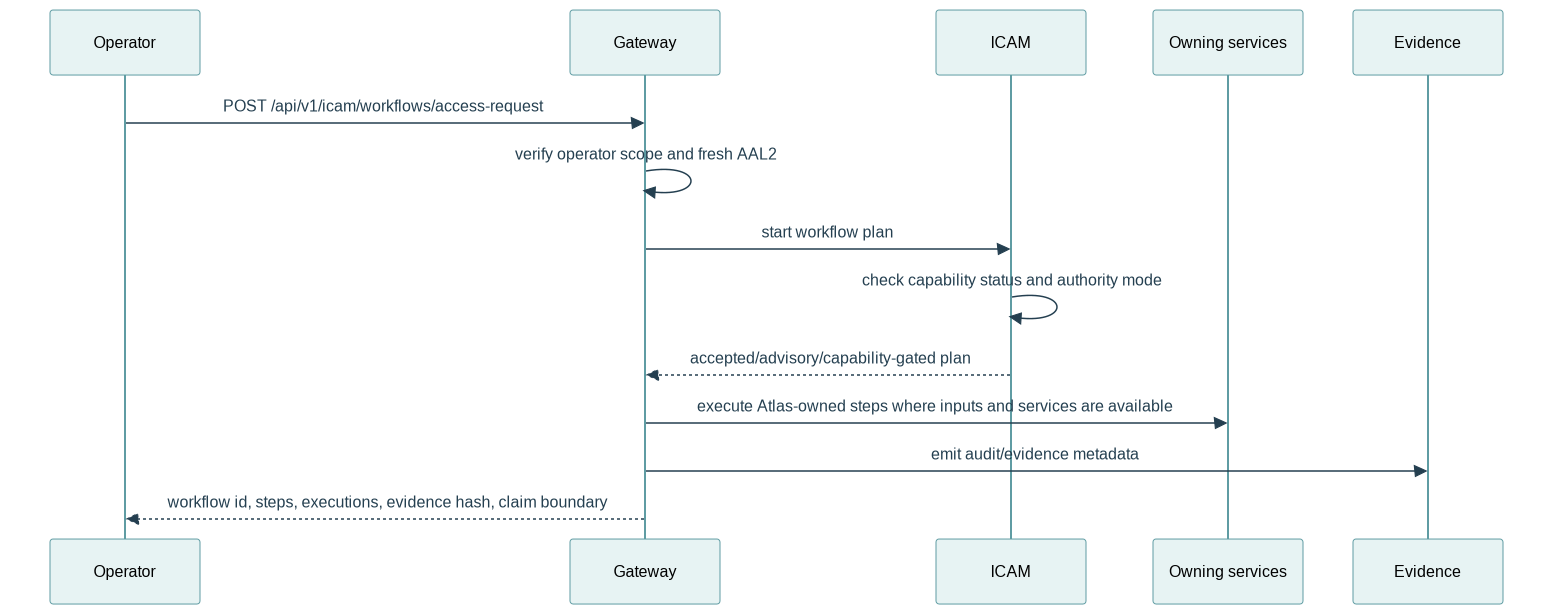
Approval never grants authorization by itself. Session, policy, assurance, trust, resource, device, PAM, and audit controls still decide access at use time.
Workflow responses include steps[] and, when Atlas-owned work was attempted, executions[]. steps[] are the planned control path. executions[] are concrete downstream calls such as identity profile create/update, lifecycle SCIM job creation, governance request creation, PAM request creation, risk evaluation, session revocation, application onboarding draft creation, or evidence export. Capability-gated executions are explicit and must not be counted as operational success.
Authority Modes
| Mode | Meaning |
|---|---|
|
Atlas owns the record and can validate the behavior locally. |
|
Atlas is explicitly configured to write authoritative state for that module. |
|
Atlas ingests and displays state but does not recommend mutations. |
|
Atlas can recommend operator actions but does not mutate external state. |
|
An external system remains the system of record. |
|
The capability depends on deployment or enterprise evidence outside the repo. |
Performance Model
The ICAM BFF is designed for parallel fanout and cached non-sensitive summaries. Default targets are:
| Operation | Target | Boundary |
|---|---|---|
Dashboard aggregate |
p95 under 500 ms in local-live |
Partial dependencies may degrade instead of blocking the entire dashboard. |
Paged inventory |
p95 under 300 ms in local-live |
Inventory uses service-owned pagination where available. |
Mutation acknowledgement |
p95 under 1 s excluding downstream provisioning |
Downstream lifecycle fulfillment is asynchronous and evidence-tracked. |