
User and operator guide · Operations
Incident Response
On this page
PurposeAlignment BaselineAtlas Incident Response ArchitectureOperating RolesSeverity And Priority ModelFederal Reporting Data ElementsResponse LifecycleAtlas Incident Categories And PlaybooksContainment Decision MatrixEvidence And Chain Of CustodyDeployment-Specific ProceduresReporting WorkflowPost-Incident ReviewValidationIR Control CrosswalkRelated PagesPurpose
This page defines a DoD/Federal-aligned incident response operating guide for Atlas deployments. It explains how Atlas detection, evidence, session, identity, audit, DDIL, and workflow capabilities support incident handling. It does not replace an agency Computer Security Incident Response Team (CSIRT), Security Operations Center (SOC), Cyber Protection Team, Authorizing Official, law enforcement, privacy office, or DoD chain-of-command procedure.
Use this guide to:
-
classify and triage Atlas security incidents consistently
-
preserve audit and evidence artifacts in a defensible way
-
coordinate containment actions such as session revocation, account lock, policy change, DDIL isolation, or firewall action
-
support Federal and DoD reporting workflows with the required technical facts
-
validate incident response implementation and evidence with repeatable repository checks
For controlled playbook authoring and execution, use the ICAM Response tab and the dedicated Response Playbook Manager guide. That page explains template creation, draft review, dry-run, approval, execution, and evidence export.
Alignment Baseline
| Reference | How this guide uses it | Atlas boundary |
|---|---|---|
NIST SP 800-61 Rev. 3, Incident Response Recommendations and Considerations for Cybersecurity Risk Management: A CSF 2.0 Community Profile |
Structures incident response as part of cybersecurity risk management and maps response work to CSF 2.0 outcomes. |
Atlas can produce technical evidence and automate selected response actions; the organization owns governance, risk decisions, and lessons-learned approval. |
NIST SP 800-53 Rev. 5 IR family |
Maps Atlas procedures and evidence to incident handling, monitoring, reporting, training, testing, and response planning expectations. |
Atlas supports selected IR controls but cannot independently satisfy organizational IR policy or reporting requirements. |
CISA Federal Incident Notification Guidelines |
Uses functional impact, information impact, recoverability, detection time, affected systems/users/records, location, contact, attack vector, indicators, and mitigation actions as reporting data elements. |
Atlas can populate many technical fields; the agency or organization determines what must be submitted and when. |
DoD cyber incident handling policy, including DoDM 8530.01 / DoDI 8530.03 as applicable to the operating organization |
Treats DoD incident handling, reporting, coordination, evidence, and DODIN risk decisions as environment-owned authority. |
Atlas must not claim it completes DoD incident reporting; it supports the technical package used by authorized DoD processes. |
References:
Atlas Incident Response Architecture

Operating Roles
| Role | Primary responsibility | Atlas interaction | Required evidence |
|---|---|---|---|
Incident Commander |
Owns response coordination, priorities, and decision log. |
Reviews incident status, containment options, and recovery gates. |
Timeline, decision log, escalation record, closure approval. |
SOC Analyst / CSIRT Responder |
Triage, analysis, scoping, indicator handling, and reporting package preparation. |
Reviews Atlas audit, incident, session, identity, TrustAI, DDIL, and workflow evidence. |
Event queries, affected assets/users, IOCs, mitigation actions, evidence hashes. |
Atlas Operator |
Executes approved Atlas controls such as session revoke, account status change, workflow hold, policy action, or DDIL isolation. |
Uses the operator UI/API under the required assurance level. |
Operator identity, action timestamp, approval, audit record. |
Identity / Application Owner |
Confirms affected users, roles, assignments, applications, and business impact. |
Reviews identity, access review, approvals, and application onboarding data. |
Affected identity list, access decision, restoration approval. |
Platform SRE |
Handles infrastructure containment, network controls, backups, restore, and platform logs. |
Provides Kubernetes, Docker, cloud, database, cache, queue, and SIEM evidence. |
Pod/container logs, firewall records, backup/restore records, host evidence. |
Evidence Custodian |
Preserves chain of custody, hashes, redaction notes, and export decisions. |
Packages Atlas artifacts and external evidence without overstating provenance. |
Hash manifest, custody log, redaction record, storage location. |
ISSO / System Owner / AO Representative |
Reviews residual risk, POA&M, reporting obligations, and return-to-service authorization. |
Consumes Atlas evidence as part of the authorization and risk process. |
Risk decision, reportability determination, POA&M, closure statement. |
Severity And Priority Model
Atlas uses P1-P4 incident severity. The values below are operational targets; the deployment authority may define stricter values.
| Priority | Federal/DoD-aligned interpretation | Atlas examples | Initial response target | Escalation |
|---|---|---|---|---|
P1 Critical |
Confirmed or strongly suspected compromise with severe mission, confidentiality, integrity, availability, privileged access, or reportability impact. |
Unauthorized privileged access, active data exfiltration, signed audit tampering, destructive action, SQL injection with data impact, enterprise credential compromise. |
Immediate, normally within 15 minutes for acknowledgement. |
SOC lead, Incident Commander, system owner, ISSO, privacy/legal if data affected, and DoD/Federal reporting authority. |
P2 High |
Material security incident with likely access-control, authentication, anomaly, or service-impact concerns. |
Brute-force threshold exceeded, anomalous privileged behavior, suspicious mass session revocation, high-risk DDIL replay issue, policy bypass attempt. |
Within 1 hour. |
Security on-call, platform SRE, identity owner, application owner. |
P3 Medium |
Security event requiring investigation and possible containment, but without confirmed major impact. |
Limited failed authentication, suspicious user workflow, isolated XSS attempt, incomplete evidence package, monitoring alert requiring review. |
Within 4 hours. |
Security responder and service owner. |
P4 Low |
Low-impact issue, test event, false positive candidate, or procedural finding. |
Scanner finding without exploitation evidence, isolated low-risk policy alert, tabletop follow-up. |
Within 24 hours. |
Queue for normal security operations review. |
Federal Reporting Data Elements
When an incident may require Federal or DoD reporting, the response team should capture these fields early. Do not include sensitive PII in external submissions unless the authorized reporting process explicitly requires it.
| Data element | Atlas source | Responder action |
|---|---|---|
Functional impact |
Service health, API/gateway status, session failures, DDIL status, dashboard impact. |
Describe effect on mission, users, identity operations, access decisions, or service availability. |
Information impact |
Audit records, affected identity/application data, evidence exports, database/query results. |
Identify whether confidentiality, integrity, or availability of data was affected. |
Recoverability |
Backup/recovery evidence, service health, containment state, deployment runbook. |
Estimate time/resources to restore normal operations and record blockers. |
Detection time |
Incident |
Record earliest known event and when the CSIRT/SOC identified the incident. |
Affected systems, users, records |
Identity, session, application onboarding, audit, gateway, deployment inventory. |
Provide counts, scope, and confidence level. Avoid overstating unknowns. |
Network location |
Gateway logs, ingress, source IP, service name, namespace/container, DDIL node. |
Record observed locations and whether they are local-live, lab, enterprise, classified, or DDIL. |
Point of contact |
Incident commander, SOC responder, system owner, ISSO. |
Use the organization-approved contact path. |
Attack vector |
Event type, playbook trigger, gateway route, federation source, API path. |
Map to the best-known vector and update as analysis matures. |
Indicators of compromise |
Source IP, user ID, session ID, token JTI, file hash, request path, certificate subject, payload fingerprint. |
Preserve raw values in protected evidence; redact before broad distribution. |
Mitigation actions |
Response actions table, audit events, firewall/session/account changes, policy changes. |
Record action, authority, executor, time, result, and rollback state. |
Response Lifecycle
The response lifecycle below preserves the practical NIST incident handling flow while aligning evidence and reporting to CSF 2.0 outcomes.
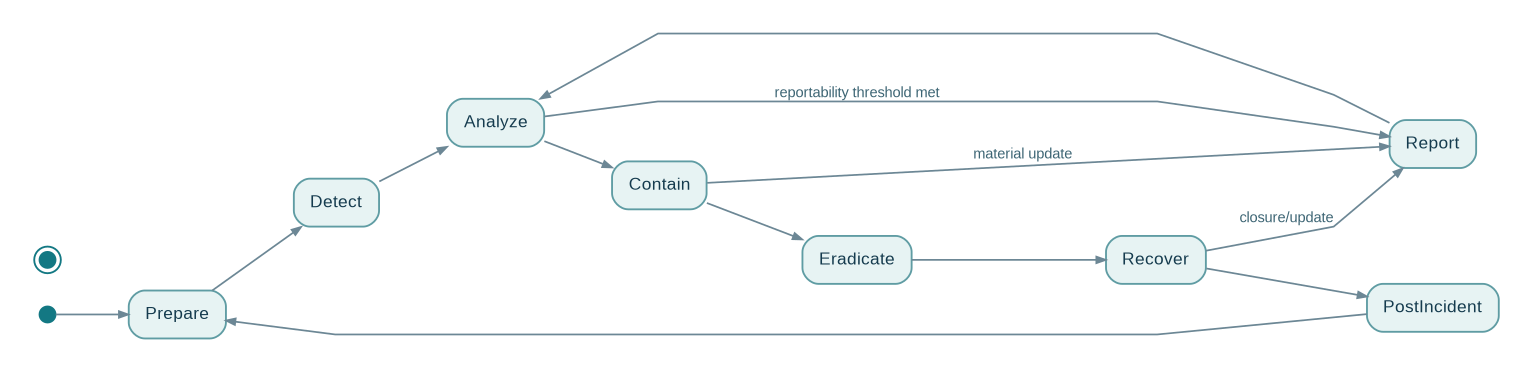
| Phase | Atlas actions | Federal/DoD-aligned output |
|---|---|---|
Prepare |
Configure incident thresholds, playbooks, on-call rotation, ticketing, evidence paths, notification routes, and validation checks. |
Approved IR plan, contact list, tested playbooks, training/tabletop record, reporting path. |
Detect |
Process failed auth, anomaly, session revoke, bulk modification, unauthorized access, injection, XSS, CSRF, privilege escalation, and exfiltration events. |
Initial alert, event timestamp, source, severity, affected user/resource. |
Analyze |
Correlate events, deduplicate incidents, scope identities/sessions/apps, inspect audit trails, collect metrics/logs/snapshots. |
Triage notes, severity, impact assessment, IOCs, affected systems/users/records, initial reportability view. |
Contain |
Revoke sessions, require step-up, lock account, block IP, isolate DDIL node/queue, disable app binding, freeze workflow, preserve evidence. |
Containment approval, action log, residual access review, mission impact note. |
Eradicate |
Remove malicious artifacts, rotate secrets, patch route/policy/config, disable vulnerable integration, update model or indicator controls. |
Remediation ticket, change record, validation output, rollback plan. |
Recover |
Restore trusted service, re-enable accounts/apps, validate session behavior, verify audit generation, run live/security/control validation. |
Return-to-service approval, recovery evidence, open POA&M items. |
Post-incident improve |
Generate review, update playbook, adjust thresholds, add tests, improve monitoring, package evidence. |
Lessons learned, MTTD/MTTR, action items, control updates, training needs. |
Atlas Incident Categories And Playbooks
| Category | Trigger examples | Default or documented response actions | Evidence focus |
|---|---|---|---|
Brute force |
|
Block source IP where authorized, collect authentication logs, create threat-intel note, notify security. |
Failed-auth timeline, source identifiers, account/session status, lockout evidence. |
Unauthorized access |
Unauthorized access event, policy bypass attempt, impossible privilege path. |
Revoke sessions, lock or hold affected account, collect access logs, snapshot relevant data, notify SOC. |
Actor, target resource, route/API path, session ID, action result, approval. |
Anomalous activity |
TrustAI/anomaly score, suspicious behavior, after-hours privileged action. |
Require step-up authentication, collect behavior data, notify user or responder. |
Baseline comparison, anomaly metadata, step-up result, false-positive analysis. |
Injection or XSS |
SQL injection, XSS, CSRF, request-shape attack, frontend guardrail alert. |
Block request/source where authorized, enable WAF or gateway rule, collect app/database logs, run integrity checks. |
Payload fingerprint, route, input validation evidence, database integrity result. |
Data integrity |
Unexpected data modification, audit mismatch, backup/restore discrepancy. |
Preserve database snapshot, verify audit hashes, suspend affected workflow, run integrity validation. |
Before/after hashes, affected record scope, restore point, custody log. |
System anomaly |
Mass session revocation, queue spike, DDIL replay anomaly, service health degradation. |
Investigate system health, collect metrics, protect queue state, validate recovery path. |
Metrics snapshot, queue depth, replay state, service logs. |
Security violation |
Policy/procedure violation, suspicious admin action, unsupported access path. |
Escalate to security owner, preserve evidence, determine containment with ISSO/system owner. |
Decision log, policy reference, affected scope, remediation action. |
Containment Decision Matrix
Containment should be fast, recorded, and reversible where mission allows. Do not automate destructive actions without written deployment authorization.
| Containment action | Use when | Approval | Rollback / recovery |
|---|---|---|---|
Revoke one session |
A single session is suspicious or confirmed compromised. |
Atlas operator or SOC responder per local policy. |
User reauthenticates after risk review. |
Revoke all user sessions |
Credential compromise or unauthorized access risk affects one user. |
Incident Commander or identity owner for P1/P2 unless pre-approved. |
Re-enable login after credential reset, MFA review, and audit check. |
Lock or suspend account |
Account is compromised, used for attack, or requires investigation hold. |
Identity owner or security authority. |
Document reactivation criteria and owner approval. |
Require step-up authentication |
Risk is elevated but access may continue under stronger assurance. |
Policy owner or automated rule if pre-approved. |
Clear after investigation or policy expiry. |
Block source IP or network path |
Attack source is reliable and blocking will not disrupt mission-critical traffic. |
Platform/network owner. |
Record firewall rule, expiry, and validation. |
Disable application binding or workflow |
A target application integration is compromised or unsafe. |
Application owner and Incident Commander. |
Re-enable after connector validation and access review. |
DDIL isolate / hold replay |
Reachback, queue, or replay behavior risks data integrity or unauthorized sync. |
Edge operator and enterprise synchronization owner. |
Reconcile, deduplicate, and preserve replay evidence before release. |
Secret rotation |
Key, token, credential, federation secret, or signing material may be exposed. |
Secret owner and platform SRE. |
Validate all dependent services, revoke old material, and document cutover. |
Evidence And Chain Of Custody
Every incident package should separate raw evidence, sanitized sharing artifacts, and reviewer notes.
| Evidence type | Examples | Handling rule |
|---|---|---|
Atlas incident record |
Incident ID, severity, status, category, assigned responder, affected user/resource. |
Preserve database record and export with timestamp. |
Timeline |
Detection, acknowledgement, containment, eradication, recovery, closure. |
Record actor, source system, and time zone. |
Audit and session evidence |
Audit export, session ID, token JTI, revocation event, account status change. |
Hash exports and preserve original raw form. |
Gateway and service logs |
HTTP route, source address, error, request ID, service logs. |
Redact secrets and PII only in derivative copies. |
Metrics and monitoring |
Prometheus snapshot, dashboard export, alert history. |
Include query time range and panel/query source. |
Forensic snapshots |
Database snapshot, volume snapshot, queue export, DDIL staging state. |
Require evidence custodian and storage owner approval. |
External evidence |
SIEM receipt, firewall rule export, IdP logs, PKI/revocation data, cloud/platform ticket. |
Record provider, collector, timestamp, source path, and review status. |
Recommended package layout:
artifacts/incidents/
  <incident-id>/
    incident-summary.adoc
    timeline.json
    evidence-manifest.sha256
    raw/
      audit/
      logs/
      metrics/
      snapshots/
    sanitized/
      report-package/
    external/
      siem/
      idp/
      firewall/
    review/
      post-incident-review.adoc
      poam-items.adoc
Deployment-Specific Procedures
| Deployment | Incident response focus | Special evidence |
|---|---|---|
Local-live validation |
Use incidents to test response behavior, not to claim production readiness. |
|
Docker lab |
Preserve Compose config, container logs, named-volume state when needed, and host port evidence. |
|
Kubernetes |
Preserve pod logs, events, NetworkPolicies, ingress, PVC snapshots, service account/RBAC state, and rollout history. |
|
Enterprise |
Coordinate with SIEM, IdP, PKI, WAF, load balancer, secret manager, database, and managed service owners. |
Provider tickets, SIEM case, IdP audit, certificate logs, backup/restore evidence. |
Classified |
Keep authoritative evidence in enclave unless export is approved. |
Classified evidence package, media-control record, redacted summary with retained original hashes. |
DDIL edge |
Protect queue state, local audit, revocation cache age, model provenance, and replay/reconciliation evidence. |
Queue depth before/after, replay logs, deduplication result, model checksum, reachback status. |
Reporting Workflow

Reporting rules:
-
Use the organization’s authorized reporting channel. Atlas does not decide reportability.
-
For Federal civilian reporting, prepare the CISA data elements early, including functional impact, information impact, recoverability, detection time, affected systems/users/records, location, contact, vector, indicators, and mitigations.
-
For DoD environments, follow the applicable DoD, command, enclave, contract, and DODIN reporting procedure. Preserve technical evidence so authorized personnel can complete required reporting.
-
Do not submit secrets, private keys, raw tokens, passwords, unnecessary PII, classified data, or controlled operational details through an unapproved channel.
-
If facts are incomplete, label estimates and update them as analysis matures.
Post-Incident Review
P1 and P2 incidents should not be closed until a post-incident review exists or the incident authority records why one is not required.
| Review section | Required content |
|---|---|
Executive summary |
What happened, when it was detected, current status, impact, and residual risk. |
Timeline |
Detection, triage, escalation, containment, eradication, recovery, communication, and closure times. |
Root cause and contributing factors |
Technical cause, process gaps, monitoring gaps, control failures, or environmental dependencies. |
Control performance |
Which Atlas controls worked, failed, skipped, or lacked evidence. |
Evidence integrity |
Evidence sources, hash manifest, chain of custody, redaction/export decisions. |
Metrics |
MTTD, time to acknowledge, time to contain, MTTR, false-positive notes, reopen count. |
Corrective actions |
Owner, due date, severity, POA&M mapping, validation method, and closure authority. |
Reporting closeout |
Internal ticket, external report IDs where applicable, update/closure submissions, and reviewer approval. |
Validation
Incident response changes should be paired with implementation tests, live checks when available, and control-validation evidence.
| Validation | Command or evidence | Pass criteria |
|---|---|---|
Implementation verification |
|
Incident tables, views, indexes, playbooks, and mock incident creation paths are present in the configured database. |
Integration tests |
internal release validation |
Detector, orchestrator, ticketing, chat, status, and review flows pass in the test harness. |
Live security validation |
|
Live gateway, auth/session, CAC/federation where configured, and security checks pass or skipped checks are excluded from claims. |
Artifact-gated controls |
|
IR-4 remains |
Guide and claim language |
|
The guide builds and claim-boundary checks pass. |
IR Control Crosswalk
| Control | Atlas support | Evidence | Boundary |
|---|---|---|---|
IR-4 Incident Handling |
Detector, orchestrator, timelines, response actions, playbooks, evidence collection, post-incident review. |
Incident record, timeline, action logs, evidence package, post-incident review. |
Shared. Organizational incident command and reporting authority are external. |
IR-5 Incident Monitoring |
Incident metrics, status, MTTD/MTTR fields, monitoring configuration, dashboard/audit evidence. |
Metrics export, incident status reports, monitoring alerts. |
Shared. SOC monitoring cadence and escalation are organizational. |
IR-6 Incident Reporting |
Provides data elements and evidence for authorized reporting workflows. |
Reporting package, ticket IDs, external report IDs where applicable. |
External authority determines reportability and submission. |
IR-8 Incident Response Plan |
This guide plus configuration and playbook files provide implementation support. |
Approved deployment IR plan, contact list, tabletop results, training records. |
Plan approval and training are organizational. |
AU family support |
Audit generation, review, export, and integrity evidence support incident analysis. |
Audit logs, Merkle/hash proofs, SIEM receipt. |
Storage immutability and retention may be inherited. |
AC / IA / SC support |
Session revocation, account lock/review, MFA step-up, route protection, TLS/session authenticity. |
Action records, auth/session evidence, gateway logs. |
Some containment actions require identity, network, or platform owners. |