
User and operator guide · Architecture
Network CIDR And Zone Policy
On this page
PurposeCIDR And Network Zone ModelWhat Atlas SupportsDecision FlowResponsibility BoundaryCIDR Evidence ModelOperator WorkflowDDIL And Edge NetworksTechnical Review ChecklistRelated PagesPurpose
Use this page to understand how Atlas supports CIDRs, subnets, allowed networks, network zones, and network boundary evidence.
Atlas treats a raw CIDR range as deployment-owned network evidence and a named network zone as the policy label that operators can use inside Atlas. The deployment evidence answers "which packets can reach this boundary." Atlas answers "which named network context was recorded, which policy expected it, which subject or workload carried it, and which decision or evidence item resulted."
This separation lets security engineers keep precise CIDR control at the infrastructure layer while giving Atlas a stable, reviewable model for application onboarding, access preview, MFA, ABAC, risk behavior, audit, incident response, and DDIL operations.
CIDR And Network Zone Model

The model has two layers:
-
Network enforcement layer: ingress rules, network policies, firewalls, WAF policy, ZTNA policy, service mesh policy, and enclave routing decide whether traffic can reach Atlas or a protected integration.
-
Atlas decision layer: named network zones, perimeters, boundaries, source IPs, session posture, identity attributes, workload attributes, and risk signals become reviewable policy context.
The named zone is the contract between these layers. For example, a deployment can map 10.24.0.0/14 and 10.31.8.0/21 to mission-network in its network evidence package. Atlas can then use mission-network in allowed-network policy, access preview, authorization boundary review, risk reporting, and audit without becoming the router or firewall.
What Atlas Supports
| Capability | Atlas record | How it is used | Evidence to review |
|---|---|---|---|
Network zone catalog |
Named options such as |
Gives operators selectable network context during application onboarding. Production and mission zones require deployment evidence before publish. |
Zone owner, purpose, environment, CIDR mapping, enforcement point, evidence hash, and approval reference. |
Allowed networks |
Application access policy contains allowed network labels. |
Access preview compares the subject network context to the allowed labels and records satisfied or missing controls. |
Access preview result, staged policy, assigned subjects, network labels, and denial reason when a subject is outside an allowed zone. |
OIDC network perimeters |
Client network policy and named perimeter labels. |
Captures whether an OIDC client is expected to run from an Atlas-managed, named-perimeter, or validation-only network posture. |
Client registration, redirect URI policy, perimeter evidence, assignment policy, and sign-on validation. |
API and NPE network boundaries |
Runtime network, enclave, or API gateway boundary labels. |
Strengthens service-account and workload review by tying scopes and audiences to declared runtime boundaries. |
API gateway boundary, workload identity evidence, ingress/egress policy, network allowlist, and sponsor approval. |
Authorization boundary network zone |
Hosting enclave and network zone on the application boundary profile. |
Makes boundary review explicit for system owners and RMF reviewers. |
Boundary record, interconnections, ingress points, egress points, inherited controls, and enclave evidence. |
Source IP audit context |
Source address recorded from the trusted request path and carried into audit or response workflows. |
Supports investigation, containment, firewall handoff, and SIEM correlation. |
Trusted proxy header policy, ingress logs, gateway audit entries, and downstream log receipt. |
Behavior and risk network context |
Network zone, network-zone risk, and traversed network-zone history. |
Raises risk context when a subject changes network zones or appears in a higher-risk zone. |
Behavior event, risk score input, decision result, and follow-up action. |
MFA and ABAC network context |
Environment or subject network attribute in policy evaluation. |
Can require stronger assurance or apply attribute-based policy when a request comes from a named network context. |
Policy rule, evaluation input, step-up result, and session/audit evidence. |
Firewall and kill-switch handoff |
Source IP, destination IP, user, session, and reason fields. |
Lets an incident workflow ask a configured firewall provider or session controller to contain traffic or terminate sessions. |
Incident record, containment action, firewall provider result, and session revocation evidence. |
Kubernetes and enterprise deployment controls |
Deployment evidence references for ingress, NetworkPolicy, load balancer, firewall, WAF, route, and scan output. |
Proves which CIDR ranges, clients, admin paths, and service-to-service flows are allowed in the deployed environment. |
Rendered manifests, cluster policy, firewall rule export, WAF/load balancer policy, route table, exposure scan, and validation report. |
Decision Flow
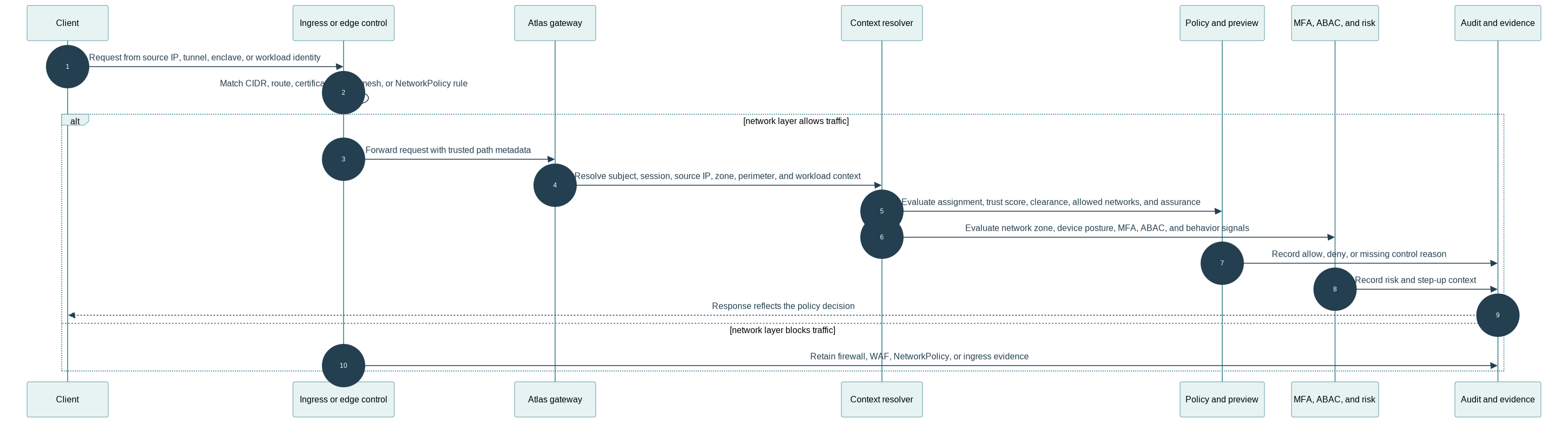
Atlas can only evaluate network context it receives from a trusted deployment path or an operator-attested evidence record. The strongest posture is a closed loop:
-
the CIDR registry is approved and owned;
-
the enforcement point accepts only the approved ranges;
-
the enforcement point emits logs or configuration evidence;
-
the Atlas zone label maps to those ranges and owners;
-
access policy, MFA, ABAC, risk, audit, and incident workflows use the same label.
Responsibility Boundary
| Layer | Primary responsibility | Atlas support |
|---|---|---|
CIDR registry |
Own the approved ranges, owners, expiration, mission, environment, and data sensitivity. |
Store or reference the evidence package through application, boundary, and deployment evidence. |
Ingress and edge |
Restrict inbound clients, admin paths, route exposure, TLS policy, and proxy header trust. |
Record gateway URL, trusted proxy assumptions, source IP context, and validation results. |
Firewall, WAF, and ZTNA |
Enforce allowlists, deny known-bad sources, inspect request posture, and contain incidents. |
Carry source/destination IP and session context into firewall handoff and incident evidence. |
Kubernetes NetworkPolicy or service mesh |
Restrict east/west traffic and service-to-service reachability. |
Link rendered policies, runtime checks, and exposure scans to deployment evidence. |
Application onboarding |
Declare allowed network labels, OIDC perimeters, API/NPE boundaries, and authorization boundary network zone. |
Preview who would be allowed, who would be denied, and why a network label is missing or satisfied. |
MFA and ABAC |
Apply assurance or attribute policy based on environment and network context. |
Evaluate named network attributes with the rest of the session, subject, resource, and risk inputs. |
Risk and continuous evaluation |
Detect network-zone traversal, risky network posture, and session changes. |
Feed network zone and network risk into behavior, TrustAI, audit, and containment workflows. |
Evidence and RMF review |
Prove that claimed network controls match the deployed boundary. |
Bind Atlas decisions to deployment artifacts, manifests, hashes, validation runs, and reviewer notes. |
CIDR Evidence Model
A deployment CIDR evidence record should be precise enough for a security engineer to recreate the boundary without guessing. Use a table like this in the deployment evidence package or linked reviewer artifact.
| Field | Description |
|---|---|
Zone label |
The Atlas label used in policy, such as |
CIDR ranges |
Approved IPv4 or IPv6 ranges. Examples: |
Owner |
Network owner, enclave owner, application owner, or system owner responsible for the range. |
Environment |
Local validation, enterprise, mission enclave, tactical edge, staging, production, or other approved environment label. |
Purpose |
Human users, admin paths, API clients, service-to-service traffic, DDIL reachback, telemetry, or incident response. |
Direction |
Inbound, outbound, east/west, admin-only, reachback, or bidirectional. |
Enforcement point |
Ingress, firewall, WAF, route table, NetworkPolicy, service mesh, ZTNA policy, proxy, or enclave control. |
Trust metadata |
TLS profile, client-certificate policy, trusted proxy header policy, workload identity, or tunnel identity. |
Evidence artifacts |
Rule export, rendered manifest, route table, screenshot, scan result, SIEM receipt, validation report, and hash manifest. |
Review state |
Approved, inherited, evidence-required, expired, exception-approved, or retired. |
Expiration or review date |
Date when the CIDR mapping must be reviewed or refreshed. |
Operator Workflow
-
Confirm the application or boundary has a named network zone.
-
Link the named zone to a CIDR evidence record owned by the deployment.
-
Confirm the enforcement point is configured for the approved ranges.
-
In application onboarding, set allowed networks, network perimeters, or API/NPE network boundaries as appropriate.
-
Run access preview to confirm expected users or workloads satisfy the network label and unexpected subjects are denied.
-
Confirm MFA, ABAC, and risk policy use the same network context where required.
-
Collect audit, ingress, firewall, NetworkPolicy, and validation evidence in the reviewer package.
-
Review expiration dates and update the zone mapping when ranges, tunnels, enclaves, or routing change.
DDIL And Edge Networks
DDIL deployments add two network questions:
-
Is the edge operating with enterprise reachback, degraded reachback, or disconnected state?
-
Which local enclave, tactical network, or approved remote range is mapped to the Atlas zone used for policy?

The edge zone label should map to local enclave or tactical network evidence. Sensitive actions still depend on freshness, policy, session assurance, and replay controls. After reconnect, reconciliation evidence should show the edge decision, network context, event hash, and enterprise receipt status.
Technical Review Checklist
| Question | What to verify |
|---|---|
Which CIDRs are allowed? |
The deployment evidence lists every approved CIDR range, owner, purpose, direction, and expiration date. |
Which Atlas labels use those ranges? |
Each range maps to a named zone, perimeter, or boundary used by application onboarding, policy, or boundary review. |
Where is enforcement performed? |
Ingress, firewall, WAF, NetworkPolicy, service mesh, ZTNA, or enclave controls contain the actual allow or deny rule. |
Does Atlas receive trusted context? |
The request path defines trusted proxy headers, source IP handling, client certificate behavior, workload identity, or other trusted metadata. |
What happens to a subject outside the zone? |
Access preview and runtime policy evidence show a deny, step-up, or missing-control reason. |
How are network changes detected? |
Behavior and risk evidence include network-zone traversal or network-zone risk when the subject context changes. |
Can incidents contain traffic? |
Incident workflows carry source/destination IP, session, user, reason, and firewall provider result where configured. |
What proves east/west segmentation? |
Rendered policies, runtime checks, and scan output show allowed service paths and denied unrelated paths. |
What proves DDIL network posture? |
Edge zone mapping, reachback state, cache freshness, replay events, and reconciliation evidence are included in the DDIL package. |