
User and operator guide · Architecture
Data And Control Flows
On this page
PurposeSecurity Mental ModelEnd-To-End Flow MapData Sensitivity ClassesAuthentication And Session LifecycleProtected Request Control FlowUniversal Directory, Governance, And Lifecycle FlowApplication Onboarding And Launch FlowTrustAI And Risk Signal FlowSession Revocation, Containment, And Kill-Switch FlowDDIL Data And Control FlowIncident, Backup, And Evidence FlowControl Validation And Claim FlowControl Point RegisterSecurity Review ChecklistFailure ModesValidation HooksRelated PagesPurpose
This page explains how security-relevant data, control decisions, and evidence move through Atlas. It is written for reviewers who need to understand where authority is established, where a request can be denied, which service owns the state, and what artifact proves the behavior.
Use this page with architecture:trust-boundaries.html and architecture:service-boundaries.html. The trust-boundaries page defines the zones. This page follows the flows across those zones.
Security Mental Model
Atlas separates three things that are often confused during review:
-
Data flow is the movement of identity attributes, tokens, session state, directory facts, access requests, risk signals, audit records, and evidence artifacts.
-
Control flow is the decision path that permits, denies, steps up, queues, replays, or records an action.
-
Claim flow is the evidence path that turns runtime behavior into a reviewable validation artifact.
The API gateway is the browser-facing control point. The frontend can display workflow state and warnings, but service-side checks decide whether a request is accepted. Domain services and gateway-integrated domain runtimes own the state and invariants for their areas. External sources, target applications, IdPs, SIEMs, firewalls, and authorization officials remain outside the repo-generated claim unless their evidence is attached.
End-To-End Flow Map

The map shows the current implementation shape. The API gateway receives protected API traffic, validates identity/session context, dispatches to route families, and records audit or evidence output. Public or setup handlers exist, but they are narrow and do not replace protected route enforcement. External systems are data sources or evidence recipients until deployment evidence establishes their authority.
Data Sensitivity Classes
| Class | Examples | Allowed movement | Security review focus |
|---|---|---|---|
Authentication secrets |
Passwords, recovery codes, private keys, signing keys, bearer tokens, refresh tokens, client secrets, bind credentials. |
Secret values remain in Vault, protected stores, or one-time browser exchanges. User-facing APIs should return references, status, or redacted summaries. |
No raw secret echo, secure custody, rotation, revocation, transport protection, and audit. |
Session and assurance state |
Session id, JTI, access-token claims, refresh state, AAL, IAL, FAL, provider, auth method, issued-at time. |
Gateway middleware turns token/session state into request context. Operators see status and actions, not reusable token material. |
Issuer/audience checks, denylist, refresh rotation, AAL2 step-up, fresh-auth window, revocation consistency. |
Identity and directory facts |
Users, groups, org units, attributes, profile schema, profile source, assignments, group rules, source freshness, evidence hashes. |
Universal Directory and identity surfaces provide facts to gateway, governance, lifecycle, policy, and My Apps projections. |
Source authority, provenance, stale-source behavior, writeback boundary, conflict handling, and PII protection. |
Governance state |
Entitlements, access packages, requests, approvals, SoD results, certifications, fulfillment outbox, exceptions. |
Gateway routes carry actor context to governance surfaces and record decisions for audit and lifecycle handoff. |
No self-approval, fresh AAL2 where required, SoD denial, exception expiry, fulfillment separation. |
Application access state |
Drafts, imported metadata, readiness results, connector packages, assignment rules, launch state, token exchange, rollback evidence. |
Application onboarding and My Apps routes use gateway and directory context before activation or launch. |
Operator approval, secret-reference handling, readiness evidence, assignment projection, external target boundary. |
Risk and trust signals |
Behavior observations, anomaly signals, trust scores, device posture, PAM events, risk evaluations. |
Gateway and services send signals into TrustAI, risk, session, policy, and audit paths. |
Model/ruleset provenance, cache age, fallback state, risk decision explainability, DDIL model posture. |
Evidence artifacts |
Audit exports, local-live artifacts, RMF control results, manifests, screenshots, incident packages, backup proof. |
Evidence flows from runtime checks to artifact directories, guide summaries, and external packages when approved. |
Hash manifest, timestamp, source path, same-run linkage, redaction, claim boundary. |
Authentication And Session Lifecycle
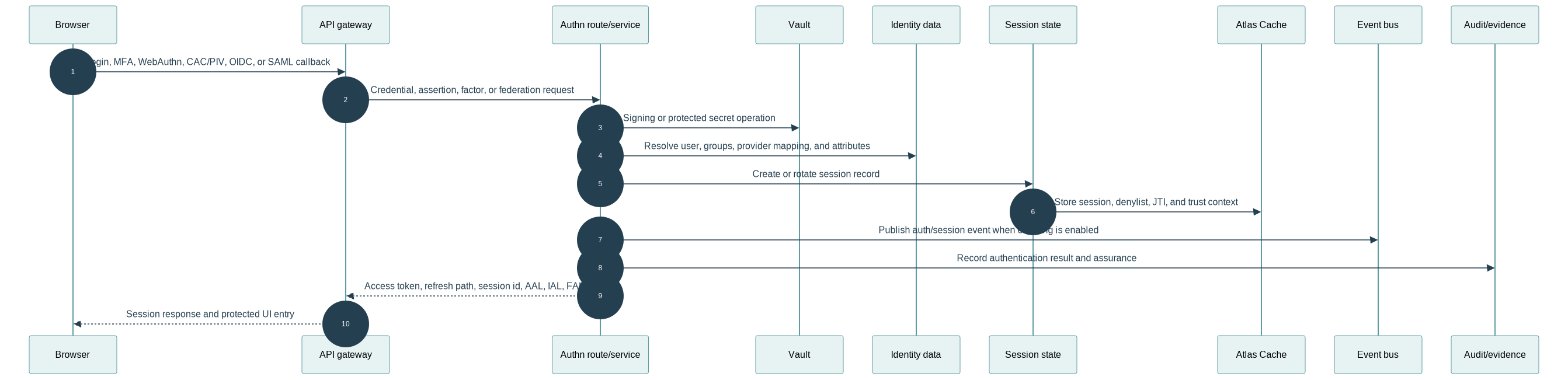
Security interpretation:
-
Session authority starts with successful authn, but route access still depends on gateway validation for each protected request.
-
The gateway validates token signature, expiration, issuer, audience, session id, denylist state, and assurance context before protected route work.
-
WebSocket authentication uses a token in the WebSocket protocol header or the standard authorization path.
-
CAC/PIV and federation evidence produced by local-live validation proves local harness behavior. Production PKI and IdP authority require deployment artifacts.
Protected Request Control Flow

Security interpretation:
-
The frontend can disable or hide controls, but the route still performs server-side authorization.
-
Operator mutations use operator scope and AAL2-or-stronger freshness checks; current gateway behavior uses a 15-minute freshness window.
-
Authorization can also depend on Universal Directory source freshness, policy context, device/risk state, DDIL posture, SoD conflicts, or app readiness.
-
Denials should be auditable enough to explain whether the failure was authentication, capability, assurance, policy, freshness, or dependency state.
Universal Directory, Governance, And Lifecycle Flow

Security interpretation:
-
Source import and mapping previews classify rows before canonical mutation.
-
Universal Directory provides facts to governance and policy; it does not replace the policy decision point or external source authority.
-
Governance approval records intent and evidence. Lifecycle and connector boundaries execute, retry, reconcile, dead-letter, or roll back target actions.
-
External writeback or target app change claims require connector and deployment evidence, not only a governance approval row.
Application Onboarding And Launch Flow
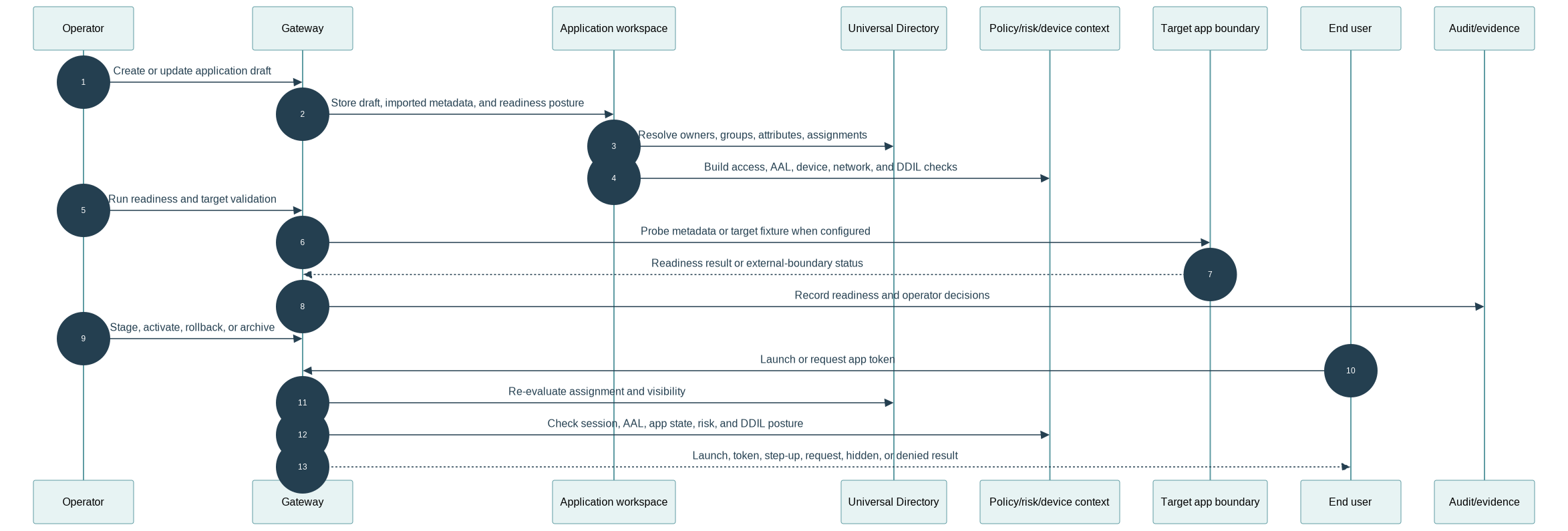
Security interpretation:
-
Application onboarding is operator controlled; generated recommendations and assistant deltas require review before they affect a draft.
-
Launch and token exchange are not browser-cache decisions. They re-evaluate session, assignment, app state, policy, AAL, and risk context.
-
Imported metadata can guide configuration, but production target authority depends on target-app and deployment evidence.
TrustAI And Risk Signal Flow

Security interpretation:
-
TrustAI output informs policy, session, risk, and operator review. It is not a standalone authorization authority.
-
Scoring evidence must identify live, cached, degraded, or unavailable status.
-
Edge scoring should record model version, ruleset version, TLS/mTLS posture where configured, and bundle provenance.
-
DDIL operation must identify whether local model and cache state are current, stale-but-accepted, or unavailable.
Session Revocation, Containment, And Kill-Switch Flow
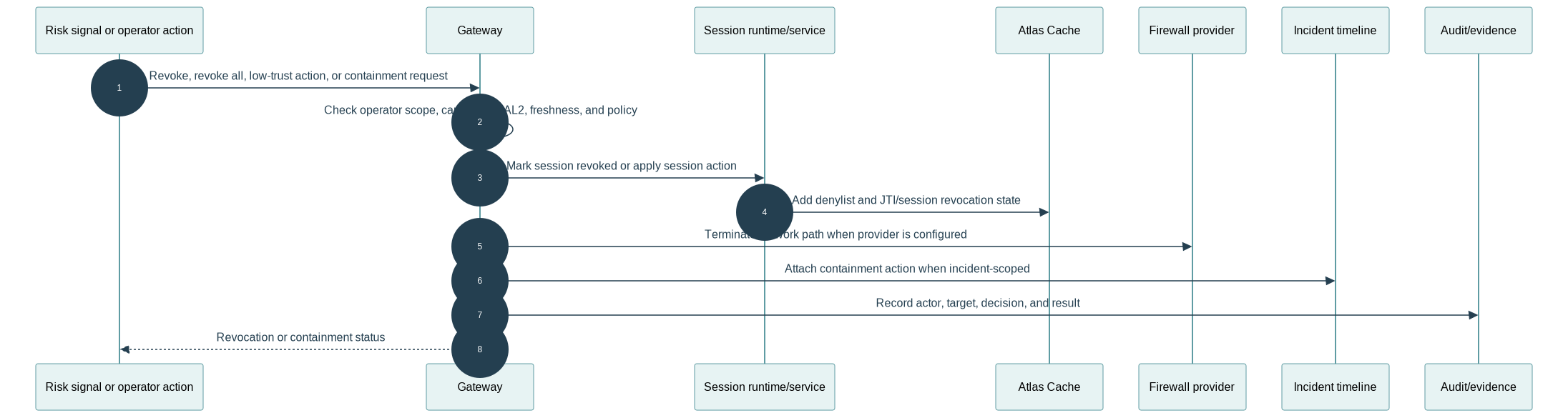
Security interpretation:
-
Denylist and session state are control data, not just telemetry.
-
Firewall-backed termination is claimable only when provider configuration and action receipt are present.
-
Incident-driven containment belongs in both audit and incident timeline evidence.
DDIL Data And Control Flow

Security interpretation:
-
DDIL keeps local operations explicit: cache age, queue state, model readiness, federation freshness, replay, and reconciliation are visible.
-
Non-sensitive visibility can continue with stale markers. Sensitive access, assignment, launch, lifecycle, and replay actions must satisfy freshness rules or use an approved local path.
-
Enterprise delivery is established by replay and reconciliation evidence, not by a local queued event alone.
Incident, Backup, And Evidence Flow

Security interpretation:
-
Incident response, backup, audit, and control validation share evidence mechanics but remain separate claim paths.
-
Raw artifacts, sanitized reports, operator notes, and external reporting packages should remain distinguishable.
-
Backup success is not recovery evidence by itself. Restore, integrity, checksum, and sequencing evidence are required for recovery claims.
Control Validation And Claim Flow
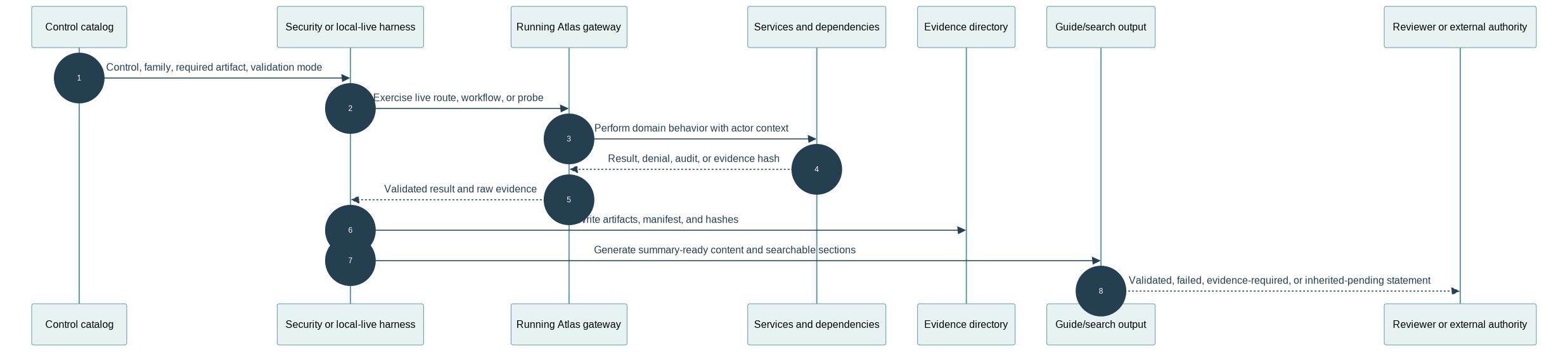
Security interpretation:
-
A guide statement is claim-ready only when it is backed by current same-run artifacts.
-
validatedmeans the Atlas-owned local evidence boundary passed.evidence-requiredandinherited-pendingmean an external or deployment-owned artifact is still required. -
External authority decisions, FIPS validation, Common Criteria certification, ATO, SIEM acceptance, and production connector approval remain outside repo-generated evidence unless attached separately.
Control Point Register
| Control point | Data inspected | Decision made | Evidence to review |
|---|---|---|---|
Ingress and frontend host |
Host, path, TLS state, static asset request. |
Route to frontend, gateway, or reject. |
Ingress manifest, TLS configuration, static UI checks. |
Gateway authentication middleware |
Token, cookie, session id, JTI, issuer, audience, expiry, denylist. |
Allow request context or reject as unauthorized. |
Auth/session tests, denylist evidence, gateway logs. |
Route capability check |
User id, roles, capability, subject, resource, requested action. |
Allow read, allow mutation, deny, or require operator scope. |
Route tests, audit denial reason, capability decision evidence. |
Fresh assurance check |
AAL, session record, issued-at or authenticated-at timestamp. |
Allow sensitive operator mutation or require reauthentication. |
AAL2/fresh-auth test, step-up evidence, denied mutation audit. |
Policy and risk check |
Directory facts, source freshness, app assignment, device posture, risk state, trust score, DDIL posture, SoD context. |
Permit, deny, step up, review, or queue. |
Policy decision evidence, TrustAI status, DDIL freshness, governance evidence. |
Domain invariant check |
Service-owned record, schema, workflow state, idempotency key, replay marker. |
Apply domain change, block invalid transition, or keep preview-only. |
Service test, local-live artifact, audit event, evidence hash. |
External connector boundary |
Connector state, target app metadata, source authority, credential reference, delivery receipt. |
Read, stage, execute, retry, dead-letter, or reconcile. |
Connector validation, receipt, reconciliation, external approval artifact. |
Evidence gate |
Artifacts, manifest, hashes, timestamps, generated summaries. |
Validated, failed, evidence-required, or inherited-pending. |
Control results, evidence manifest, guide check, docs-boundary check. |
Security Review Checklist
Use this checklist when reviewing a new or changed Atlas flow:
-
Identify the data class and the authoritative owner.
-
Identify the first boundary that accepts browser or external input.
-
Confirm the route has authentication, capability, and assurance behavior appropriate to the action.
-
Confirm sensitive mutations do not rely on the frontend as the only control.
-
Confirm source freshness, DDIL state, risk state, and SoD context are included where relevant.
-
Confirm secrets are references or one-time exchanges, not reusable browser payloads.
-
Confirm external writes, SIEM delivery, firewall action, SaaS target behavior, and enterprise IdP authority have deployment evidence before being claimed.
-
Confirm the same validation run produces artifacts, hashes, and guide-visible summary status.
Failure Modes
| Failure mode | Security impact | Expected response |
|---|---|---|
Valid token with revoked session |
A stale token may reach protected routes. |
Denylist and session checks fail closed where required; revocation evidence remains visible. |
Frontend-only authorization |
A hidden button is mistaken for enforcement. |
Gateway and service routes repeat capability, assurance, and policy checks. |
Source freshness missing |
Directory, assignment, or policy decisions may use stale facts. |
Sensitive paths fail closed or require approved local/DDIL handling with evidence. |
Service endpoint unavailable |
A route may degrade to local validation behavior or become unavailable. |
Evidence records service mode and avoids deployed-service claims unless the endpoint was exercised. |
TrustAI unavailable |
Risk context may be cached, degraded, or absent. |
Decision output records live, cached, degraded, or unavailable status. |
DDIL queue replay lacks receipt |
A local action may be interpreted as enterprise-delivered. |
Keep state staged until replay, deduplication, and reconciliation evidence exists. |
Evidence without hash or source path |
Reviewers cannot connect claim to artifact. |
Regenerate evidence with manifest, hash, timestamp, and source boundary. |
Validation Hooks
| Flow | Validation hook | Expected evidence |
|---|---|---|
Guide and architecture coverage |
|
Coverage, claims, Antora build, search index, static UI validation. |
Gateway and live routes |
|
Gateway logs, local trust material, authn/federation, lifecycle, governance, DDIL, and service-flow artifacts. |
Security posture |
|
Auth/session, protected routes, frontend security, DDIL, CAC/federation, and claim-boundary evidence. |
Control status |
|
Control results, required artifacts, and hash manifests. |
TrustAI |
|
Model/ruleset posture, edge scoring behavior, and scoring evidence. |
DDIL |
|
Enterprise/edge gateway evidence, replay, reconciliation, reachback, and control artifacts. |
Docs boundary |
|
Guide coverage and claim-boundary checks. |