
User and operator guide · Architecture
Governance And Universal Directory Architecture
On this page
Universal Directory Capability ModelArchitecture BoundariesCapability CoverageCanonical Universal ProfileSource Registry And Import PreviewAttribute Mapping And Source PriorityOrganization And Membership GraphAssignment And My Apps ProjectionPolicy PIP ContextLifecycle And Connector OutboxDirectory Studio UXScale And DDIL PostureValidation Evidence GateService BoundaryRuntime TopologyData OwnershipAccess Request FlowCertification FlowSecurity PropertiesCurrent Validation BoundaryGovernance/Directory separates identity governance from the browser-facing gateway while keeping identity and directory authority in atlas-identity. The gateway remains the browser trust boundary and BFF. atlas-governance owns entitlement, request, approval, certification, and fulfillment-outbox state through a gRPC contract. This page describes the current Atlas capability model and the evidence boundaries operators can rely on during review.
Universal Directory Capability Model
Atlas Universal Directory is the identity-owned canonical data substrate for profile, group, organization, source, assignment, and policy context. Atlas presents that data through stable gateway and service routes so operators can work from one directory model while existing route contracts remain compatible.
The operator goal is familiar to administrators who have used mature commercial IAM directory products: one place to understand profile schemas, source mappings, groups, app assignments, and provisioning. Atlas adds stronger provenance and evidence: every sourced attribute, group edge, assignment projection, and policy-facing context must be explainable by source, freshness, conflict state, and evidence hash.
The capability set covers source registry, import preview, attribute mapping, source priority, organization graph, group membership explanation, application assignment visibility, policy information context, lifecycle outbox, Directory Studio, DDIL posture, access requests, approvals, certifications, SoD review, and validation evidence.
Architecture Boundaries
| Boundary | Default | Reason |
|---|---|---|
Canonical owner |
|
Universal Directory is identity data, not a gateway aggregation cache or governance workflow store. |
External directory posture |
Import and projection by default |
External LDAP, SCIM, HR, and application sources remain their own authorities. Atlas records normalized source state and provenance without source-directory writeback unless lifecycle/provisioning explicitly owns that connector action. |
Source precedence |
Fail closed on lower-priority overwrite |
A lower-authority source must not silently replace higher-authority profile, group, or assignment data. Conflicts require visible operator resolution and audit evidence. |
Compatibility facade |
Stable REST payloads remain compatible |
Users, groups, org, profile-source, identity detail, My Apps, governance, lifecycle, and policy routes continue working while Atlas serves them from Universal Directory projections or compatibility facades. |
Policy PIP context |
Universal Directory enriches PDP requests |
UD provides profile, group, org, mission, clearance, assignment, and source freshness context. The PDP remains the decision authority. |
DDIL behavior |
Bounded stale-source use by configured policy |
Disconnected operation must expose source age and evidence. Sensitive decisions fail closed when required UD source context is stale or unavailable. |
Capability Coverage
| Capability | What Atlas provides |
|---|---|
Universal Profile |
Identity-owned profile schema, source metadata, source priority, sensitivity labels, freshness, provenance, and evidence hashes. |
Source registry and import preview |
LDAP, LDAPS, SCIM, HR, file, API, local Atlas, and application-derived source records with preview-only import decisions, duplicate detection, stale-source blockers, and secret-value rejection. |
Attribute mapping and mastering |
Managed source-to-Atlas and Atlas-to-application mapping rules, preview decisions, source precedence checks, override evidence, and conflict queues. |
Organization and group graph |
Directory-backed organization hierarchy, selected-unit breadcrumbs, direct and descendant members, group rules, protected-group checks, and membership explanation. |
Assignment and My Apps projection |
Subject-to-application visibility for assigned, eligible, requestable, hidden, restored, disabled, and test-access states. |
Policy context |
PDP-ready facts for profile attributes, groups, org path, mission, clearance, assignment state, source freshness, conflicts, and evidence hash. |
Lifecycle and connector outbox |
Metadata-only lifecycle, provisioning, reconciliation, rollback, retry, dead-letter, and completion state for approved connector actions. |
Governance workflows |
Entitlement catalog, access request submission, approval decisions, no-self-approval checks, SoD review, certification campaigns, evidence exports, and fulfillment outbox. |
Directory Studio |
Operator cockpit for source health, profile coverage, mapping coverage, organization graph, groups, assignments, selected user context, evidence, and next actions. |
Scale and DDIL posture |
Server-owned counts, pagination posture, p95 targets, stale-source visibility, and fail-closed sensitive-action semantics. |
Canonical Universal Profile
Atlas maintains an identity-owned Universal Profile model alongside route-compatible user and profile payloads. Route payloads can be converted into the Universal Profile shape and back through a compatibility adapter, which lets Atlas include source metadata, freshness, and provenance without changing browser contracts.
Universal Profile schema metadata tracks base, mission, and custom attributes with display labels, friendly help text, required and unique flags, sensitivity, value type, source priority, freshness, provenance, and evidence hash. Secret-bearing attributes remain rejected: Universal Directory stores identity attributes and provenance, not passwords, private keys, bearer tokens, client secrets, assertions, or other credential material.
This gives Atlas a stable substrate for import preview, mapping conflict resolution, org and group graph projection, My Apps visibility, and PDP policy context. Operators see this as source and freshness chips on profile fields rather than as internal schema mechanics.
Source Registry And Import Preview
Universal Directory source records now model the source families Atlas expects to project from: LDAP, LDAPS, SCIM, HR, file, API, local Atlas, and application-derived sources. Source metadata includes authority, source priority, freshness TTL, optional field mappings, and evidence hash. These records describe the import authority boundary; they do not by themselves write back to any external directory.
Import preview is dry-run only. It normalizes source rows, applies configured field mappings into Universal Profile attributes, identifies existing profile matches, flags duplicate or ambiguous candidates, blocks stale source data, and rejects secret-looking material without echoing those values back in preview responses. The preview response explicitly states that it does not mutate canonical Universal Directory state.
This preview-first posture is important for operator usability and security. Operators should see safe rows, blocked rows, duplicate rows, and stale rows before any canonical mutation exists. Authorized apply or commit flows reuse the same evidence and row classification so operators can review connector import behavior before it changes directory state.
Attribute Mapping And Source Priority
Atlas now has managed Universal Directory mapping rules for source-to-Atlas and Atlas-to-application attribute flows. Mapping rules are lightweight metadata: source, direction, source field, Atlas attribute, optional application attribute, transform, required state, status, audit reference, and evidence hash. A mapping preview evaluates those rules as operator-readable rows with proposed value, current value, source priority, decision, blockers, and evidence hash.
Source priority is enforced before mutation. Higher-authority sources can replace lower-authority values, equivalent updates pass without noise, stale source values block, and lower-priority overwrites require an explicit override reason. Override evidence is part of the preview result so later commit and audit flows can record why an exception was permitted.
Saving mapping rules does not write profile values into canonical Universal Directory state. The preview creates explainable decision rows that a later authorized apply or commit workflow can consume after approval, source freshness validation, and audit recording.
Organization And Membership Graph
Universal Directory now owns the organization hierarchy projection used by the directory read model. The public /api/v1/directory/org payload remains compatible, but the hierarchy is generated from UD profile projections rather than gateway-only grouping logic. The graph includes divisions, organizations, org units, selected-unit breadcrumbs, direct and descendant members, manager references, source attributes, completeness notes, and evidence hashes.
The projection normalizes the canonical Atlas fields division, department or organization, orgUnit, and managerId, while still recognizing legacy aliases from connected sources. Missing source attributes no longer disappear into an unexplained flat view: profiles with incomplete organization data are placed under explicit unassigned units and the response includes completeness notes. This lets the operator see whether the problem is missing source data, a mapping gap, or an expected fallback.
Universal Directory group rules add a governed membership projection layer. Rules are identity-owned metadata with a target group, status, source reference, conditions, protected-group state, audit reference, and evidence hash. Preview evaluates add, remove, unchanged, and blocked membership rows without mutating the canonical group catalog. Commit is a separate PDP-gated mutation and remains blocked for protected administrator or break-glass groups and for nested-group loops.
Membership explanation is also Universal Directory-backed. The gateway can describe whether a user is in a group because of direct Atlas assignment, imported source membership, or an active rule-derived match. This explanation is operator-facing evidence; external directory writeback and connector execution still belong to lifecycle and provisioning boundaries.
The Identity Org experience can therefore stay simple: select a unit, inspect child units and members, and use source/evidence details when a directory record looks wrong. The implementation detail is hidden behind the compatibility facade, and every hierarchy row is backed by the same UD projection used for assignment, policy, and lifecycle context.
Assignment And My Apps Projection
Universal Directory also owns the subject-to-application visibility projection used by My Apps. The gateway still returns the same /api/v1/me/apps and stream payloads, but the decision for assigned, test-access, eligible, requestable, disabled, hidden, and restored states is now evaluated as UD assignment context.
The projection combines direct subject assignments, group-derived assignments, reviewed bulk assignments, test users, application access policy attributes, requestable catalog visibility, and governance entitlement context. It also maintains the subject/application visibility ledger that records whether the subject previously held entitlement, whether a removed app must be hidden, and the last launch attempt or successful launch evidence.
This gives end users a stronger launcher guarantee: if access is removed, the app disappears from All, Pinned, Recent, and detail views on the next server snapshot, and stale launch attempts fail at the broker. If the assignment is restored, the app reappears through the same server projection rather than through any browser cache.
Directory Studio exposes read-only assignment and app-profile previews over this projection. Assignment preview answers what a selected user will see in My Apps: launchable, requestable, hidden because access was removed, blocked because the app is inactive, or not visible. App-profile preview evaluates the Atlas profile fields and application attribute mappings that would be sent to the target app, flags missing required values, and marks overwrites as confirmation-required. These previews do not mutate canonical profiles, group memberships, assignments, or target applications; they provide operator evidence before an approved assignment, provisioning, or lifecycle workflow runs.
Policy PIP Context
Universal Directory now supplies the policy information context that the gateway sends to the Atlas PDP. The PDP remains the authorization decision authority; UD does not make allow/deny decisions. Instead, UD builds the actor and resource facts the PDP evaluates: profile attributes, groups, org path, mission, clearance, assignment projections, source freshness, conflict state, and evidence hash.
The gateway uses this context for both /api/v1/me/authorization and direct backend capability enforcement. A normal route guard or page control therefore sees the same UD-enriched facts as a direct API mutation. If a profile source is stale, an org is wrong, a group is missing, a clearance is insufficient, or assignment evidence is absent, the resulting blocker can be described in those terms instead of as a generic RBAC failure.
Sensitive decisions still fail closed when the PDP is unavailable, a capability is unmapped, the session lacks required assurance, or required UD context is missing or stale. Authorization audit evidence records the PDP decision together with the UD evidence hash so auditors can reconstruct which directory projection fed the decision.
Directory Studio also exposes access-decision rows for policy, access requests, approvals, certifications, and segregation-of-duties review. These rows are read-only PIP evidence. They assemble the selected user’s profile, groups, org path, mission, clearance, assignment projection, source freshness, conflict state, and application access requirements, then translate directory failures into operator blockers such as missing group, stale source, wrong mission, insufficient clearance, conflicted profile, or removed assignment.
This keeps a clean boundary. Universal Directory supplies facts and evidence; the PDP and governed workflow decide whether an action is allowed. A reviewer can use the access-decision row to understand why a request is blocked or ready without treating the Studio preview as the approval itself.
Lifecycle And Connector Outbox
Universal Directory now includes an event and outbox substrate for lifecycle-sensitive changes. The outbox records profile, group, assignment, source freshness, conflict, lifecycle intent, provisioning intent, reconciliation drift, and rollback events with a stable evidence hash. It is intentionally metadata-only: connector secrets, bearer tokens, private keys, passwords, and raw source payloads are not stored in the UD outbox.
Governance assignment decisions now emit UD assignment-change events when access is granted or revoked. Those events are idempotent, persisted with identity state, and carry enough context for lifecycle, SCIM, group-push, deprovisioning, and reconciliation executors to consume the intent later. Approval therefore does not silently provision the target application; it records the canonical directory event that the connector boundary can execute, retry, dead-letter, roll back, and audit.
Directory Studio exposes governed outbox state transitions for operators who have the required identity update capability: approve, execute, complete, retry, dead-letter, and rollback. These transitions update the UD event state and evidence hash; they do not perform the external connector write themselves. Reconciliation drift is listed from reconciliation.drift outbox events so operators can compare expected state, observed state, retry path, rollback path, connector id, and evidence before a connector executor takes action.
This keeps the operator model simple. A reviewer approves or revokes access, Atlas records the UD intent and evidence, and lifecycle/provisioning surfaces can show what will happen next, which connector is responsible, and what rollback evidence exists. The separation also protects DDIL and federated deployments because replay, duplicate fulfillment, stale connector state, and reconciliation drift can be treated as outbox state rather than hidden side effects.
Directory Studio UX
The Identity landing experience now opens Universal Directory Studio. This is an operator cockpit over the existing compatible read models rather than a diagnostic workspace. The first view shows source health, profile coverage, mapping coverage, org graph size, group context, assignment posture, selected user context, evidence hashes, and one next action.
The Studio uses a guided graph with Sources, Mappings, Groups, Org Graph, and Assignments nodes. Each node has a state, record count, plain-language blocker, and drilldown action. The drilldowns keep the operator inside the Identity workbench and open the existing Users, Groups, Org, or Directory Sources sections rather than requiring the operator to know which backend route or diagnostic panel produced the data.
The production Studio APIs expose the working queues behind that cockpit:
-
profile schema and source health
-
preview-only source import rows
-
managed mapping rules and preview-only mapping decisions
-
conflict queue
-
group rules and membership explanation
-
assignment visibility projection
-
launcher-impact and app-profile previews
-
lifecycle outbox status and governed state transitions
-
reconciliation drift rows
Import and mapping previews are read-only. Mapping rule CRUD changes mapping metadata only; it does not rewrite profile values. Previews show safe, duplicate, conflicted, blocked, and equivalent rows before a deployment runs an authorized apply or commit flow. Preview responses include evidence hashes and do not echo connector secrets, bind passwords, bearer tokens, private keys, assertions, raw source payloads, or other credential material.
This gives operators a familiar commercial directory-style entry point while retaining Atlas evidence. Source precedence, mapping gaps, stale source signals, assignment visibility, outbox state, and org completeness notes are presented as next actions and source/evidence chips. The compatibility routes remain intact, but the normal workflow starts with the Studio cockpit so profile, group, org, assignment, lifecycle, and policy context feel like one directory model.
Scale And DDIL Posture
Universal Directory Studio now publishes a compact scale summary with profile, group, org unit, assignment, mapping, conflict, and outbox counts. The summary includes the server-selected page size, search mode, p95 response targets, pagination note, and evidence hash. These fields give operators and validators a stable way to confirm that compatibility routes remain paginated and that Studio is not depending on hidden client-side counts.
The DDIL posture separates non-sensitive directory visibility from sensitive mutations. Non-sensitive directory views may remain visible with freshness markers so operators can inspect stale context. Sensitive policy, assignment, launch, and lifecycle actions fail closed when the required Universal Directory source context is stale, conflicted, or missing. The posture includes stale and current source counts, blocker text, action semantics, a claim boundary, and an evidence hash.
This keeps operations practical. Operators can still navigate the directory during disconnected or degraded periods, but Atlas does not treat stale source data as authoritative for sensitive access decisions, assignment changes, app launches, or provisioning execution.
Validation Evidence Gate
make universal-directory-validation is the current Universal Directory evidence gate. It runs the strict Universal Directory ledger check, focused backend coverage for profile, source, mapping, graph, assignment, policy-context, outbox, Studio API, and compatibility behavior, the Directory Studio frontend test, and an evidence writer under artifacts/universal-directory-validation/latest/.
The generated control map records which repository artifacts support each Universal Directory capability and writes a manifest for the current evidence bundle. It also records the claim boundary explicitly: Atlas validates the local engineering substrate, compatibility projections, and operator cockpit. It does not claim production HR authority designation, external directory writeback approval, assessor acceptance, FIPS validation, or authorization to operate.
Compatibility facades remain in place until the validation gate is current and any deployment-specific DDIL, scale, source-freshness, and connector evidence has been attached. This keeps route behavior stable while preserving the fail-closed evidence boundary for sensitive actions.
Service Boundary
| Boundary | Atlas-owned | Out of scope or inherited |
|---|---|---|
Universal directory |
Profile schema, profile source, group/resource owner overlays, assignment records, and assignment history remain identity-owned. |
Enterprise HR authority, production directory approval, and external authoritative-source adjudication. |
Governance |
Entitlement catalog, SoD checks, access requests, certification campaigns, review decisions, evidence exports, and fulfillment outbox. |
Mission owner designation policy, organizational review cadence approval, and external assessor acceptance. |
Gateway |
REST facade, session/AAL/role enforcement, audit event emission, and legacy route deprecation bridge. |
Direct browser access to the governance service. |
Lifecycle |
Receives fulfillment intent through the governance fulfillment outbox and continues to own SCIM/provisioning execution. |
Production SaaS connector approval and HR master authority. |
Runtime Topology

Data Ownership
| Entity | Owner | Reason |
|---|---|---|
Profile schema and profile source |
|
Identity attributes must remain tied to source authority, freshness, and directory projection. |
Group/resource owners |
|
Owners are directory metadata consumed by governance routing and review. |
Entitlements and SoD policy tags |
|
Entitlements are governance review objects rather than authentication credentials. |
Access requests |
|
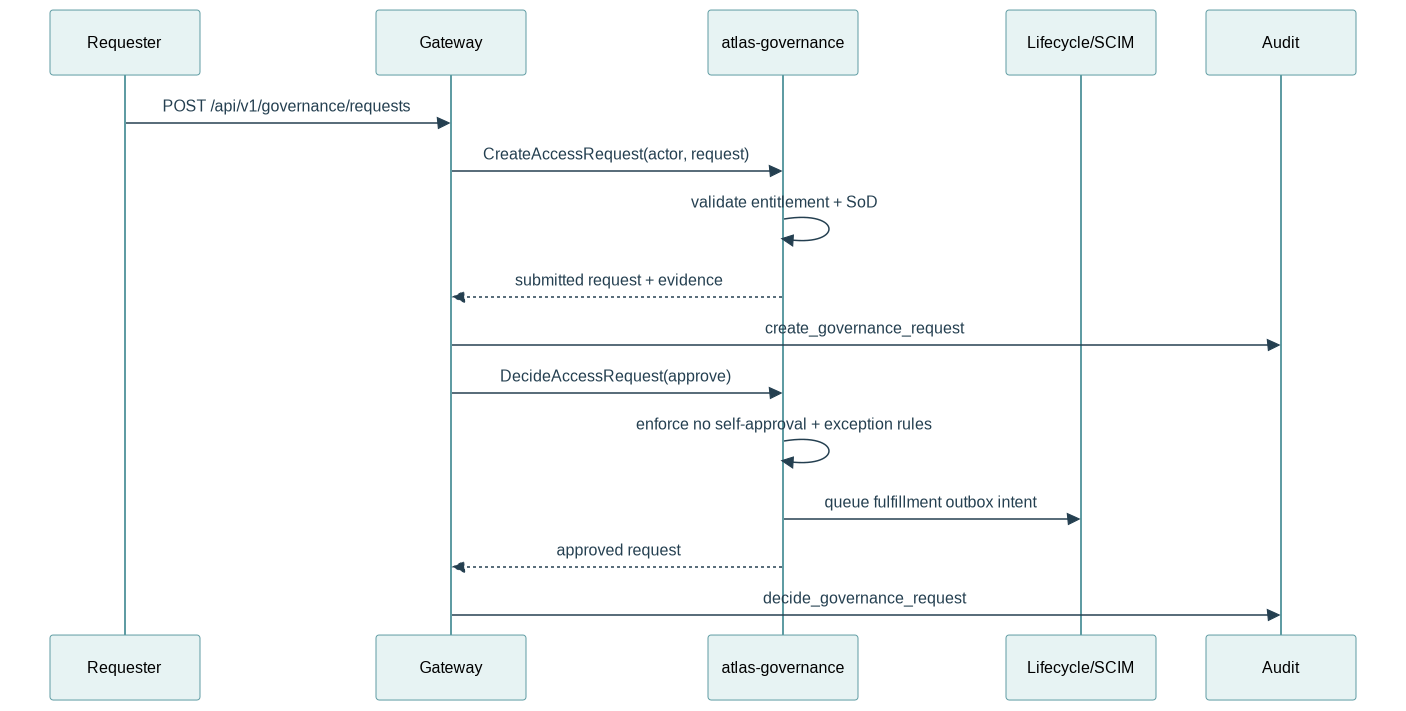
Request state, decisions, exceptions, and evidence must remain auditable and deterministic. |
Certification campaigns and review items |
|
Campaign decisions drive revoke/retain evidence and downstream fulfillment. |
Provisioning jobs |
Lifecycle and SCIM boundary |
Approval does not provision directly; it emits controlled fulfillment intent. |
Access Request Flow
Certification Flow

Security Properties
| Property | Implementation |
|---|---|
No self-approval |
Approval and certification decisions reject actors reviewing their own access. |
Fresh operator authentication |
Mutating gateway routes and governance service decisions require AAL2-or-better with a fresh authentication timestamp. |
SoD fail-closed behavior |
Conflicting entitlement tags block approval unless an expiring exception is supplied and recorded. |
Provisioning separation |
Approval creates fulfillment intent; lifecycle still executes target writes and records provisioning evidence. |
Evidence integrity |
Governance records include evidence refs and SHA-256 hashes; local-live writes a governance manifest. |
Current Validation Boundary
Governance/Directory is validated against local-live fixtures: seeded users, directory records, entitlements, access requests, SoD conflict denial, campaign review, fulfillment outbox records, and audit evidence. External directories, SaaS apps, trust agreements, and assessor artifacts remain evidence-required or inherited-pending.