
User and operator guide · Architecture
Atlas IdP Implementation
On this page
PurposeRuntime ModelAuthority BoundariesPublic And Protected SurfacesSAML IdP FlowSAML Assertion ConstructionSigning Material And MetadataInbound Federation RuntimeProvider ReadinessOIDC Sign-In ControlsSAML Sign-In ControlsSession Handoff And AuthorizationCAC/PIV RelationshipDDIL BehaviorThreat And Failure ModelEvidence To ReviewOperator ChecksRelated TopicsPurpose
Use this page to understand the Atlas identity-provider implementation as a technical system: what Atlas publishes, what it consumes, how trust material is resolved, how assertions and sessions are created, and which evidence a security engineer should review.
Atlas has two related federation roles:
-
Atlas can act as a SAML identity provider for applications that are onboarded to Atlas. In this role, Atlas publishes per-application IdP metadata, signs SAML responses, and hands the browser to the service provider after Atlas policy allows the launch.
-
Atlas can consume external OIDC and SAML identity providers for workforce sign-in. In this role, Atlas validates provider metadata, performs OIDC or SAML login, maps external claims into an Atlas session, and keeps external provider authority visible in the session record.
Those roles share policy, session, audit, and DDIL evidence boundaries, but they do not collapse into one authority. Atlas-owned sessions and application launches are governed by Atlas. External identity-provider approval, production federation agreements, and deployed trust roots remain deployment evidence.
Runtime Model

The browser-facing gateway is the control point. IdP metadata is intentionally public because SAML service providers need to import it. SSO work is authenticated and uses the same application-launch authorization path as the Atlas user application catalog. Provider management is operator controlled and requires authenticated gateway access, with fresh assurance required for mutation-style actions.
Authority Boundaries
| Boundary | Atlas behavior | Security meaning |
|---|---|---|
Atlas as SAML IdP |
Publishes per-application metadata and signs SAML responses for Atlas-governed app launches. |
Atlas is the asserting party for that application launch, but the service provider still enforces its own trust configuration, ACS behavior, and session handling. |
Atlas as OIDC/SAML relying party |
Redirects the browser to an enabled external provider, validates the returned token or assertion, and issues an Atlas session. |
The external provider remains the authentication authority for the upstream ceremony; Atlas remains the local session and authorization authority after handoff. |
Application onboarding |
Imports or stages protocol metadata, validates required fields, provisions IdP metadata references, and runs live SAML sign-on checks when configured. |
App readiness is evidence-backed and separate from production approval by the app owner or environment authority. |
DDIL edge behavior |
Uses cached provider metadata and fresh federated claim context for constrained disconnected decisions. |
The edge can allow degraded non-sensitive context only within freshness and replay limits. Sensitive or stale cases require step-up or deny. |
Compliance evidence |
Records validation checks, hashes, provider posture, session attributes, and launch audit records. |
Repository evidence supports the Atlas-owned claim boundary; external approvals stay attached separately. |
Public And Protected Surfaces
| Surface | Purpose | Access posture |
|---|---|---|
|
Publishes Atlas IdP metadata for a single onboarded SAML application. |
Public by SAML design. The subject application must exist as a published app or onboarding draft. |
|
Answers SAML AuthnRequests for SP-initiated sign-on. |
Browser navigations without credentials are redirected to Atlas login. Authenticated requests pass through the app-launch gate. |
|
Starts launcher-driven application access from the Atlas catalog. |
Requires a valid Atlas session, assignment, policy, and assurance posture. SAML apps receive a signed form-post response. |
|
Lists enabled external OIDC and SAML sign-in providers for the login page. |
Public discovery of enabled provider options. Secrets and private trust material are not returned. |
|
Starts and completes external OIDC sign-in. |
Uses state, nonce, PKCE, issuer, audience, expiry, issued-at, and JWKS validation before issuing an Atlas session. |
|
Starts external SAML sign-in, publishes Atlas SP metadata, and receives assertions from external IdPs. |
Uses relay state, configured provider metadata, assertion validation, audience/recipient checks, and session issuance. |
|
Manages the external provider registry. |
Operator-authenticated. Create/update moves providers to draft; validate and enable are fail-closed until readiness checks pass. |
|
Stores, validates, lists, and reconciles DDIL federation cache and replay records. |
Protected gateway route. Records metadata and evidence hashes, not raw bearer tokens or private signing material. |
SAML IdP Flow
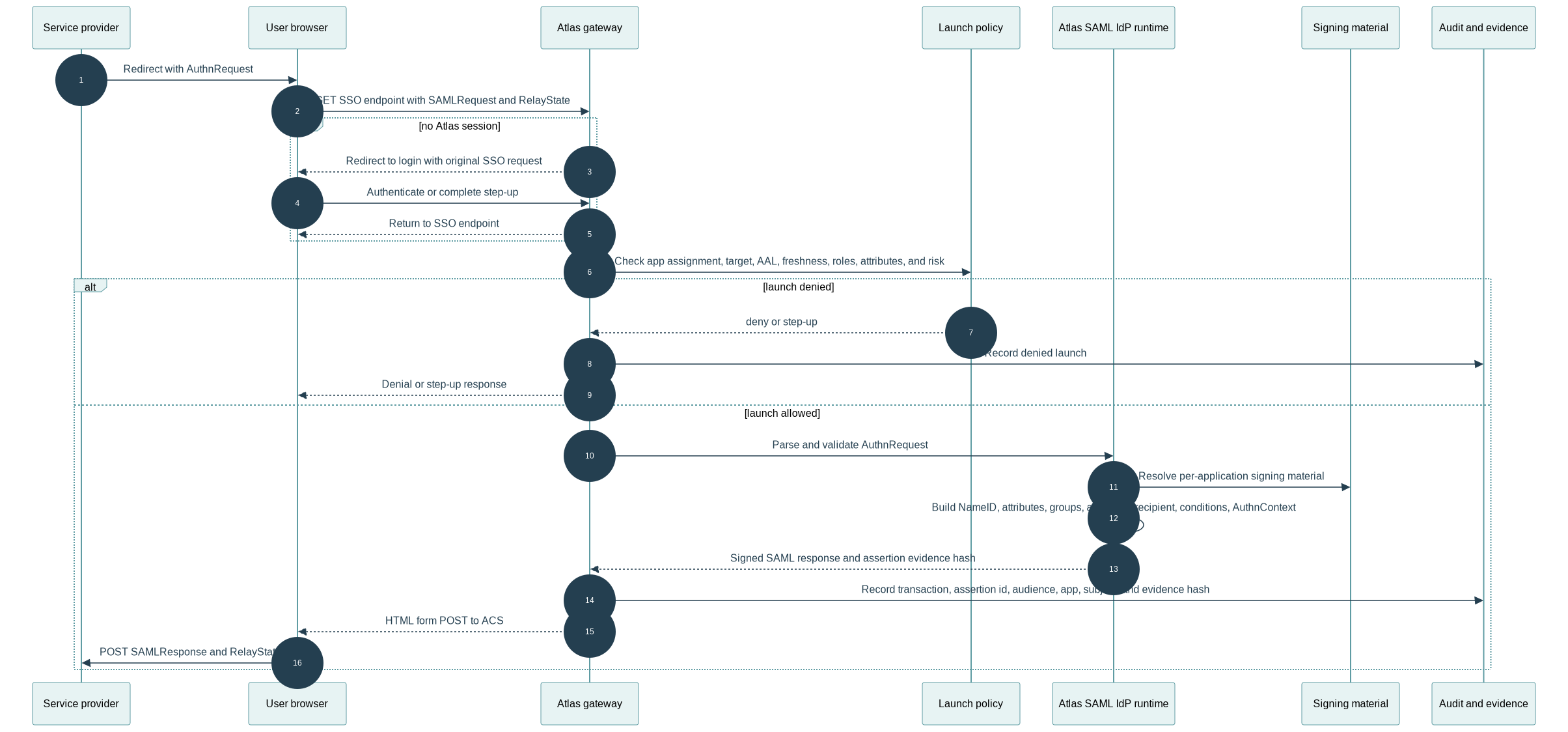
Atlas resolves the service-provider configuration from the application integration record. The resolved configuration includes entity ID, ACS URL, optional additional ACS URLs, recipient, audience, NameID format, requested authentication context, signed-request posture, encryption posture, SP signing certificates, SP encryption certificates, and session lifetime.
Before minting, Atlas checks that the ACS used by the request is one of the registered ACS locations. This matters for SP-initiated flows: an attacker-controlled ACS cannot be introduced by changing the request alone. If signed requests are required for the app, Atlas verifies the request signature against the configured SP signing certificates for HTTP-Redirect or HTTP-POST binding.
SAML Assertion Construction
| Assertion element | Atlas value | Security effect |
|---|---|---|
Issuer |
The per-application Atlas IdP metadata URL. |
The metadata URL doubles as the IdP entity ID, giving each application a stable trust anchor. |
NameID |
Derived from the Atlas profile using the app username format: email, principal name, or UID-style value. |
Prevents a one-size-fits-all subject format and lets each service provider receive the expected subject shape. |
Subject confirmation |
Bearer confirmation with recipient and NotOnOrAfter. |
Binds the assertion to the configured recipient and a short validity window. |
Conditions |
NotBefore, NotOnOrAfter, and audience restriction. |
Limits clock drift, replay window, and target audience. |
AuthnContext |
Application-configured context, or password-protected transport by default. |
Gives the service provider a standards field for the authentication method and assurance context it requested. |
Attributes |
Configured profile attributes plus group attributes. |
Releases only configured profile context and group context needed by the app. |
Signature |
RSA-SHA256, RSA-SHA384, or RSA-SHA512. |
SHA-1 signing is rejected by the issuer configuration. |
Evidence hash |
SHA-256 over the minted response XML. |
Gives operators and validation runs a stable reference without exposing private material. |
The default assertion validity window is five minutes with a modest clock-skew allowance. The live SAML sign-on readiness check mints a valid assertion and an expired assertion: a conforming service provider should accept the valid case and reject the expired case.
Signing Material And Metadata

Atlas uses per-application signing material. The preferred mode stores material in the deployment secret store and records only references in application state. A local file-backed fallback is available for local-live, test, and DDIL-style operation when the secret store is temporarily unreachable. When connectivity returns, the provider can promote fallback material back to the secret store instead of silently changing the application’s signing identity.
IdP metadata includes the per-application entity ID, supported NameID formats, SSO endpoints for HTTP-Redirect and HTTP-POST bindings, and signing certificates. During rotation, Atlas can publish current and next certificate material in metadata so service providers can pre-trust the incoming key during the overlap window.
Inbound Federation Runtime

The inbound provider registry stores protocol, lifecycle state, issuer or entity ID, metadata URL, discovery URL, client ID, secret reference posture, redirect URI, scopes, TLS posture, assurance mapping, JIT policy, rollover state, and last validation. API responses redact raw secrets and report whether secret material is configured.
Provider lifecycle states are draft, enabled, disabled, and retired. Create and update operations place a provider in draft. Enable runs validation first; failed readiness keeps the provider out of the runtime maps.
Provider Readiness
| Provider type | Validation checks | Enable behavior |
|---|---|---|
OIDC |
Issuer, client ID, resolved client secret, redirect URI, discovery document, JWKS URI, issuer match, audience/client binding, TLS posture, and secret redaction. |
Builds an OIDC relying-party runtime only after discovery and JWKS readiness pass. |
SAML |
Entity ID, metadata URL safety, fetched metadata, entity-ID match, usable SSO binding, signing certificate presence, metadata signature policy, and signed-assertion posture. |
Rebuilds SAML service-provider runtime only after metadata readiness passes. |
Lifecycle state |
Draft, enabled, disabled, retired. |
Disabled and retired providers are removed from runtime login options. Enabled providers must be validated. |
Rollover posture |
Last JWKS validation or last metadata validation plus stale-key policy. |
Stale keys deny new logins when policy requires it. |
JIT policy |
Required claims and missing-claim behavior. |
Missing required claims deny or require step-up according to provider policy. |
Unsigned SAML IdP metadata is accepted only for development or local-live style validation where the metadata URL policy allows it. Non-development environments require signed metadata before readiness can pass.
OIDC Sign-In Controls
OIDC sign-in uses the authorization-code flow with PKCE. Atlas generates state, nonce, and a code verifier for each login and stores them with a short lifetime. On callback, Atlas consumes the state, exchanges the code, validates the ID token signature using JWKS, checks issuer, audience, expiration, issued-at freshness, nonce, and subject, then merges ID token and user-info claims for session mapping.
Atlas records provider type, provider ID, federated subject, authentication context, AAL, IAL, FAL, roles, tenant context, and revocation identifiers into the local session and JWT claims. External claims can inform policy, but they do not directly authorize a protected Atlas route by themselves.
SAML Sign-In Controls
External SAML sign-in uses Atlas as a service provider. Atlas initiates login with a relay-state token, validates the returned assertion through the SAML service-provider runtime, resolves the configured provider, maps NameID and attributes to a directory user or JIT identity record, and issues an Atlas session.
The SAML validation path checks assertion freshness, conditions, subject confirmation, authentication statement, signature presence when required, NameID presence, response structure, InResponseTo when applicable, certificate validity, and unacceptable authentication-context values. It also maps SAML authentication context into local assurance posture.
Session Handoff And Authorization
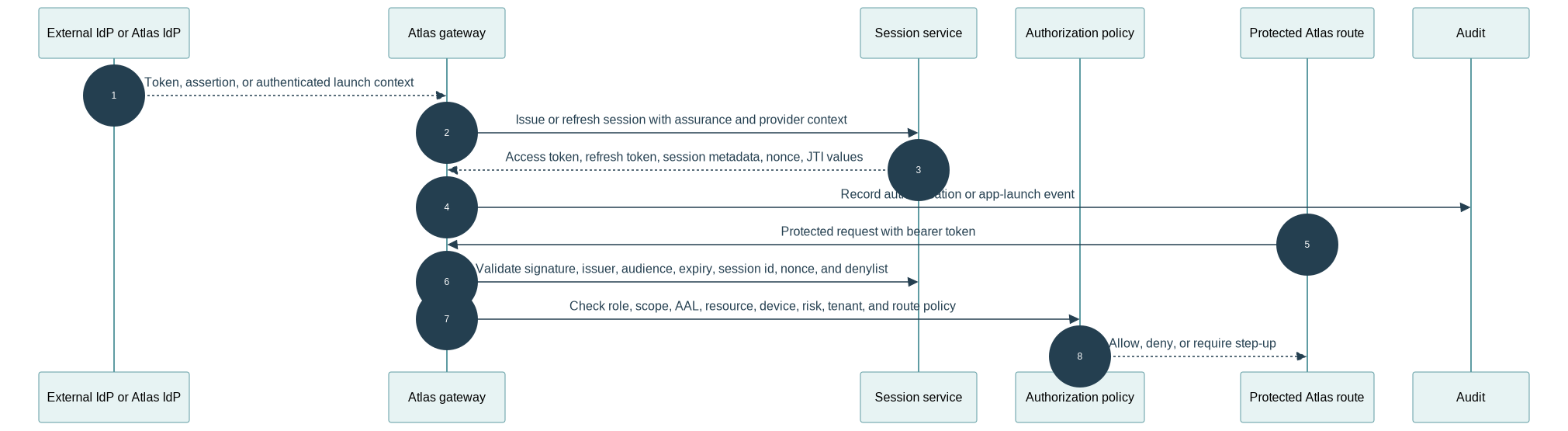
An Atlas session is the local enforcement object. It carries the effective AAL, IAL, FAL, authentication method, provider type, provider ID, federated subject, authentication context, certificate-binding state where applicable, assurance-degraded state, tenant boundary, roles, session nonce, and token identifiers. Refresh and step-up reissue the tokens and denylist prior token identifiers where the session posture changes.
For SAML SP-initiated application launches, Atlas also sets a path-scoped SAML SSO cookie after successful authentication. The cookie is limited to the SAML SSO route path so a top-level browser redirect from a service provider can complete the AuthnRequest without exposing that cookie to unrelated API paths.
CAC/PIV Relationship
CAC/PIV is an authentication input, not a replacement for federation policy. When browser CAC/PIV is configured, Atlas validates the client certificate, maps certificate attributes to a directory subject, sets assurance based on chain, revocation, and key-usage results, and issues a local session. That session can then be evaluated by the same application-launch, SAML IdP, provider management, and protected-route controls as other sessions.
Federated OIDC and SAML assertions can also carry CAC/PIV-related signals, such as smart-card authentication context or a PIV subject attribute. Atlas records those signals as federated session attributes and can require step-up when provider assurance is below the protected action’s requirement.
DDIL Behavior
Atlas DDIL federation support is designed for constrained edge use. The edge stores provider cache records with provider ID, protocol, node ID, node role, source node, issuer or entity ID, metadata hash, thumbprint, fetched time, expiry, status, validation status, and disabled flag. A DDIL decision then checks provider cache freshness, claim freshness, provider disabled state, metadata validation state, signature/thumbprint posture, replay state, and action sensitivity.
| DDIL condition | Atlas decision | Evidence |
|---|---|---|
Fresh cache and fresh claim for a non-sensitive action |
Allow a constrained degraded session decision. |
Metadata age, claim age, degraded-session flag, decision hash, replay event. |
Sensitive action while disconnected |
Require local step-up or deny according to policy. |
Sensitivity flag, step-up or denial reason, queued replay event. |
Missing, stale, disabled, or invalid provider cache |
Deny the federation decision. |
Cache state, validation reason, evidence hash. |
Stale claim, replayed nonce/state, invalid signature, or thumbprint mismatch |
Deny the federation decision. |
Decision reason and replay event. |
Reconnected reachback |
Reconcile queued events idempotently and record accepted, duplicate, rejected, conflict, and failed counts. |
Reconciliation run hash and replay status. |
The default local-live freshness model uses a longer metadata window than claim window. Deployment-specific values should be recorded with DDIL evidence and reviewed against mission policy.
Threat And Failure Model
| Failure mode | Atlas control | Security review focus |
|---|---|---|
Service provider sends an AuthnRequest for an unregistered ACS |
SAML IdP minting checks the ACS against the application configuration and additional allowed ACS list. |
Confirm imported SP metadata and app configuration contain only approved ACS endpoints. |
Service provider requires signed AuthnRequests |
Atlas verifies redirect or post binding signatures with configured SP signing certificates. |
Confirm SP signing certificates are current and rollover is planned. |
SAML assertion is replayed after expiry |
Assertions have bounded NotBefore and NotOnOrAfter values; live readiness includes an expired-assertion negative case. |
Confirm the service provider rejects the expired negative case. |
Provider metadata is stale or unsigned in production |
Provider enablement validates metadata and requires signed SAML metadata outside development/test contexts. |
Confirm production metadata provenance, signature, and trust agreement evidence. |
OIDC key rotates during login |
JWKS validation refreshes keys when the token key is not found. |
Confirm provider rollover windows and stale-key policy. |
External claim lacks required identity data |
JIT required-claim policy denies or requires step-up when required claims are missing. |
Confirm required claims match the deployment identity-proofing and account-linking model. |
Token or session is reused after reissue |
Session refresh and step-up preserve posture while denylisting prior token identifiers. |
Confirm denylist storage and session cache health. |
DDIL cache is stale or provider is disabled |
Edge federation decision denies the request and queues reviewable evidence. |
Confirm cache propagation and disabled-provider procedures. |
Sensitive action is attempted without reachback |
DDIL policy returns step-up or deny instead of treating the action as degraded. |
Confirm sensitive action classes match mission policy. |
Evidence To Review
| Evidence | What it proves inside the Atlas boundary |
|---|---|
IdP metadata for each SAML application |
Entity ID, SSO endpoints, NameID support, signing certificate, and rollover posture. |
Application onboarding readiness runway |
SAML/OIDC required fields, imported metadata, generated configuration, live sign-on checks, and evidence hashes. |
SAML live sign-on result |
The service provider accepted a signed assertion and rejected an expired assertion. |
Provider registry validation record |
OIDC discovery/JWKS/audience/secret-redaction readiness or SAML metadata/entity/signing-certificate readiness. |
Session record and JWT claims |
Effective AAL, IAL, FAL, provider context, federated subject, authentication method, tenant boundary, nonce, and token identifiers. |
Audit trail |
Authentication, provider management, application launch, denial, step-up, and logout/revocation events. |
DDIL cache and replay artifacts |
Provider cache freshness, claim freshness, edge decision reason, replay idempotency, and reconciliation result. |
Deployment evidence |
Approved production IdP metadata source, trust agreement, PKI trust roots, signing key custody, SIEM receipt, and authorization package. |
Operator Checks
-
Confirm the application or external provider is in the intended lifecycle state.
-
Confirm metadata URLs, issuer/entity IDs, ACS URLs, redirect URIs, and audience values match the approved integration record.
-
Confirm secret fields are reference-only in operator surfaces and raw private material is not displayed.
-
Confirm SAML signing algorithms are RSA-SHA256 or stronger.
-
Confirm OIDC callbacks use state, nonce, PKCE, issuer, audience, expiration, issued-at, and JWKS validation.
-
Confirm the resulting Atlas session carries the expected provider ID, provider type, AAL, IAL, FAL, tenant, roles, and federated subject.
-
Confirm sensitive route tests require fresh AAL2 or stronger when policy requires it.
-
Confirm DDIL cache, replay, and reconciliation artifacts match the deployed freshness and reachback policy.