
User and operator guide · Architecture
Lifecycle And SCIM Architecture
On this page
BoundaryRuntime TopologyDurable Data ModelJob State ModelSCIM Client BehaviorJoiner Mover Leaver FlowApplication Activation GateRelated PagesAtlas lifecycle management and SCIM adds lifecycle management and SCIM as a service-owned domain behind the gateway trust boundary. The implementation is intentionally Postgres-first for authoritative state: SCIM connections, lifecycle jobs, attempts, dead letters, reconciliation runs, and evidence hashes are durable records. Atlas Cache remains a runtime coordination tool only; it is not the source of truth for lifecycle state.
Boundary
| Boundary | Owned by lifecycle and SCIM | Not owned by lifecycle and SCIM |
|---|---|---|
Identity source |
Lifecycle jobs consume subject/profile inputs and write target provisioning state. |
Authoritative HR/personnel source approval, proofing, CAC/PIV issuance, and enterprise directory authority. |
Connector configuration |
SCIM connection records, readiness state, enabled state, capabilities, evidence hash, and secret reference. |
Raw bearer tokens, external vault administration, SaaS tenant approval, or production connector support agreements. |
Provisioning action |
Joiner, mover, leaver, group push, deprovision, restore, retry, dead-letter, and reconciliation behavior. |
Authorization to access a protected resource. Provisioning is evidence and state, not access approval by itself. |
Evidence |
Local-live Lifecycle/SCIM artifacts and SHA-256 manifest. |
ATO authorization, external assessor acceptance, SIEM retention proof, or inherited enterprise controls. |
Runtime Topology

The gateway is the browser-facing enforcement point. Mutating routes require operator authorization and a fresh AAL2-or-better session. Read routes require an operator/read posture appropriate for lifecycle operations. Responses return secret references only.
Durable Data Model
| Table | Purpose | Security relevance |
|---|---|---|
|
Connection metadata, base URL, auth mode, token secret reference, enabled state, readiness status, evidence hash, capabilities, and config. |
Stores only references to secrets. Enabled state is fail-closed if readiness is missing or failed. |
|
Requested lifecycle operation, state, app, subject, idempotency key, correlation ID, input, result, and evidence references. |
Creates the auditable control point for joiner, mover, leaver, deprovision, and reconciliation behavior. |
|
Attempt number, operation, status, target response status, retry delay, error code, and evidence hash. |
Supports retry, rate-limit handling, and failure traceability. |
|
Final-failure records, reason, last attempt, operator action, resolution state, and evidence hash. |
Prevents silent loss of failed provisioning operations. |
|
Expected target state, observed drift, repair-action plan, status, and evidence hash. |
Provides CM/SI evidence for drift detection and recovery. |
Job State Model
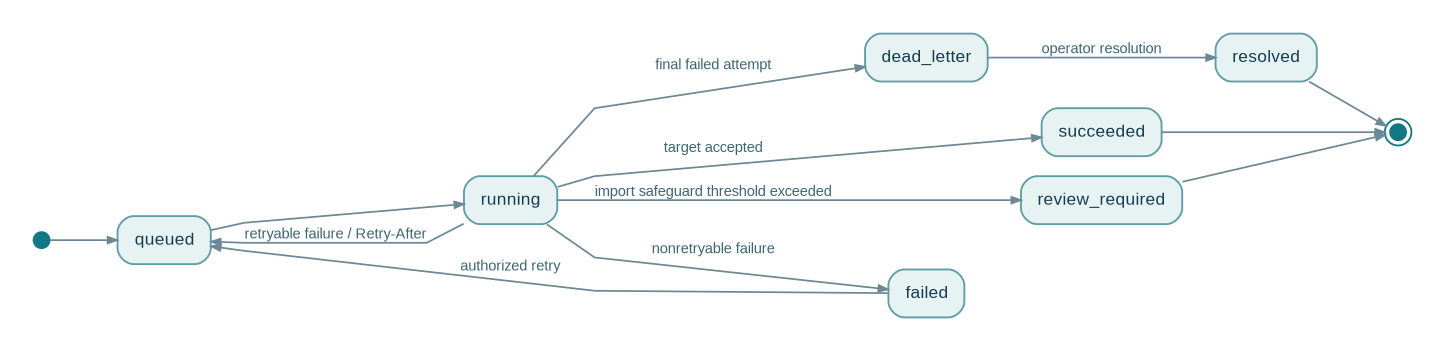
The service never treats a provisioning success as authorization. Access still depends on Atlas session, assurance, policy, resource, trust, and audit controls.
SCIM Client Behavior
| Capability | Implemented behavior | Validation target |
|---|---|---|
Service provider readiness |
Fetches |
|
User create/read/filter/update |
Creates users, finds users by |
Joiner and mover cases in |
Deactivate without hard delete |
Sets |
Leaver/deprovision case and result field |
Group push |
Creates or replaces group membership for managed target groups. |
Group-push case in positive evidence |
Retry |
Honors |
Rate-limit retry case and attempt history |
Dead letter |
Creates durable dead-letter evidence after final failure. |
Negative evidence and dead-letter resolution audit |
Import safeguard |
Marks high-impact import/reconciliation proposals |
Negative evidence with |
Joiner Mover Leaver Flow
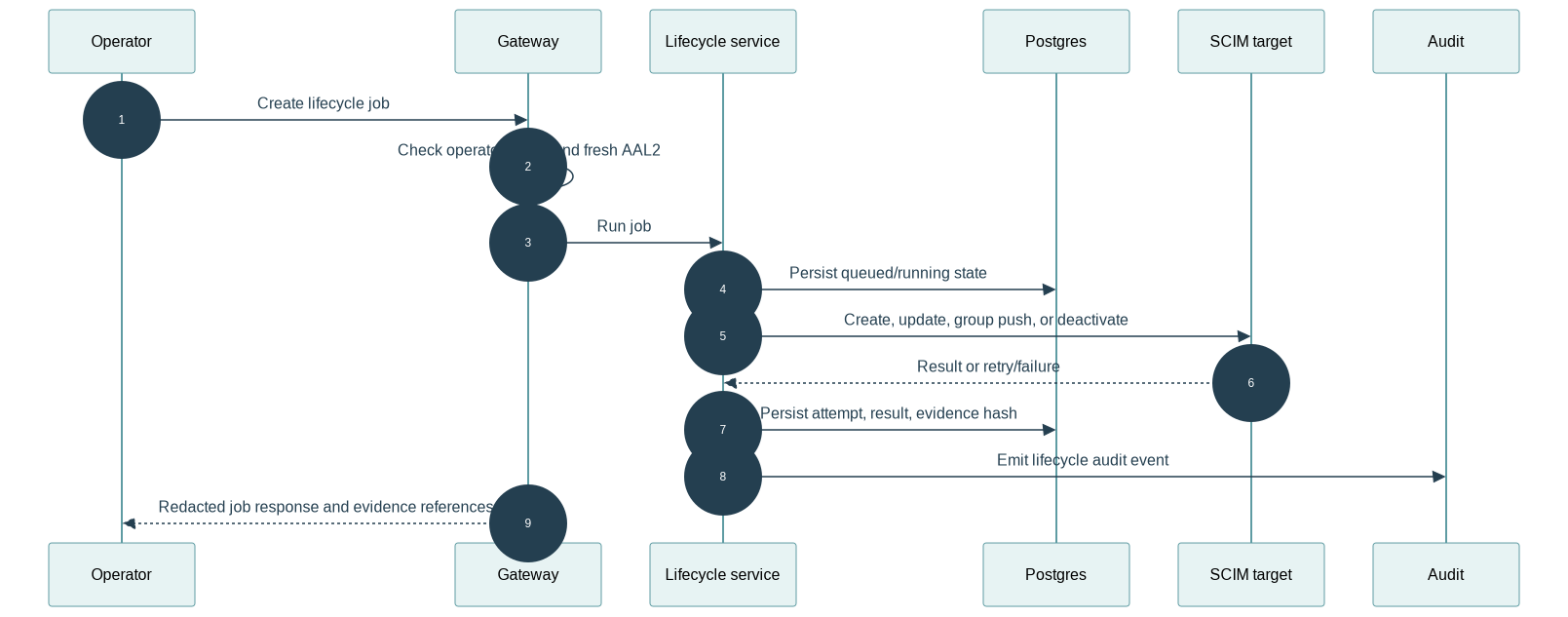
Application Activation Gate
Applications with provisioning or group-push scope cannot be activated only because SSO is configured. The activation path checks for an enabled, validated SCIM connection with a current evidence hash. This keeps SSO readiness separate from provisioning readiness and prevents an app from entering an operational state with unvalidated lifecycle behavior.
| Condition | Activation result |
|---|---|
SCIM not required |
SSO and application readiness gates decide activation. |
SCIM required, no connection |
Activation blocked. |
SCIM required, connection disabled |
Activation blocked. |
SCIM required, readiness failed or unknown |
Activation blocked. |
SCIM required, validated enabled connection with evidence hash |
Provisioning readiness gate passes; authorization still depends on Atlas policy. |